
How Biogas Power Plant Projects and USR Process Meet Global Wastewater Policies
Global industrial wastewater treatment policies are escalating from "compliance discharge" to mandatory "resource recovery" and "zero liquid discharge." The EU, through its Circular Economy Action Plan, requires member states to increase industrial wastewater reuse rates and extends carbon footprint accounting to the full life cycle of wastewater treatment. China continuously updates and tightens industrial water pollutant discharge standards, with increasingly stringent limits on total nitrogen, total phosphorus, and characteristic pollutants for industries such as chemicals, pharmaceuticals, and printing and dyeing. Some water-scarce regions and highly polluting industries are mandated to adopt zero or near-zero liquid discharge technologies. Germany has established a differentiated pretreatment technical standard system by industry, requiring industrial wastewater to meet specific quality requirements before discharge into municipal wastewater treatment plants, implementing strict source control.
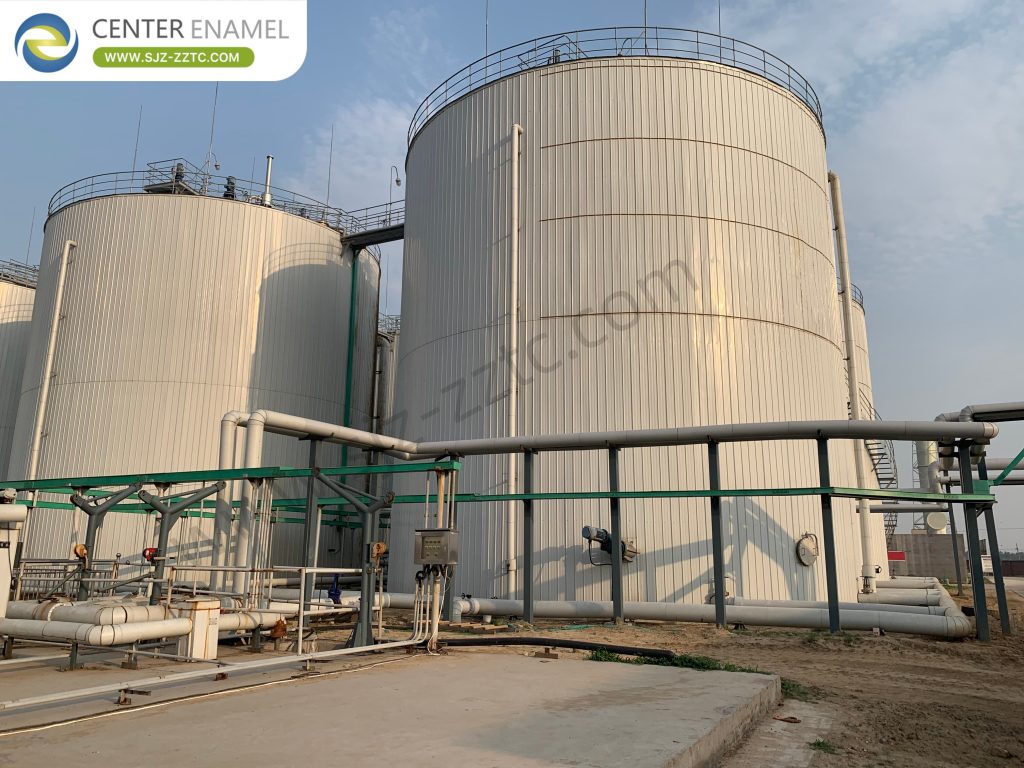
Meeting these escalating requirements demands integrated solutions-where Biogas Power Plant design and USR Process technology work together to convert waste into energy. This article explores how Center Enamel delivers these solutions across policy compliance, compact plant layouts, food waste treatment, and real-world project performance.
Global Policy Comparison for Industrial Wastewater
| Region | Policy Framework | Key Requirements | Impact on Biogas Power Plant Adoption |
| EU | Circular Economy Action Plan | Increased reuse rates; full life-cycle carbon footprint | Drives energy recovery integration |
| China | Tightening discharge standards | Strict limits on TN, TP, characteristic pollutants | Mandates advanced treatment and ZLD |
| Germany | Industry-specific pretreatment standards | Differentiated quality requirements before municipal discharge | Strict source control by sector |
| Water-scarce regions | Zero/near-zero liquid discharge mandates | Near-complete elimination of liquid discharge | Requires high-efficiency anaerobic plus polishing |
These policies directly favor Biogas Power Plant adoption, as anaerobic treatment simultaneously reduces pollutant load and recovers energy-aligning compliance with circular economy goals.
GFS Tanks for Modern Intensive Plant Layouts
GFS tanks offer flexible customization of size and appearance, with higher land utilization rates, ideally suited for modern compact plant layouts, with significant advantages over fixed poured concrete tanks. Concrete tanks cannot alter volume or shape after pouring, with heavy bases occupying large areas, making placement difficult on narrow or irregular plots. Their rough, uniform appearance cannot match modern facility aesthetic requirements.
GFS tank volume can be precisely customized as needed, with capacities ranging from dozens of cubic meters to 50,000 cubic meters freely selectable. Tank height and diameter can be flexibly combined to fit narrow or irregularly shaped plots, effectively saving plant land occupation. Enamel color customization is also supported, achieving visual harmony with plant buildings and environmental facilities. During later plant expansion, GFS tanks can be directly adjusted in layout and expanded; concrete tanks, being monolithic structures, must be demolished and rebuilt, offering less flexibility in land resource utilization. This aligns well with the intensive construction and aesthetic operation and maintenance needs of industrial parks.
GFS Tanks vs Concrete Tanks for Plant Layout
| Feature | GFS Tanks | Concrete Tanks |
| Volume Flexibility | Dozens to 50,000 m³, freely selectable | Fixed after pouring |
| Shape Adaptability | Height and diameter flexibly combined | Cannot alter shape |
| Land Utilization | High-fits narrow or irregular plots | Low-heavy bases occupy large areas |
| Aesthetic Customization | Enamel color options | Rough, uniform appearance |
| Expansion Flexibility | Directly adjusted and expanded | Must be demolished and rebuilt |
| Construction Period | Short, modular assembly | Long, cast-in-place |
This layout flexibility makes GFS tanks ideal for Biogas Power Plant projects where space is constrained and aesthetic integration matters.
USR Supporting Equipment for High-Solids Wastewater
Core equipment is the GFS tank with no complex media or precision three-phase separators, featuring a rugged clog-resistant structure. The bottom large-diameter anti-clogging distribution system is suitable for high-solids wastewater, preventing pipe clogging.
Supporting equipment includes influent lift pumps, simple pretreatment screens, and equalization tanks for impurity removal and water quality balancing. Simple top gas collection devices and biogas conveying/desulfurization equipment enable biogas resource recovery. Temperature, level, and pH online monitoring equipment ensures process stability. Bottom large-diameter sludge discharge pipes and pumps allow rapid removal of high-concentration residual sludge, suitable for high-solids conditions. The complete system has extremely low failure rates, outstanding wear and clog resistance, and is far easier to maintain than conventional anaerobic processes.
USR Process Supporting Equipment and Functions
| Equipment Component | Function | Benefit |
| GFS Tank | Core reactor shell | Rugged, clog-resistant |
| Bottom Distribution System | Large-diameter anti-clogging feed | Prevents pipe clogging |
| Influent Lift Pumps | Feed delivery | Reliable operation |
| Pretreatment Screens | Impurity removal | Protects downstream equipment |
| Equalization Tanks | Water quality balancing | Stable influent conditions |
| Top Gas Collection | Biogas capture | Resource recovery |
| Desulfurization Equipment | Biogas cleaning | Enables power generation |
| Online Monitoring | Temperature, level, pH | Process control |
| Sludge Discharge Pipes | Rapid residual removal | Suitable for high solids |
These components make the USR Process practical and maintainable-even in the most demanding high-solids applications feeding a Biogas Power Plant.
Food Waste Standardized Treatment Solutions
Core treatment uses a combination process of "pretreatment oil/grease/solids removal + anaerobic digestion + aerobic treatment + advanced treatment," specifically addressing high oil, high salt, and high organic load characteristics.
Pretreatment uses mechanical sorting and crushing/screening to remove inorganic impurities like plastics and bone fragments. Three-phase separators recover oil for sale, significantly reducing wastewater oil content. DAF further removes emulsified oil to prevent oil entry into biological systems.
The main stage uses CSTR anaerobic process, suitable for high-solids, high-oil organic fermentation with strong shock resistance, simultaneously producing biogas for energy recovery. Anaerobic effluent is followed by A/O or A²O aerobic processes for nitrogen/phosphorus removal. High-salinity wastewater requires salinity load control, with dilution or halophilic bacteria acclimation as needed. Final membrane treatment or constructed wetlands provide polishing for compliance. Digester tanks use Center Enamel GFS tanks, resistant to oil and high-salt corrosion with excellent sealing to prevent odor escape.
Food Waste Treatment Process Stages
| Stage | Process | Function |
| Pretreatment | Mechanical sorting, crushing, screening | Remove plastics, bone fragments |
| Oil Recovery | Three-phase separators, DAF | Recover oil for sale; reduce load |
| Anaerobic Digestion | CSTR process | Biogas production; high shock resistance |
| Aerobic Treatment | A/O or A²O | Nitrogen and phosphorus removal |
| Salinity Control | Dilution or halophilic acclimation | Manage high salt loads |
| Polishing | Membrane treatment or constructed wetlands | Final compliance |
| Tank Material | Center Enamel GFS tanks | Oil/salt corrosion resistance; odor sealing |
This integrated approach demonstrates how the USR Process and Biogas Power Plant design combine to solve complex food waste challenges.
Bangladesh Poultry Farm Manure Resource Recovery Project
This benchmark project targets local poultry farm manure resource recovery with daily treatment of 47 tons. Influent COD, BOD, and SS were as high as 50,000 mg/L, 25,000 mg/L, and 50,000 mg/L. After CSTR + UASB anaerobic treatment, all three parameters were reduced to below 200 mg/L, 100 mg/L, and 100 mg/L-effluent compliant with local environmental discharge standards. The project produces approximately 4,900 m³ biogas daily-each m³ biogas can generate 2 kWh of electricity, with daily power generation of 9,800 kWh-simultaneously achieving pollutant reduction and clean energy recovery. This is a benchmark project for livestock waste recycling in Southeast Asia.
Bangladesh Poultry Farm Manure Project Performance Data
| Parameter | Influent | Effluent | Removal Rate |
| COD | 50,000 mg/L | <200 mg/L | >99.6% |
| BOD | 25,000 mg/L | <100 mg/L | >99.6% |
| SS | 50,000 mg/L | <100 mg/L | >99.8% |
| Daily Treatment | 47 tons | - | - |
| Daily Biogas | 4,900 m³ | - | - |
| Daily Power Generation | 9,800 kWh | - | - |
This project demonstrates how integrated Biogas Power Plant technology transforms agricultural waste into clean energy while meeting strict discharge standards.
Center Enamel Full-Category Product Matrix
Center Enamel has built a complete product matrix of "core storage tanks + supporting covers + specialty pressure vessels + complete environmental engineering services"-the only company globally to achieve integrated enamel frit R&D, self-manufacturing, and GFS tank application.
Core: Proprietary GFS Tanks
Using proprietary double-sided hot-rolled double-layer enamel anti-corrosion technology-resistant to strong acids/alkalis, high salinity, and microbial corrosion-modular quick assembly-suitable for all strong-corrosion conditions in wastewater, biogas, and chemical applications.
Supporting: Fusion Bonded Epoxy Tanks
Produced on China's first intelligent standardized production line-primarily for drinking water, fire water, and neutral medium storage.
Sealing: Aluminum Dome Covers
Proprietary high-strength aluminum alloy self-supporting structure-meeting international waterproof and load-bearing standards-suitable for tank sealing and biogas collection.
Other Tanks:
Carbon Steel Tanks, Stainless Steel Tanks, Composting Tanks, Various Non-Standard Pressure Vessels.
Engineering Services:
Environmental EPC General Contracting, Anaerobic Process Section Subcontracting-one-stop coverage across food waste, leachate, municipal wastewater, livestock biogas, petrochemical/metallurgical, and seawater desalination industries-customizable tank volume, corrosion protection grade, and complete process solutions with integrated equipment manufacturing and engineering construction.
Center Enamel Product Matrix Components
| Category | Product | Key Features | Applications |
| Core | GFS Tanks | Double-sided enamel; acid/alkali/salt resistant | Wastewater, biogas, chemical |
| Supporting | Fusion Bonded Epoxy Tanks | Intelligent standardized production | Drinking water, fire water |
| Sealing | Aluminum Dome Covers | Self-supporting; waterproof | Tank sealing, biogas collection |
| Other Tanks | Carbon/Stainless Steel, Composting, Pressure Vessels | Various materials | Specialized storage |
| Engineering | EPC Contracting, Anaerobic Subcontracting | One-stop process integration | Food waste, leachate, biogas, desalination |
This full-category capability positions Center Enamel as a single-source provider for complex Biogas Power Plant and USR Process projects worldwide.
Global Integrated Standardized Service System
Leveraging regional sales centers in China and overseas local agent networks, Center Enamel has established a complete after-sales service loop covering all markets. The system provides four core service pillars:
24/7 rapid response mechanism
On-site domestic and overseas installation services
Full-project-cycle after-sales support
Long-term warranty protection
This forms a complete service chain from preliminary site survey, mid-term construction management, to long-term inspection and maintenance. The entire system is uniformly adapted to both domestic and international project service standards, coordinating personnel scheduling, material support, and on-site coordination for simultaneous projects across multiple regions-significantly reducing customer multi-party coordination costs and ensuring efficient domestic and overseas project delivery.
Ready to implement a Biogas Power Plant with advanced USR Process technology for your wastewater project? Contact us today for a customized solution covering design, manufacturing, installation, and long-term O&M support.
With 1,000+ biogas projects and over a decade of global installation experience, we turn complex wastewater challenges into compliant, resource-recovery success. Reach out now and let's build your next project together.
FAQ
1. What makes the USR Process suitable for high-solids wastewater in a Biogas Power Plant?
The USR Process eliminates complex three-phase separators and uses upflow hydraulics for gentle mixing. It tolerates very high suspended solids without requiring granular sludge formation-flocculent sludge operates stably, preventing clogging and sludge washout common in traditional anaerobic systems.
2. How do GFS tanks support modern compact plant layouts for biogas projects?
GFS tanks offer flexible volume customization from dozens to 50,000 cubic meters, with adjustable height and diameter to fit narrow or irregular plots. They support enamel color customization and can be directly expanded during plant expansion-unlike concrete tanks that must be demolished and rebuilt.
3. What results did the Bangladesh poultry farm project achieve with Biogas Power Plant technology?
The project treats 47 tons daily, reducing COD from 50,000 to below 200 mg/L, BOD from 25,000 to below 100 mg/L, and SS from 50,000 to below 100 mg/L. It produces 4,900 m³ biogas daily, generating 9,800 kWh of clean electricity.