
Biogas Power Plant Solutions with Advanced GFS Tanks Engineering for Livestock Industry
The global livestock industry stands at a pivotal crossroads where environmental responsibility meets renewable energy opportunity. As intensive farming operations expand worldwide, the need for efficient, sustainable waste management has never been more urgent. Modern Biogas Power Plant facilities are emerging as the preferred solution, transforming organic waste into valuable energy resources while mitigating environmental pollution. At the heart of these systems, GFS tanks (Glass-Fused-to-Steel tanks) provide the robust, corrosion-resistant infrastructure essential for long-term operational success in demanding agricultural environments.
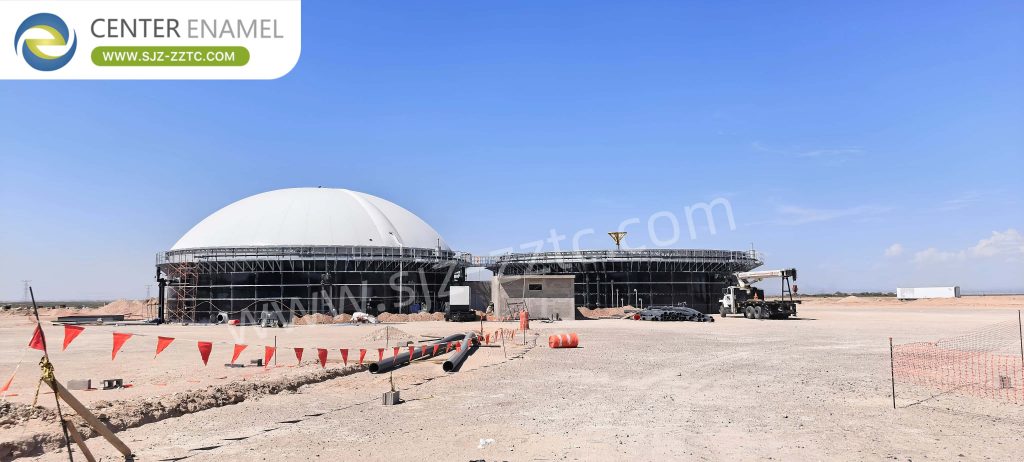
Market and Industry Landscape: The Shift Toward Dual-Value Creation
The livestock manure treatment market is transitioning from environmental compliance-driven to dual-value-driven by energy and fertilizer valorization. The European digestate concentration fertilizer market is mature, and large-scale biogas projects in North America commonly include digestate processing centers. In terms of business model innovation, the asset-light model of farmers paying per volume treated has been piloted successfully in some countries. China's "biogas operation outsourcing" model is beginning to penetrate county-level projects. Digital technology-driven precision nutrient management platforms are emerging as new industry links connecting farms, treatment centers, and agricultural end-users. In terms of process equipment, CSTR is the mainstream anaerobic digestion process for treating livestock manure. After anaerobic digestion, manure produces biogas for power generation or grid-injection purification, while digestate is processed into organic fertilizer for farmland application. GFS tanks, with strong corrosion resistance and low maintenance costs, are widely used in manure treatment projects on large-scale farms in North America, Europe, and China, particularly suited to the corrosive environments of high ammonia-nitrogen and high hydrogen sulfide in manure.
This market evolution underscores the growing importance of integrating reliable storage and fermentation infrastructure within any viable Biogas Power Plant. As project developers seek to maximize energy output and fertilizer value, the choice of tank technology becomes a strategic decision affecting both operational efficiency and lifecycle costs.
GFS Tanks: Engineered for Modern Intensive Plant Layouts
GFS tanks offer flexible customization of size and appearance, with higher land utilization rates, ideally suited for modern compact plant layouts, with significant advantages over fixed poured concrete tanks. Concrete tanks cannot alter volume or shape after pouring, with heavy bases occupying large areas, making placement difficult on narrow or irregular plots. Their rough, uniform appearance cannot match modern facility aesthetic requirements.
GFS Tanks volume can be precisely customized as needed, with capacities ranging from dozens of cubic meters to 50,000 cubic meters freely selectable. Tank height and diameter can be flexibly combined to fit narrow or irregularly shaped plots, effectively saving plant land occupation. Enamel color customization is also supported, achieving visual harmony with plant buildings and environmental facilities. During later plant expansion, GFS tanks can be directly adjusted in layout and expanded; concrete tanks, being monolithic structures, must be demolished and rebuilt, offering less flexibility in land resource utilization. This aligns well with the intensive construction and aesthetic operation and maintenance needs of industrial parks.
The modular nature of GFS Tanks not only accelerates construction timelines-typically requiring only one-third the time of concrete alternatives-but also simplifies future capacity upgrades. For a growing Biogas Power Plant, this scalability ensures that fermentation and storage capacity can keep pace with increasing waste volumes or expanded energy generation targets without disruptive and costly reconstruction.
UASB Process Advantages for High-Efficiency Biogas Production
No mechanical mixing equipment is required, with sludge suspension achieved through hydraulic action, resulting in very low overall energy consumption. High-concentration anaerobic granular sludge can be cultivated, with high sludge concentration, strong activity, excellent settleability, low sludge washout, and low sludge yield, significantly reducing sludge disposal costs. The integrated design combines reaction, sedimentation, and separation simultaneously, with small footprint and moderate capital investment. Simple structure with low failure rates and convenient maintenance. High volumetric loading rate with excellent organic pollutant degradation efficiency and good shock load resistance. Stable biogas production with high resource recovery value. The process is mature and widely adopted, with well-established construction, commissioning, and O&M systems, suitable for large-scale industrial wastewater treatment.
When integrated with high-quality GFS tanks as the primary fermentation vessels, UASB systems deliver exceptional performance in Biogas Power Plant applications. The corrosion-resistant enamel coating ensures that the aggressive acidic environment generated during anaerobic digestion does not compromise tank integrity, while the smooth glass surface prevents biofilm accumulation and simplifies cleaning protocols.
Livestock Wastewater Environmental Toxicity Profile
No synthetic chemical toxicity, no hazardous substances-very low risk of acute or chronic toxicity. Pollution impacts are primarily biological and nutrient pollution. All pollutants are natural organics from livestock metabolites and feed residues, with no inhibition of microbial activity and no toxicity to soil, water, or aquatic organisms. However, they are rich in nitrogen, phosphorus, and suspended impurities, carrying E. coli, parasite eggs, and pathogens. Direct discharge without treatment rapidly causes eutrophication, black-odor conditions, mosquito breeding, and disease transmission. Long-term discharge causes soil compaction and elevated nutrient levels in groundwater-persistent ecological pollution, but no hazardous substance accumulation or carcinogenic/mutagenic risks.
Understanding this toxicity profile reinforces why anaerobic digestion within GFS tanks is the preferred treatment pathway for livestock waste. By capturing biogas for energy recovery and producing stabilized digestate for fertilizer, a well-designed Biogas Power Plant effectively neutralizes the biological risks while creating economic value-turning a pollution liability into a renewable energy asset.
Indonesia Palm Oil Biogas Project: A Benchmark Success
Specifically designed for high-concentration palm oil wastewater treatment with 3 GFS fermentation tanks, each 19.86 m diameter × 8.4 m height. Installation began November 2009 with only 7 construction personnel, completing all tank assembly in 40 days-highly efficient and time-saving. Tanks are fitted with dual-membrane gas storage covers for POME anaerobic digestion-degrading organics and recovering biogas energy while eliminating palm industry pollution. This is an early benchmark POME biogas treatment project in Southeast Asia.
This landmark project demonstrates the practical viability of GFS tanks in tropical, high-corrosion environments where wastewater characteristics-high temperature, high organic loading, and aggressive acidity-would rapidly degrade conventional tank materials. The success of this Biogas Power Plant has served as a template for numerous subsequent installations across the region, proving that standardized GFS Tanks technology can deliver reliable performance across diverse climatic and operational conditions.
Installation and Construction Team: Global Expertise, Local Delivery
The installation team has practical experience from over 10,000 GFS tank projects globally, strictly following standardized construction procedures-full control over project mobilization, civil coordination, tank assembly, piping, and commissioning schedules and quality.
The team is proficient in complete standardized installation processes for GFS tanks, dual-membrane gas storage covers, USR/CSTR/IC anaerobic reactors, and biogas desulfurization/piping systems-adaptable to large-scale farms, industrial parks, remote mountainous sites, coastal high-corrosion sites, and other complex locations-strictly implementing unified global safety construction standards. For large overseas cross-border projects, the team can be deployed as complete units for on-site construction, technical training, and local worker practical instruction-full control over construction details, air-tightness testing, and corrosion protection-ensuring timely and stable commissioning of global environmental projects through standardized delivery capability.
The combination of world-class GFS Tanks with an experienced global installation force ensures that every Biogas Power Plant project, regardless of location, achieves rapid deployment and dependable performance. This integrated approach reduces the risk of construction delays, quality issues, and operational inefficiencies that often plague large-scale infrastructure projects in remote or challenging environments.
Center Enamel's Extensive Global Benchmark Project Cases
Center Enamel's project portfolio covers over 100 countries across Southeast Asia, Africa, Europe, and the Americas-30,000+ mature projects-accumulating complete industry solutions across palm oil, livestock, municipal, brewing, and food waste biogas-rapidly matching customized solutions for different regional climates, water quality, and regulations.
This vast experience base enables Center Enamel to provide tailored Biogas Power Plant configurations that optimize performance for specific waste streams and energy recovery goals. Whether deploying GFS tanks for high-solids digestion, low-temperature adaptation, or saline wastewater treatment, the company's engineering team draws upon proven global best practices to ensure project success from initial design through long-term operation.
Frequently Asked Questions
Q1: Why are GFS tanks preferred for biogas power plant applications?
GFS tanks offer exceptional corrosion resistance to the acidic, high-sulfide, and high-ammonia environments found in anaerobic digesters. Their modular bolted construction enables rapid installation-typically 30-40 days-and future capacity expansion without demolition. The non-porous glass surface prevents biofilm adhesion, reduces cleaning frequency, and ensures stable biogas production over a 30-year design life with minimal maintenance.
Q2: What is the typical biogas yield from livestock waste in a biogas power plant?
Using CSTR or UASB processes within GFS tanks, livestock manure typically produces 20-40 m³ of biogas per ton of fresh manure, depending on feed composition and digestion temperature. This biogas contains 55-65% methane, suitable for combined heat and power (CHP) generation or upgrading to biomethane for grid injection. The digestate byproduct retains nutrients for organic fertilizer application.
Q3: How does Center Enamel support biogas projects in remote locations?
Center Enamel deploys experienced installation teams with over 10,000 completed projects worldwide. The team manages full turnkey execution-from civil coordination and tank assembly to piping, gas system integration, and commissioning. Training programs for local workers ensure sustainable operation. The global service network provides 24/7 remote support and rapid on-site response for maintenance and troubleshooting.