
How Center Enamel's GFS Tanks and Biogas Power Plant Expertise Solve Global Livestock Manure Challenges
The global livestock manure treatment policy system, with the US and EU as typical representatives, is shifting from end-of-pipe treatment to full-process nutrient management. The US establishes a manure management framework covering the entire livestock production process through Comprehensive Nutrient Management Plans. The EU, through the Nitrates Directive, strictly limits manure application amounts, with Germany and the Netherlands using tax instruments to mandate nitrogen and phosphorus recovery rates, and Denmark demonstrating distinctive features in livestock regulation and ecological compensation.
The Netherlands applies a management mechanism linking manure treatment with phosphate quotas. China has issued a series of environmental regulations, with the current legal system providing comprehensive regulation of pollution from large-scale livestock operations. These converging policy pressures mean that farms and project developers increasingly require treatment equipment that can meet stringent nutrient management standards while remaining economically viable-a demand that directly shapes the role of GFS Tanks and biogas power plant infrastructure in modern manure management.
GFS Tanks: Flexible, Durable Fit for Modern Intensive Plant Layouts
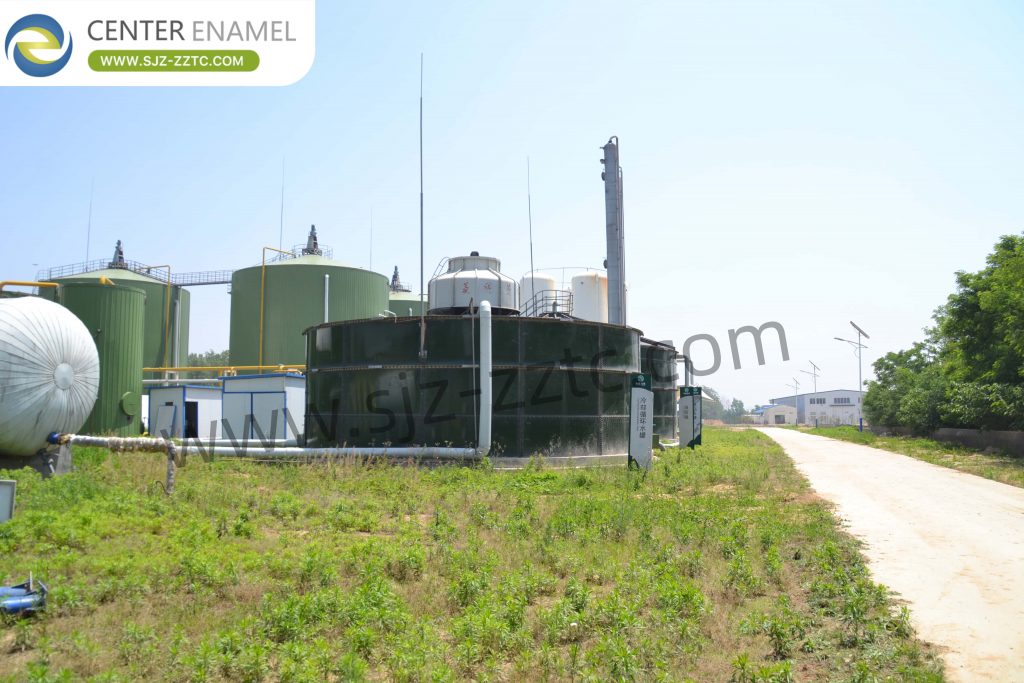
GFS Tanks offer flexible customization of size and appearance, with higher land utilization rates ideally suited for modern compact plant layouts, delivering significant advantages over fixed poured concrete tanks. Concrete tanks cannot alter volume or shape after pouring, and their heavy bases occupy large areas, making placement difficult on narrow or irregular plots. Their rough, uniform appearance also cannot match modern facility aesthetic requirements. GFS Tank volume can be precisely customized as needed, with capacities ranging from dozens of cubic meters to 50,000 cubic meters freely selectable.
Tank height and diameter can be flexibly combined to fit narrow or irregularly shaped plots, effectively saving plant land occupation. Enamel color customization is also supported, achieving visual harmony with plant buildings and environmental facilities. During later plant expansion, GFS Tanks can be directly adjusted in layout and expanded, whereas concrete tanks, being monolithic structures, must be demolished and rebuilt-offering less flexibility in land resource utilization. This aligns well with the intensive construction and aesthetic operation and maintenance needs of industrial parks.
USR Process Definition: Purpose-Built Anaerobic Technology for High-Solids Wastewater
USR, or Upflow Solids Reactor, is an upflow anaerobic process modified for high-suspended-solids, high-solids organic wastewater, specifically designed to solve problems of clogging, sludge washout, and uneven reaction common in traditional anaerobic processes for high-solids wastewater. The process eliminates complex three-phase separators, simplifies internal structure, and relies on upflow hydraulics to promote thorough mixing of solid materials and anaerobic sludge. No strict granular sludge formation conditions are required-flocculent sludge can operate stably. The key feature is high solids tolerance and impurity resistance, with very high influent suspended solids tolerance. It is a dedicated high-efficiency anaerobic process for livestock manure, agricultural organic waste, and high-solids livestock wastewater, specifically developed for agricultural and environmental applications. When paired with GFS Tanks for digestion and storage, the USR process forms the biological core of a complete biogas power plant configuration.
Livestock Wastewater Sources: Understanding the Input Stream
Livestock wastewater is the core agricultural pollution wastewater from large-scale poultry, livestock, and aquaculture operations, generated primarily during farming operations and facility cleaning. Poultry and livestock wastewater is the main component, including wash water from pig, cattle, and poultry housing, manure and urine seepage, and facility washdown-rich in livestock metabolic residues. Aquaculture wastewater comes from periodic pond water exchange and pond cleaning, with feed residues and metabolic waste as pollutants. Wastewater is primarily generated in peri-urban and rural farming areas. Small-scale farmers lack adequate collection facilities, with wastewater discharged directly to land and water. Large-scale farms have collection systems for centralized treatment, with water production varying with production cycles and cleaning frequency. Understanding these source characteristics is essential for correctly sizing GFS Tanks and configuring the appropriate biogas power plant capacity.
Center Enamel Development History: Three Decades of Environmental Equipment Leadership
Center Enamel has been deeply engaged in the environmental bolted storage equipment field for over 30 years. Starting with proprietary enamel anti-corrosion material technology, the company has gradually completed the full-industry-chain upgrade from a single tank manufacturer to a comprehensive environmental EPC service provider. Throughout its 30+ year history, the company has been recognized as a National High-Tech Enterprise, National Specialized and Sophisticated "Little Giant," Manufacturing Single Champion, and Provincial Green Factory. It has successfully delivered over 30,000 environmental projects globally, establishing itself as a leading enterprise in the global GFS Tank storage industry. The company has fully integrated the entire chain from enamel frit R&D, intelligent environmental equipment manufacturing, to EPC project contracting-every business breakthrough has been achieved through proprietary core anti-corrosion technology. This vertically integrated capability is what allows Center Enamel to deliver complete biogas power plant solutions rather than isolated components.
Full-Chain Professional Team and Proprietary Material Technology Barrier
Center Enamel has built a full-chain professional team covering R&D, design, marketing, installation, and after-sales. The R&D team is led by national-level materials technology experts, specializing in enamel frit and tank anti-corrosion core technologies. External senior environmental engineering and mechanical structure engineers are retained to strengthen R&D capabilities, focusing on anti-corrosion coating formulations, specialty corrosion-resistant tanks, and anaerobic supporting integrated equipment-continuously breaking through industry technological barriers. The team operates through proprietary laboratories with external university research collaboration, conducting year-round new material and new process durability pilot testing and long-term corrosion simulation testing. Specialized enamel formulations are iteratively developed for extreme conditions such as high-salinity wastewater, strong acid/alkali POME, and high-organic livestock manure-providing core technical support for the company's annual new invention and utility patents and building a proprietary material technology barrier.
Single and Double Membrane Roof for Biogas Storage Projects
Single and Double Membrane Roofs are proprietary airtight tank cover systems for anaerobic digestion and biogas storage projects, specifically developed for biogas collection and odor containment, representing a benchmark lightweight sealing solution for fermentation tanks. The single-layer membrane roof features a simple structure with economical cost, meeting basic biogas containment needs. The double-layer membrane roof consists of inner and outer corrosion-resistant membrane materials, with pressurized air in the interlayer forming rigid support, providing outstanding thermal insulation that reduces biogas condensate formation inside the tank, with enhanced wind and snow load resistance suitable for high-altitude and windy outdoor sites.
The membrane material is specialized aging-resistant and biogas-slurry-corrosion-resistant PVDF membrane, which will not leak or degrade from long-term contact with biogas or hydrogen sulfide. The flexible structure accommodates tank settlement and slight deformation without cracking or gas leakage. The lightweight design eliminates heavy steel support trusses, significantly reducing the load on the tank and foundation, saving construction costs. The roof integrates biogas outlets, safety pressure relief valves, and access channels, fully enabling closed gas collection for anaerobic fermentation tanks, recovering biogas for power generation and heating while blocking odor diffusion to meet environmental odor control requirements. It is widely used in large-scale livestock biogas projects, municipal sludge anaerobic digestion, and food waste fermentation projects, compatible with large-volume glass-fused-to-steel anaerobic tanks, with fast construction and simple maintenance requiring only periodic membrane seal integrity checks, offering significant overall engineering advantages.
Table 1: Center Enamel Global Track Record and Capabilities
| Metric | Value | Significance |
| Years in Environmental Equipment | 30+ | Long-term industry expertise |
| Global Environmental Projects Delivered | 30,000+ | Proven large-scale delivery |
| Core Technology | Proprietary enamel anti-corrosion | Material technology barrier |
| Business Scope | Enamel frit R&D to EPC contracting | Full-chain integration |
| Recognition | National High-Tech Enterprise, "Little Giant," Manufacturing Single Champion, Provincial Green Factory | National-level credentials |
| Team Coverage | R&D, design, marketing, installation, after-sales | Complete lifecycle support |
Table 2: Membrane Roof Options for Biogas Power Plant Storage
| Feature | Single Membrane Roof | Double Membrane Roof |
| Structure | Simple, economical | Inner + outer membrane with pressurized interlayer |
| Thermal Insulation | Basic | Outstanding, reduces condensate formation |
| Wind/Snow Load Resistance | Standard | Enhanced, suitable for high-altitude and windy sites |
| Membrane Material | Aging-resistant PVDF | Aging-resistant, biogas-slurry-corrosion-resistant PVDF |
| Flexibility | Accommodates settlement | Accommodates settlement without cracking or leakage |
| Structural Load | Lightweight | Lightweight, eliminates heavy steel trusses |
| Integrated Components | Biogas outlets, pressure relief valves, access channels | Biogas outlets, pressure relief valves, access channels |
| Typical Applications | Basic biogas containment | Large-scale livestock biogas, sludge digestion, food waste fermentation |
Ready to design a complete GFS Tank and biogas power plant solution for your livestock manure project? Contact Center Enamel today and let our engineers build a configuration matched to your waste volume and energy targets.
Join the 30,000+ projects worldwide that trust Center Enamel's proprietary enamel technology and full-chain EPC capability-reach out now to discuss your requirements with our team.
Frequently Asked Questions
Q1: How do GFS Tanks support biogas power plant operations in livestock projects?
GFS Tanks provide corrosion-resistant anaerobic digestion and biogas storage vessels that withstand high ammonia-nitrogen and hydrogen sulfide, forming the structural core of a biogas power plant while resisting the aggressive conditions of manure treatment.
Q2: What makes the USR process suitable for high-solids livestock wastewater?
The USR Reactor eliminates complex three-phase separators and tolerates very high influent suspended solids, using flocculent sludge without requiring granular sludge formation-solving clogging and sludge washout issues common in traditional anaerobic treatment.
Q3: Which membrane roof option is best for biogas storage?
Single membrane roofs suit basic containment needs economically, while double membrane roofs offer superior thermal insulation, wind and snow resistance, and are preferred for large-scale livestock biogas power plant projects in demanding climates.