
Biogas Production From Anaerobic Digestion: CHP, Upgrading And Uses
Biogas production from anaerobic digestion yields a gas of roughly 55-65% methane and 30-45% carbon dioxide, plus traces of H2S that must be removed. The two main energy paths are on-site CHP - converting the gas to heat and power at 30-40% electric efficiency - or upgrading to biomethane for injection or vehicle fuel. The choice is driven by the gas volume, the off-take, and the heat demand, not by a default.
What Biogas Is Made Of
Biogas is not pure methane. Straight from the digester it is 55-65% CH4, 30-45% CO2, with hydrogen sulphide, water, and siloxanes depending on the feed. Before use, H2S is stripped because it corrodes engines and pipelines; the CO2 is what separates simple combustion from upgraded biomethane. The exact composition shifts with feedstock and digester stability, which is why on-site monitoring matters.
CHP: Simple, Local Energy
A combined heat and power unit burns the biogas in an engine to make electricity and recover jacket heat. Electric efficiency is typically 30-40%, and using the waste heat for the digester or nearby buildings lifts the total energy use well above that. CHP needs no gas grid and suits a single farm or plant where heat has a local use - but it is tied to the site's own demand.
| Path | Output | Efficiency / note |
| CHP | Power + heat | 30-40% electric |
| Boiler | Heat only | Simple, low cost |
| Upgrading | Biomethane | Grid / vehicle grade |
Upgrading To Biomethane
Upgrading removes CO2 and H2S to reach a methane purity (often 95%+) comparable to natural gas, letting the gas enter a grid or fuel vehicles. The methods - water, amine, membrane, or pressure-swing - differ in capital and loss, but all assume a steady, sized gas stream and an off-take contract or filling point. Without a guaranteed off-take, upgrading is hard to justify versus CHP.
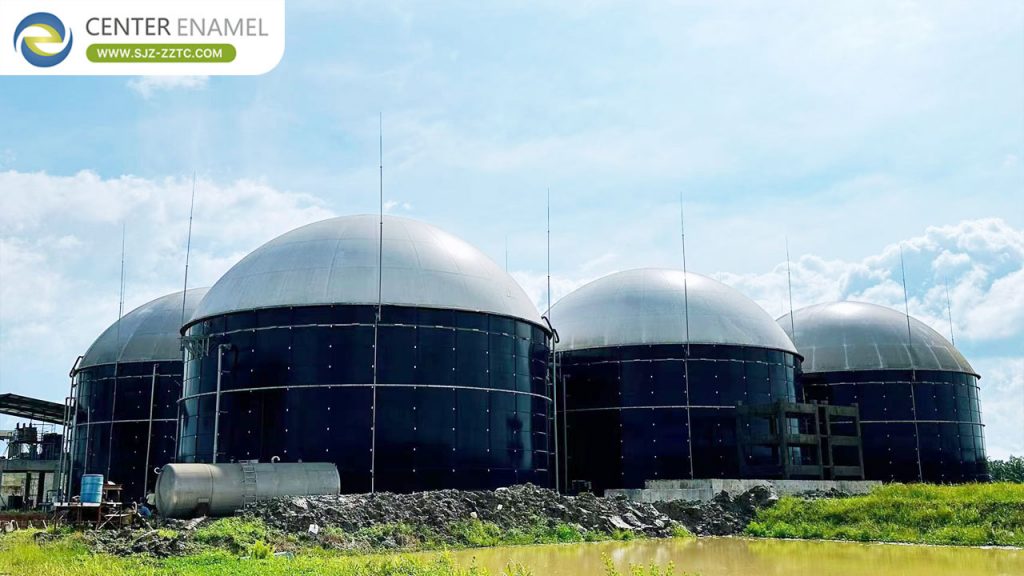
Project Case Study: Malaysia Biogas Project
Project / Application: Large-scale agricultural biogas, Malaysia. Industry: Biogas / agriculture. Process: CSTR in Glass-Fused-to-Steel tanks. Key Requirements: High-rate digestion of farm waste into biogas.
| Field | Value | Source / Evidence |
| Tank Volume | 5,400 m3 each (5 tanks) | Company project reference |
| Total Effective Volume | 27,000 m3 | Company project reference |
| Daily Biogas | 22,000 m3 total | Company project reference |
| Digestibility | approx 80% | Company project reference |
| Gas Rate | 0.45 m3/kg COD removed | Company project reference |
About Company
Shijiazhuang Zhengzhong Technology Co., Ltd (Center Enamel) is a comprehensive high-tech enterprise specializing in wastewater engineering, process section contracting, and equipment manufacturing. The company delivers biogas and wastewater projects through three main lines - EPC (turnkey) contracting, equipment supply, and process packages - covering livestock and municipal wastewater, biomass energy, industrial wastewater, and food waste. Its reactor portfolio spans CSTR, USR, UBF, UASB, IC, and EGSB, backed by in-house Glass-Fused-to-Steel tank manufacturing (enamel firing at 820-930 C) and certifications including ISO 9001, NSF/ANSI 61, and CE-EN 1090. With 35+ years of operation, a 150,000 m2 manufacturing base, and projects in 100+ countries, Center Enamel provides the single-responsibility engineering behind the Malaysia biogas project that ran five GFS CSTR tanks to produce 22,000 m3/day of biogas at about 80% digestibility - a scoped energy-recovery application of anaerobic digestion.
Comparison: CHP Versus Upgrading
| Element | CHP | Upgrading |
| Off-take | On-site | Grid / vehicles |
| Capital | Lower | Higher |
| Heat use | Local required | Not required |
| Best for | Single plant | Steady bulk supply |
Biogas production is only the first step; the value is realised by matching CHP or upgrading to the gas volume and off-take - chosen from energy demand, not assumed.
Frequently Asked Questions
Q1: How much biogas does AD produce? A1: Roughly 0.30-0.60 m3 per kg volatile solids, at 55-65% methane.
Q2: CHP or upgrading which to choose? A2: CHP for on-site heat-and-power; upgrading where a grid or vehicle off-take exists.
Q3: What is biomethane? A3: Biogas stripped of CO2 and H2S to 95%+ methane, grid- or vehicle-grade.
Q4: What is biogas used for? A4: Boiler heat, CHP electricity, or upgraded biomethane.
Q5: Why remove H2S? A5: It corrodes engines and pipelines; it is stripped before use.
Q6: What is CHP electric efficiency? A6: Typically 30-40%, with waste heat raising total use.
Q7: Does feed change gas quality? A7: Yes - composition shifts with feedstock and digester stability.
Q8: Who scopes the energy path? A8: An engineer sizes CHP or upgrading from gas volume and off-take.
Suggested CTA
Send your biogas volume, heat demand, and off-take option to an engineer, or request a biogas energy-path outline.