
Biogas Production Technology: Turning Organic Waste into Renewable Power
As global industries and municipalities prioritize carbon reduction and circular resource economies, biogas production technology has emerged as a cornerstone of modern renewable energy engineering. By transforming complex organic waste streams—such as agricultural residues, livestock manure, municipal sewage sludge, and industrial wastewater—into clean, combustible fuel, biogas systems provide a dependable, dispatchable energy source that complements volatile solar and wind generation.
Understanding the underlying biological mechanisms, reactor configurations, and upgrading pathways is essential for engineers, plant operators, and environmental investors aiming to build high-efficiency waste-to-energy infrastructure.
The Biological Core: Anaerobic Digestion Pathways
The fundamental engine of biogas production technology is anaerobic digestion (AD), a multi-stage biochemical process where specialized microbial communities break down biodegradable matter in the complete absence of dissolved oxygen. This conversion unfolds across four distinct phases:
- Hydrolysis: Extracellular enzymes decompose large, insoluble polymers (carbohydrates, lipids, proteins) into soluble monomers like sugars, amino acids, and long-chain fatty acids.
- Acidogenesis: Acid-forming bacteria convert these soluble monomers into volatile fatty acids (VFAs), alcohols, and carbon dioxide.
- Acetogenesis: Acetogenic bacteria transform VFAs into acetic acid, hydrogen, and carbon dioxide.
- Methanogenesis: Strict anaerobic methanogenic archaea consume acetic acid and hydrogen to produce biogas, typically comprising 55% to 70% methane (CH4) and 30% to 45% carbon dioxide (CO2), along with trace gases like hydrogen sulfide (H2S).
Advanced Biogas Production Infrastructure and Reactor Systems
Modern industrial facilities have evolved far beyond basic open lagoons, deploying highly engineered bioreactors designed to maximize volatile solids reduction and gas yield:
- High-Rate Anaerobic Reactors: Technologies such as Upflow Anaerobic Sludge Blankets (UASB), Upflow Solids Reactors (USR), and Internal Circulation (IC) reactors maintain dense concentrations of active granular biomass. This allows plants to handle massive organic loading rates within compact spatial footprints.
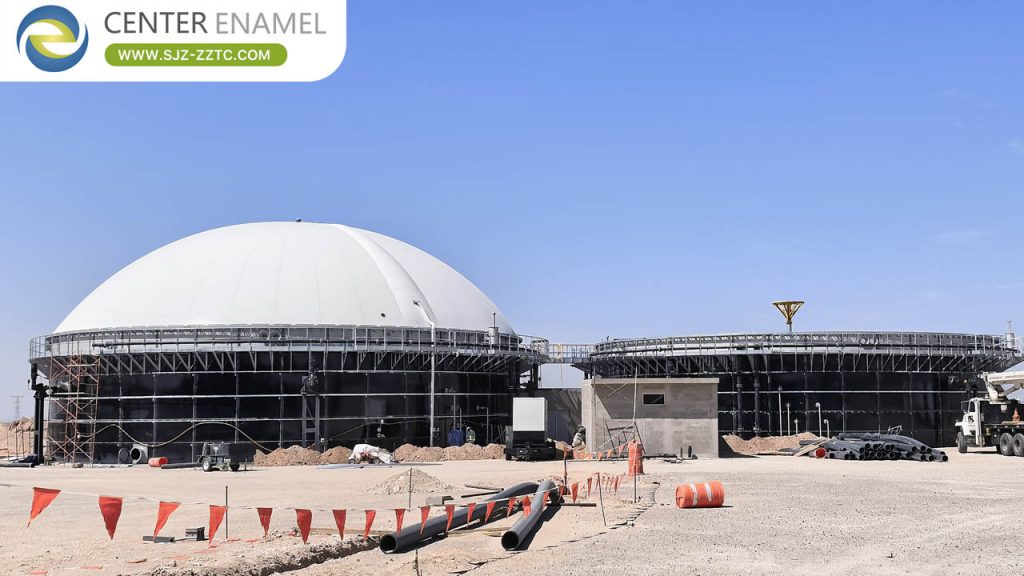
- Corrosion-Resistant Containment (Glass-Fused-to-Steel Tanks): Because anaerobic digesters process corrosive organic acids and hydrogen sulfide, modern facilities rely on Glass-Fused-to-Steel (GFS) bolted tanks. These structures combine high-strength industrial steel with a titanium-rich fused glass coating, offering a pH resilience of 1 to 14 and a structural service life exceeding 30 years.
- Biogas Upgrading & Biomethane Conversion: Raw biogas contains carbon dioxide and trace moisture that reduce its calorific value. Using advanced techniques like water washing, pressure swing adsorption (PSA), amine scrubbing, or membrane separation, operators strip impurities to produce high-purity biomethane (>95% methane content), which is fully interchangeable with natural gas for grid injection or vehicle fuel.
Comparative Data Table: Conventional Digesters vs. Next-Generation Biogas Plants
| Evaluation Parameter | Traditional Biogas Digesters | Next-Generation High-Rate Biogas Plants |
| Methane Yield & Purity | Moderate methane concentration (50%–60%) | Optimized production (up to 70%+ raw, 95%+ upgraded biomethane) |
| Hydraulic Retention Time (HRT) | Long retention times (20 to 40 days) | Short retention times (hours to a few days) |
| Reactor Footprint | Sprawling, land-intensive concrete basins | Compact, vertical modular architecture (GFS + IC/UASB) |
| Durability & Corrosion Resistance | Vulnerable to structural concrete cracking and acid degradation | Inert Glass-Fused-to-Steel (GFS) coating (30+ year lifespan) |
| Energy Output Destination | Localized on-site combined heat and power (CHP) only | Flexible: CHP, industrial boiler fuel, or direct natural gas grid injection |
Frequently Asked Questions (FAQ)
Q1: What is biogas production technology?
A: Biogas production technology involves the controlled, oxygen-free biological breakdown of organic waste (such as agricultural manure, food waste, and wastewater sludge) by specialized microorganisms to generate a renewable gaseous fuel rich in methane.
Q2: What is the difference between raw biogas and biomethane?
A: Raw biogas is the direct product of anaerobic digestion, containing roughly 50% to 70% methane alongside carbon dioxide, moisture, and trace gases. Biomethane is raw biogas that has undergone an upgrading process (using water washing, membrane separation, or pressure swing adsorption) to remove impurities, achieving over 95% methane content equivalent to fossil natural gas.
Q3: Why are Glass-Fused-to-Steel (GFS) tanks widely used in modern biogas plants?
A: GFS tanks combine the structural strength of industrial steel with the chemical inertness of fused glass. They withstand corrosive organic acids and hydrogen sulfide generated during anaerobic digestion, prevent structural leakage, and provide an extended operating lifespan exceeding 30 years.