
How a Biogas Project Contractor Delivers USR Process Systems for High-Solids Waste
The global biogas industry is in a phase of large-scale expansion, with China contributing the major share of new capacity, becoming the fastest-growing single market. Europe's mainstream model focuses on combined heat and power (CHP) and biomethane grid injection, with active biomethane certificate trading and application scenarios covering power generation, heating, and transportation fuel. China, in contrast, emphasizes vehicle fuel and industrial heating while actively promoting the fertilizer utilization of digestate, showing significant differentiation in application scenarios.
Southeast Asian emerging markets show rapidly growing food waste treatment demand, becoming key areas for global companies; while African and Latin American markets remain in the early stages, primarily relying on low-cost direct application models. Countries show differentiated development paths in biogas resource utilization: Europe focuses on energy output, China emphasizes comprehensive utilization, and emerging markets prioritize pollution control.
For project developers navigating these regional differences, selecting the right Biogas Project Contractor and anaerobic process is critical. Where high-solids agricultural wastewater is involved, the USR Process has become the proven technical pathway-and delivering it successfully requires containment infrastructure engineered for the challenge.
USR Process Applicable Scenarios: Where High-Solids Treatment Wins
The USR Process is a dedicated process for agricultural high-solids wastewater, primarily suitable for large-scale livestock manure, livestock soaking water, agricultural straw leachate, and livestock slaughterhouse high-solids wastewater. For high-suspended-solids, high-organics, high-impurity wastewater conditions, it is the core process for rural livestock pollution treatment and agricultural organic waste resource utilization.
It is suitable for township decentralized wastewater treatment and small to medium-sized agricultural enterprise wastewater treatment. The USR Process can serve as the primary process for large livestock base manure resource recovery, combining wastewater treatment with biogas recovery. It is also suitable for various high-solids, easily clogged, difficult-to-treat organic wastewater pretreatment, with superior suitability in agricultural environmental applications compared to other anaerobic processes.
Biogas Plant Wastewater Sources: Understanding What You Are Treating
Biogas plant wastewater is secondary wastewater from organic waste resource recovery-primarily digestate from anaerobic digestion, distinct from primary production wastewater. It originates from anaerobic digestion of livestock manure, crop straw, food waste, and brewery residues, as a byproduct of biogas fermentation.
Auxiliary wastewater includes equipment washing, digester tank cleaning, desulfurization system drainage, and plant floor washdown. Production is continuous and stable with only minor variations with feedstock input and fermentation cycles. Pollutants are significantly transformed through anaerobic digestion, with composition distinct from primary high-concentration organic wastewater-it is the core wastewater requiring treatment in biogas plants. Understanding this distinction is essential for any Biogas Project Contractor designing an effective treatment train.
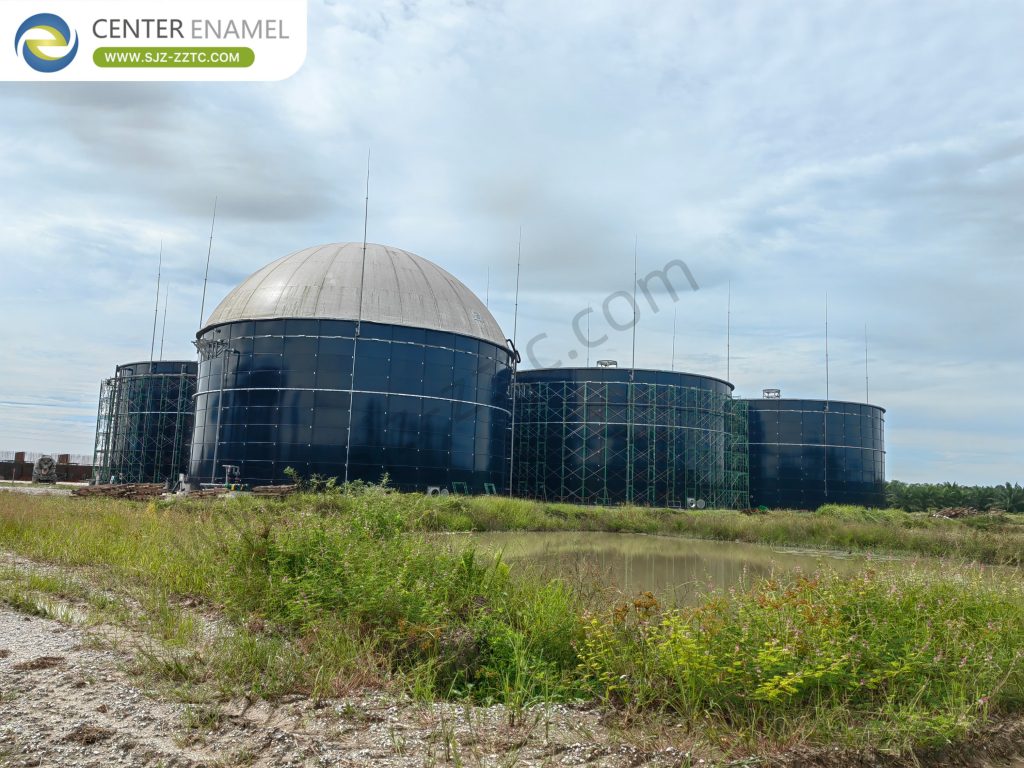
GFS Tanks Adaptable to Modern Intensive Plant Layouts
GFS Tanks offer flexible customization of size and appearance, with higher land utilization rates, ideally suited for modern compact plant layouts, with significant advantages over fixed poured concrete tanks. Concrete tanks cannot alter volume or shape after pouring, with heavy bases occupying large areas, making placement difficult on narrow or irregular plots. Their rough, uniform appearance cannot match modern facility aesthetic requirements.
GFS tank volume can be precisely customized as needed, with capacities ranging from dozens of cubic meters to 50,000 cubic meters freely selectable. Tank height and diameter can be flexibly combined to fit narrow or irregularly shaped plots, effectively saving plant land occupation. Enamel color customization is also supported, achieving visual harmony with plant buildings and environmental facilities. During later plant expansion, GFS tanks can be directly adjusted in layout and expanded; concrete tanks, being monolithic structures, must be demolished and rebuilt, offering less flexibility in land resource utilization. This aligns well with the intensive construction and aesthetic operation and maintenance needs of industrial parks.
Global Installation Coverage and Delivery Capability
Center Enamel is the pioneer of Chinese GFS equipment exports, with installation service coverage across over 100 countries and regions-possessing full delivery capability across climates, regulations, and geographies.
| Region | Countries / Areas Covered | Site Conditions Handled |
| Southeast Asia | Vietnam, Thailand, Malaysia, Indonesia, Cambodia, Bangladesh, Nepal | Tropical rainy, high salt spray |
| Africa | Ghana, South Africa, Mali, Guinea, Zambia, Kenya, Pakistan | Remote sites, high-temperature |
| Europe / Americas | Sweden, USA, Russia | Nordic severe cold, high-standard EU/US facility conditions |
| Middle East & Latin America | Multiple countries | High-altitude mountainous, arid conditions |
The company uses a dual-service model of "own cross-border construction teams + overseas local agent coordination"-whether clients are in developed countries or remote developing regions-providing one-stop services including on-site survey, on-site installation, process commissioning, and operator training. Complete coverage covers biogas engineering, municipal wastewater, industrial wastewater, livestock manure, drinking water storage, and other global mainstream environmental engineering projects.
Flexible and Efficient Service Delivery System
Center Enamel's own cross-border construction teams plus a global localized agent network enable modular GFS tank assembly with short construction periods and dismantlable/reusable capability-suitable for overseas short-term projects, phased expansions, and relocation needs-with full-lifecycle after-sales O&M support ensuring long-term stable client operations. As an experienced Biogas Project Contractor, this delivery model allows us to mobilize quickly and maintain quality control across diverse project conditions.
Gas Holder: Independent Double-Membrane Biogas Storage
Center Enamel's Gas Holder (independent double-membrane biogas holder) is a ground-mounted biogas storage device installed independently from the fermentation tank. It adopts a double-layer high-strength membrane structure, with the inner membrane forming the gas storage cavity and the outer membrane forming the protective shell. Continuous aeration between the inner and outer membranes maintains constant positive pressure, ensuring stable sealing of the gas storage cavity.
The Gas Holder is installed separately from the fermentation tank and connected via biogas transmission pipelines. Biogas produced from the fermentation tank is sent to the holder for storage after desulfurization and dehydration, then pressure-regulated and stably delivered to end-use equipment, enabling separated management of biogas production, storage, and utilization. The gasholder volume can be customized from tens to thousands of cubic meters to meet storage and peak-shaving requirements for different production rates and consumption cycles.
The Gas Holder is equipped with a comprehensive safety control system, including biogas leak detection, inner membrane overpressure protection, emergency flare stack, and lightning protection grounding, ensuring full operational safety. The membrane material uses high-strength PVDF outer membrane and biogas-corrosion-resistant inner membrane, with a service life of over 15 years. Maintenance is simple, requiring only periodic checks of membrane integrity and aeration system operation, with significantly lower lifecycle maintenance costs than steel gasholders.
Ready to start your biogas project? Contact Center Enamel today for a customized USR Process solution-our team will respond within 24 hours.
Frequently Asked Questions
Q1: What should I look for in a biogas project contractor?
A: Choose a contractor with proven USR Process experience, in-house GFS tank manufacturing, global installation references, and full EPC capability-from design through commissioning and operator training.
Q2: Which wastewater types suit the USR Process best?
A: The USR Process excels with high-solids agricultural wastewater-livestock manure, soaking water, straw leachate, and slaughterhouse effluent-where clog resistance and simplicity outperform complex reactor designs.
Q3: Does Center Enamel provide biogas storage as part of its scope?
A: Yes. We supply independent double-membrane gas holders with volumes from tens to thousands of cubic meters, complete with leak detection, overpressure protection, and emergency flare systems.