
How Do GFS Tanks and the Right Biogas Project Contractor Turn Waste Into Energy?
A biogas project is decided long before the first cubic meter of gas is flared off or sold. It is decided in the choice of tank structure, in the reactor that consumes the organic load, and in the contractor who takes responsibility for all of it. Get those three right, and wastewater becomes a revenue stream; get them wrong, and the plant spends the next decade paying for maintenance instead of generating returns.
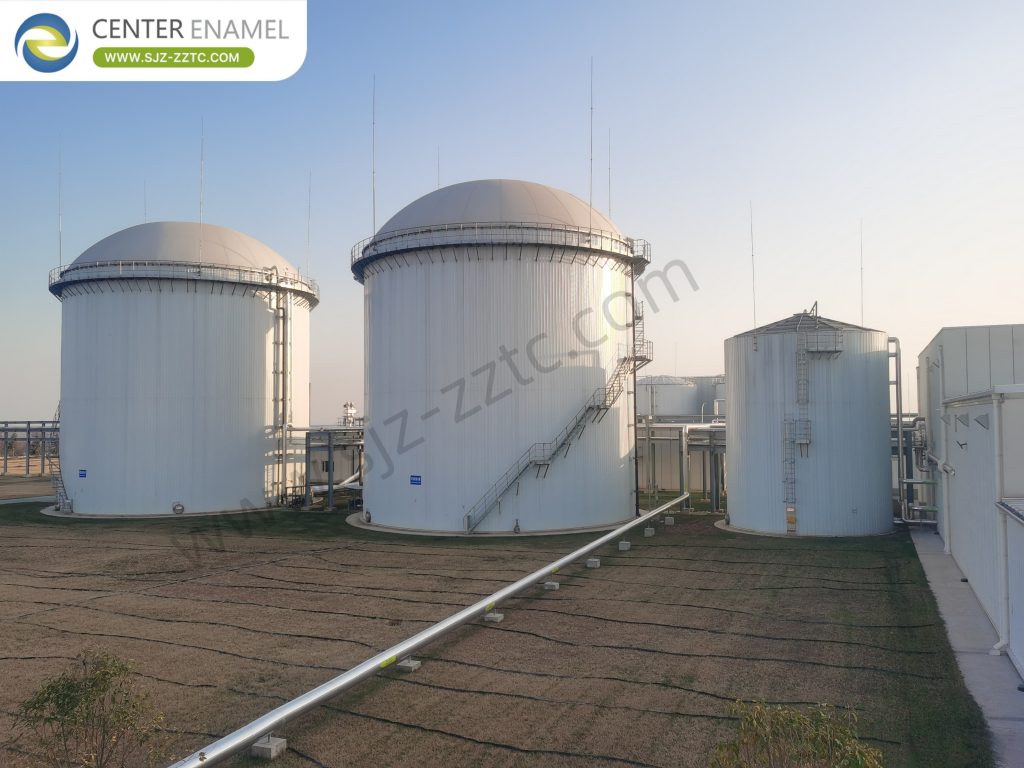
This article connects the industry's real constraints, the case for bolted GFS Tanks, the efficiency logic behind internal circulation reactors, the specific hazards of papermaking effluent, a delivered overseas reference, and the credentials and quality controls that separate a reliable Biogas Project Contractor from a supplier of parts.
Industrial Wastewater's Real Pain Points
Every sound design begins with an honest reading of the problem. Industrial wastewater treatment is still dominated by the "three highs": high difficulty, high cost and high energy consumption. Effluent from new energy, chemical and pharmaceutical production is complex in composition and loaded with characteristic pollutants that conventional processes struggle to remove. Add increasingly stringent discharge standards, plus new expectations around digitalization and low-carbon operations, and the pressure on plant managers keeps compounding.
None of these constraints is temporary, which is why the market has moved toward recovery-oriented design. Anaerobic treatment that captures methane, combined with storage and reactor structures that can be built, expanded and relocated on demand, is now the baseline expectation rather than a premium option.
Why Bolted GFS Tanks Outpace Poured Concrete
That expectation starts with the tank itself. GFS Tanks are assembled on site from factory-prefabricated panels, which means short construction windows and genuine flexibility for expansion, relocation and reuse-a set of advantages that poured concrete simply cannot match.
Concrete construction requires formwork, rebar tying, pouring and long curing periods, with a single tank occupying months of schedule. Rain, snow and low temperatures force stoppages and push completion back. Once cured, the structure is permanent: it cannot be dismantled, enlarged or moved, so a plant relocation effectively writes off the entire asset.
Bolted glass-fused-to-steel panels follow a different logic. Every panel is prefabricated in the factory, shipped to site and assembled with straightforward procedures-work continues through low temperatures and light rain, and installation takes roughly one-third of the time a concrete tank demands, keeping schedules controllable. Need more volume? Additional panels go on. Need to move the plant? The tank comes apart, the panels ship to the new site and are reassembled and reused, cutting material and construction costs for both new builds and retrofits. For short-term environmental projects, phased expansion and relocated facilities, that flexibility is worth as much as the tank capacity itself.
Inside the IC Reactor's Efficiency Edge
Flexible tanks still need a process worth putting inside them, and the internal circulation reactor delivers it. For the same treatment capacity, an IC system occupies about one-third of the footprint required by traditional anaerobic processes-a compactness advantage that matters wherever land is scarce or expensive.
Its built-in gas-lift internal circulation eliminates external recirculation equipment and forces mixing between sludge and water on its own. That strong hydraulic mixing puts microbes in thorough contact with pollutants, lifting degradation efficiency and allowing the system to absorb shocks in both water quality and hydraulic loading. A dual-zone configuration pairs high-efficiency degradation with deep polishing, so effluent quality stays stable rather than drifting. Sludge granulation is high and activity strong, with very little washout. Automation levels are high, failure rates low, biogas output large and resource recovery benefits pronounced-and long-term energy and O&M costs sit far below traditional anaerobic alternatives. For large-flow, high-concentration industrial wastewater, this is the configuration that pays back fastest.
What Makes Papermaking Effluent So Damaging?
Papermaking is one of the streams where that configuration earns its keep, and the reason lies in the pollutant profile. The contaminants are largely natural plant extracts with relatively low chemical toxicity, yet suspended solids and alkalinity are high enough to cause serious harm.
Concentrated fibers and fillers settle onto water bodies, blanketing riverbed sediment and blocking fish spawning grounds and benthic habitat. Lignin, cellulose and other organics decompose and strip dissolved oxygen, leaving fish suffocating in oxygen-depleted water. Strongly alkaline black liquor raises receiving-water pH directly, disrupting acid-base balance and harming aquatic life, while resin acids and tannins add their own toxic effect on fish. High color blocks light penetration and suppresses aquatic plant photosynthesis, and the sheer mass of fiber and filler silts up rivers and reservoirs.
The overall burden is therefore physical sedimentation plus oxygen-demanding organic pollution, without heavy metals or synthetic toxics-which means recovery periods are moderate and treatability is genuinely favorable when the right train is applied.
Case in Focus: High-Strength Brewery Wastewater in South Africa
That favorable profile becomes concrete in reference projects, and one delivered installation shows how the pieces fit together. In South Africa's brewing industry, a high-concentration organic wastewater project was built around Center Enamel GFS Tanks paired with stainless steel tanks as the core equipment set.
Table 1-South Africa brewery high-strength wastewater project
| Project Element | Configuration | Function and Outcome |
| Sector and effluent type | Brewing industry, high-concentration organic wastewater | Targets a pollution problem specific to the local brewing cluster |
| Primary treatment stage | GFS Tanks forming the anaerobic digestion system | Suits high-COD, high-sugar, readily degradable streams; destroys organic load efficiently |
| Supporting storage | Stainless steel tanks for wastewater transfer and chemical storage | Keeps auxiliary circuits stable and free of contamination |
| Material strategy | Corrosion-resistant glass-fused surfaces plus stainless wetted parts | Sustains performance in aggressive, variable effluent |
| Build method | Bolted panel assembly with factory-prefabricated components | Compresses site works and simplifies logistics to a remote location |
| Service record | Continuous treatment of production and cleaning wastewater | Long-term stable operation; a mature African reference for the technology |
The pattern repeats across industries: capture the organic load anaerobically, recover the gas, and let downstream stages finish the job. What changes is the material specification and the process detail-which is where engineering depth and certification become decisive.
Where the Engineering Comes From
Behind every delivered tank sits a material science program. Technology R&D is Center Enamel's core competitive advantage: the company independently masters more than 200 differentiated anti-corrosion enamel formulations, controls the enamel raw material chain end to end, and holds close to 100 invention and utility patents-with product performance benchmarked against high-end European and American storage equipment.
Table 2-Credentials behind the delivery
| Credential Area | Detail | What It Means for a Biogas Project |
| Enamel formulation capability | 200+ differentiated anti-corrosion formulations, full raw-material control | Coating chemistry can be matched to the specific effluent and gas environment |
| Intellectual property | Close to 100 invention and utility patents | Structural and coating improvements are proprietary rather than generic |
| Product certifications | NSF, WRAS, ASME, BSCI, CE, ISO 9001 | Meets drinking-water, pressure-vessel and EU market acceptance requirements |
| Corporate recognition | National High-Tech Enterprise, National Specialized and Sophisticated "Little Giant," Hebei Manufacturing Single Champion, Provincial Smart Factory, Provincial Green Factory | Verified manufacturing and innovation standing, not self-declared |
| Compliance scope | Complete environmental engineering and special equipment manufacturing qualifications | Full legal scope to design, fabricate and install |
| Research partnerships | Joint materials laboratories with multiple universities | Continuous iteration on coatings and large bolted tank structural design |
That material barrier is difficult to replicate, and it explains why the specification conversation tends to shift from tank price to tank life.
Installation Quality, Enforced Stage by Stage
Material excellence survives only if installation protects it, so the same discipline carries through to site. Center Enamel applies full-chain quality control across four dimensions: factory protection, on-site assembly, completion inspection and long-term warranty.
At the factory, every enameled panel, seal and structural component receives rust-proof, moisture-proof packaging with dedicated protective supports, so sea and land transport cannot chip the coating. On site, assembly follows unified process specifications-panel-by-panel tightening and layered leak testing, with air-tightness and verticality checks after each tank section, and simultaneous pressure testing and acceptance for dual-membrane covers and anaerobic piping.
Acceptance criteria are then differentiated by region rather than applied uniformly: EU and US projects follow stringent CE and NSF inspection requirements, hot-humid Southeast Asian sites receive enhanced corrosion protection and sealing acceptance, and remote African sites add foundation settlement re-inspection. On completion, construction inspection reports, pressure test records and anti-corrosion appearance documents are issued with full photo and video archives retained. Across more than 10,000 tanks delivered worldwide, long-term operation has proceeded without large-scale leakage or structural deformation-the kind of evidence that prevents O&M problems at the source rather than after handover.
Choosing a Partner Who Owns the Whole Scope
Read together, those threads point to a single selection criterion: whether one organization can carry the project from effluent survey to steady gas production. A capable Biogas Project Contractor brings the tank, the reactor, the coating chemistry, the certifications and the after-sales chain under one accountability line-so no gap opens between design intent and installed reality.
When that scope is split among suppliers, the interfaces become the risk: tank meets reactor, coating meets effluent, schedule meets shipping. When it is held by one partner with its own formulation lab, patent portfolio and regional acceptance standards, those interfaces are internal matters solved before they reach the owner's desk.
Frequently Asked Questions
How much faster are GFS Tanks than concrete construction?
Roughly one-third of the installation time. Panels arrive prefabricated and are bolted on site, work continues through light rain and low temperatures, and curing delays disappear entirely-which protects the commissioning date.
Can the same tank be reused if the plant relocates?
Yes. Bolted tanks can be fully dismantled, the panels transported to a new site and reassembled, avoiding the total loss that follows abandoning a cured concrete structure. Expansion works the same way: add panels, add volume.
Which certifications should a biogas project contractor hold?
At minimum NSF, WRAS, ASME, CE and ISO 9001 for product and process conformity, plus complete environmental engineering and special equipment manufacturing qualifications. These confirm the scope to design, fabricate and install legally.
Send us your effluent data and gas target, and we will return a tank-and-reactor configuration with a realistic delivery schedule.
Speak with a Center Enamel engineer today-the fastest way to confirm whether bolted GFS Tanks fit your site is a short technical conversation.