
How Is Biogas Plant Digestate Treated? A Biogas Project Contractor's Best Solution
The global biogas industry competitive landscape shows divergence. Leading companies dominate major project market shares through the "EPC + Operation" integrated model, while small and medium-sized enterprises focus on county-level distributed projects and specialized equipment segments. China's biogas equipment exports continue to expand, with generator sets primarily flowing to emerging markets. Business model innovation is accelerating, with carbon asset development becoming a standard feature of large projects, converting methane emission reductions into tradable carbon credits. Some countries have piloted digestate fertilizer carbon credit trading, encouraging the integration of digestate application to farmland with carbon accounting. The "biogas operation outsourcing" service model is emerging, improving operational efficiency of county-level projects through professional management.
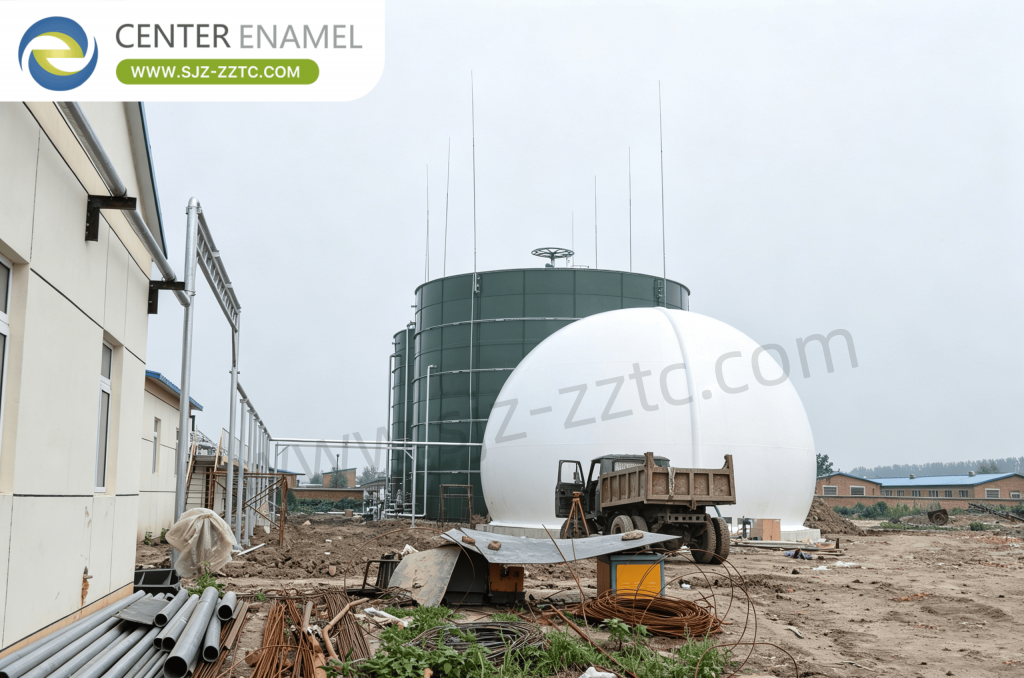
From a technology and equipment perspective, anaerobic digestion is the core process of biogas engineering. Glass-fused-to-steel (GFS) tanks, with their excellent sealing, corrosion resistance, and construction convenience, have become the mainstream choice for large anaerobic digestion tanks. Their modular design can be combined with membrane gas holders to form an integrated "fermentation + gas storage" solution, with penetration rates continuing to rise in new projects in biogas industry clusters. Selecting the right Biogas Project Contractor-one who controls both the tank infrastructure and the biological process-has therefore become decisive for project economics.
USR Process Advantages: Why It Suits High-Solids Wastewater
The USR Process delivers high solids tolerance, clog resistance, and strong adaptability, perfectly suited for high-suspended-solids, high-impurity, high-solids organic wastewater. Its equipment structure is extremely simple, with no precision wear parts, low capital investment, long service life, virtually no clogging failures, and extremely low subsequent maintenance costs. There are no strict requirements on sludge morphology-no need to cultivate mature granular sludge, as flocculent sludge can operate stably, with fast start-up and a short sludge acclimation period for rapid commissioning. Gentle hydraulic disturbance results in low sludge washout and high sludge utilization, with stable organic pollutant degradation. Operation is simple with low automation requirements and high error tolerance, suitable for remote sites, farms, and other settings with limited O&M capabilities-outstanding stability and practicality advantages within modern Anaerobic Technologies.
| USR Process Advantage | Benefit to Project Owner |
| High solids tolerance | Handles manure, straw leachate, high-impurity wastewater |
| Clog-resistant structure | Virtually no clogging failures |
| No precision wear parts | Low capital investment, long service life |
| No granular sludge requirement | Fast start-up, short acclimation period |
| Gentle hydraulic disturbance | Low sludge washout, high utilization |
| Simple operation | Suitable for remote sites with limited O&M capability |
Digestate O&M Cost Analysis: Low Cost, High Recovery Value
O&M costs are low and controllable, with outstanding resource recovery benefits-excellent overall cost-effectiveness. Treatment processes are simple and mature, with no complex pretreatment or high-end degradation equipment-conventional equipment with low failure rates and simple maintenance. Stable water quality with no drastic fluctuations means no frequent parameter adjustments, and low labor requirements and costs. No large quantities of specialty chemicals are required, keeping chemical and energy costs controlled. The key advantage is high resource recovery value-compliant digestate and treated effluent can be used as ecological fertilizer for agricultural application, reducing chemical fertilizer use. Digestate can be concentrated into commercial liquid fertilizer, with resource recovery revenues generally covering routine O&M costs-industry-leading economics.
| Cost Factor | Impact |
| Pretreatment complexity | Minimal; conventional equipment only |
| Water quality stability | Stable; no frequent parameter adjustments |
| Labor requirement | Low |
| Specialty chemicals | Not required in large quantities |
| Resource recovery | Digestate and effluent used as ecological fertilizer |
| Revenue offset | Resource recovery revenues generally cover routine O&M costs |
Bangladesh Poultry Farm: A Benchmark Biogas Project
Targeting local poultry farm manure resource recovery with daily treatment of 47 tons, influent COD, BOD, and SS as high as 50,000 mg/L, 25,000 mg/L, and 50,000 mg/L were reduced after CSTR + UASB anaerobic treatment to below 200 mg/L, 100 mg/L, and 100 mg/L respectively-effluent compliant with local environmental discharge standards. The project produces approximately 4,900 m³ biogas daily-each m³ biogas can generate 2 kWh of electricity, with daily power generation of 9,800 kWh-simultaneously achieving pollutant reduction and clean energy recovery. This is a benchmark project for livestock waste recycling in Southeast Asia.
| Parameter | Influent Concentration | Effluent Concentration |
| COD | 50,000 mg/L | Below 200 mg/L |
| BOD | 25,000 mg/L | Below 100 mg/L |
| SS | 50,000 mg/L | Below 100 mg/L |
| Daily treatment capacity | 47 tons | - |
| Daily biogas production | 4,900 m³ | - |
| Daily power generation | 9,800 kWh | - |
Core R&D Capabilities and Global Certifications
Technology R&D is Center Enamel's core competitive advantage. The company independently masters over 200 differentiated anti-corrosion enamel formulations, with full self-control over the enamel raw material chain, holding nearly 100 invention and utility patents. Products have passed NSF, WRAS, ASME, BSCI, CE, ISO9001, and other global certifications.
Company certifications and honors include: National High-Tech Enterprise, National Specialized and Sophisticated "Little Giant," Hebei Manufacturing Single Champion, Provincial Smart Factory, Provincial Green Factory; complete environmental engineering and special equipment manufacturing compliance qualifications. The company maintains long-term collaborative research with multiple universities through joint materials laboratories-continuously iterating anti-corrosion coatings and large bolted tank structural design technologies. The proprietary material technology barrier creates an irreplaceable competitive advantage, with product performance comparable to high-end imported European/American storage equipment.
| Certification / Honor | Scope |
| NSF, WRAS, ASME, CE, ISO9001, BSCI | Product and system certifications |
| National High-Tech Enterprise | National-level recognition |
| National Specialized and Sophisticated "Little Giant" | National-level recognition |
| Hebei Manufacturing Single Champion | Provincial-level recognition |
| Provincial Smart Factory / Green Factory | Provincial-level recognition |
| ~100 invention and utility patents | Intellectual property |
| 200+ anti-corrosion enamel formulations | Proprietary material technology |
Extensive Global Benchmark Project Cases
Center Enamel's project portfolio covers over 100 countries across Southeast Asia, Africa, Europe, the Americas, the Middle East, and Latin America. The company's track record spans biogas engineering, municipal wastewater, industrial wastewater, livestock manure, and drinking water storage-demonstrating the delivery depth expected of a seasoned Biogas Project Contractor.
Gas Holder: Independent Double-Membrane Biogas Storage
Center Enamel's Gas Holder (independent double-membrane biogas holder) is a ground-mounted biogas storage device installed independently from the fermentation tank. It adopts a double-layer high-strength membrane structure, with the inner membrane forming the gas storage cavity and the outer membrane forming the protective shell. Continuous aeration between the inner and outer membranes maintains constant positive pressure, ensuring stable sealing of the gas storage cavity. The Gas Holder is installed separately from the fermentation tank and connected via biogas transmission pipelines.
Biogas produced from the fermentation tank is sent to the holder for storage after desulfurization and dehydration, then pressure-regulated and stably delivered to end-use equipment, enabling separated management of biogas production, storage, and utilization. The gasholder volume can be customized from tens to thousands of cubic meters to meet storage and peak-shaving requirements for different production rates and consumption cycles. The Gas Holder is equipped with a comprehensive safety control system, including biogas leak detection, inner membrane overpressure protection, emergency flare stack, and lightning protection grounding, ensuring full operational safety. The membrane material uses high-strength PVDF outer membrane and biogas-corrosion-resistant inner membrane, with a service life of over 15 years. Maintenance is simple, requiring only periodic checks of membrane integrity and aeration system operation, with significantly lower lifecycle maintenance costs than steel gasholders.
| Gas Holder Feature | Specification |
| Structure | Independent double-membrane, ground-mounted |
| Inner membrane | Biogas-corrosion-resistant material |
| Outer membrane | High-strength PVDF |
| Pressure control | Continuous aeration between membranes |
| Volume range | Tens to thousands of cubic meters |
| Service life | Over 15 years |
| Safety systems | Leak detection, overpressure protection, emergency flare, lightning grounding |
| Maintenance | Periodic membrane and aeration checks |
Frequently Asked Questions
What does a Biogas Project Contractor deliver beyond equipment?
A Biogas Project Contractor manages design, manufacturing, installation, commissioning, and after-sales service under one contract. Center Enamel integrates GFS tanks, USR Process systems, gas holders, and compliance support for global projects.
Why is the USR Process suitable for farm-scale biogas projects?
The USR Process tolerates high solids and impurities without clogging, requires no granular sludge cultivation, and operates simply with low automation. This suits remote farms and sites with limited O&M capabilities.
How does digestate treatment offset operating costs?
Digestate and treated effluent serve as ecological fertilizer, reducing chemical fertilizer use. Concentrated liquid fertilizer generates resource recovery revenue that generally covers routine O&M costs, improving overall project economics.
Ready to work with a proven Biogas Project Contractor? Contact us today-our team will design an integrated Anaerobic Technologies solution with USR Process and gas holder storage for your project.