
Specialized Biogas Project EPC Contractor Delivering Durable GFS Tanks for Global Industrial Wastewater Treatment
Global industrial wastewater treatment policies are escalating from "compliance discharge" to mandatory "resource recovery" and "zero liquid discharge." The EU, through its Circular Economy Action Plan, requires member states to increase industrial wastewater reuse rates and extends carbon footprint accounting to the full life cycle of wastewater treatment. China continuously updates and tightens industrial water pollutant discharge standards, with increasingly stringent limits on total nitrogen, total phosphorus, and characteristic pollutants for industries such as chemicals, pharmaceuticals, and printing and dyeing. Some water-scarce regions and highly polluting industries are mandated to adopt zero or near-zero liquid discharge technologies. Germany has established a differentiated pretreatment technical standard system by industry, requiring industrial wastewater to meet specific quality requirements before discharge into municipal wastewater treatment plants, implementing strict source control.
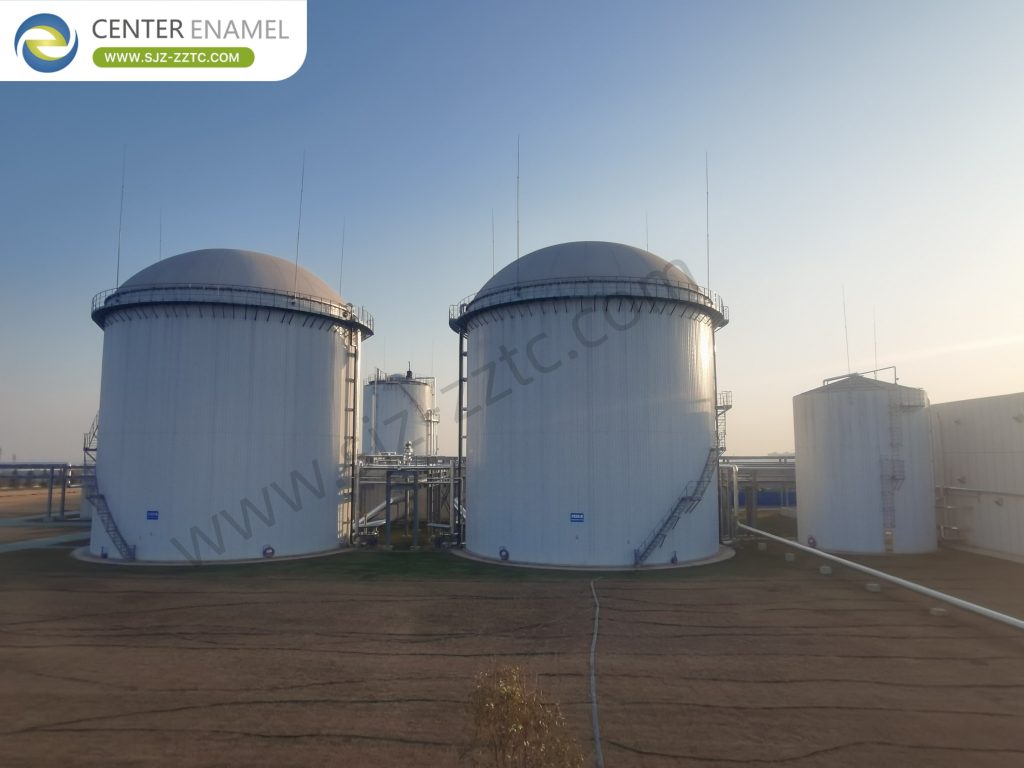
These regulatory pressures create urgent demand for infrastructure that can withstand aggressive wastewater streams while supporting resource recovery goals. As a Biogas Project EPC Contractor, Center Enamel addresses this demand by integrating advanced anaerobic treatment processes with high-performance containment systems engineered for the most challenging industrial applications.
GFS Tanks: Superior Adaptability for Complex Operating Conditions
Center Enamel has independently developed over 200 specialized enamel frit formulations and supporting patents, capable of customizing anti-corrosion enamel based on customer storage media, with adaptability comprehensively superior to concrete tanks. Concrete tanks use a single material, only suitable for neutral clean water storage. When storing corrosive materials such as livestock manure, palm oil mill effluent, chemical wastewater, food waste digestate, high-salinity wastewater, etc., additional anti-corrosion linings must be applied. These linings are prone to failure, preventing long-term stable operation and cannot adapt to alternating high/low concentration storage conditions.
GFS Tanks can be specifically formulated with specialized enamels resistant to strong acids, strong alkalis, high organic content, and high salinity. A single tank can switch between multiple wastewater and fermentation feedstock storage requirements. They are universally applicable across biogas anaerobic digestion, municipal wastewater, livestock farming, food processing, and industrial water treatment scenarios, eliminating the need to rebuild tanks for media changes, perfectly meeting the needs of diversified, multi-condition environmental protection projects. This versatility directly supports the core functions of a Biogas Project EPC Contractor - delivering adaptable infrastructure that evolves with changing operational demands.
USR Process: Purpose-Built for High-Solids Agricultural Wastewater
Dedicated process for agricultural high-solids wastewater, primarily suitable for large-scale livestock manure, livestock soaking water, agricultural straw leachate, and livestock slaughterhouse high-solids wastewater. For high-suspended-solids, high-organics, high-impurity wastewater conditions, it is the core process for rural livestock pollution treatment and agricultural organic waste resource utilization. Suitable for township decentralized wastewater treatment and small to medium-sized agricultural enterprise wastewater treatment. Can serve as the primary process for large livestock base manure resource recovery, combining wastewater treatment with biogas recovery. Also suitable for various high-solids, easily clogged, difficult-to-treat organic wastewater pretreatment, with superior suitability in agricultural environmental applications compared to other anaerobic processes.
The USR process complements Center Enamel's role as a Biogas Project EPC Contractor by providing a robust treatment pathway for feedstocks that would clog or overwhelm conventional anaerobic systems. This process expertise becomes particularly valuable when applied to POME Treatment, where high organic loading and suspended solids demand equally resilient infrastructure.
POME Treatment: Exceptional Economics Through Resource Recovery
O&M costs are moderate to low-biogas recovery benefits are exceptionally high-outstanding overall economics-one of the best input-output ratios in industrial wastewater treatment. POME has excellent biodegradability (BOD/COD 0.5-0.6) with very high anaerobic digestion efficiency-no expensive advanced oxidants or detoxification agents needed-only small amounts of lime/NaOH for pH adjustment and flocculants-low chemical costs. CSTR/USR anaerobic equipment is simple and durable-GFS Tanks with 30+ year corrosion resistance, no precision wear parts-extremely low failure rates and minimal repair/replacement-controllable long-term O&M costs.
Biogas recovery is the core economic benefit-high-concentration organic wastewater produces exceptional biogas yields of 8-15 m³ per m³ POME-CHP can meet 30-50% of mill electricity demand, with waste heat for digester heating and FFB sterilization preheating-very high energy self-sufficiency, greatly reducing or eliminating external electricity purchases. Recovered palm oil from pretreatment oil separation can be sold as biodiesel feedstock or oleochemical raw material-substantial economic benefits. Anaerobic effluent rich in nitrogen, phosphorus, and potassium can be used for palm plantation irrigation and fertilization after advanced treatment-dual resource recovery of water and fertilizer, further reducing treatment costs.
Palm oil mills in Southeast Asia commonly benefit from renewable energy subsidies and carbon reduction credits (CDM/carbon trading)-biogas power projects can apply for carbon asset development for additional carbon revenue, further improving project economics. Overall, POME Treatment system capital payback period is typically 5-8 years-biogas power generation revenues can fully cover O&M costs and generate net profit-one of the highest resource recovery value wastewater categories in industrial wastewater treatment, delivering both environmental management and clean energy recovery.
Ghana Municipal Domestic Wastewater Treatment Project
Completed installation in 2021, treating 1,800 m³/day of municipal wastewater using UBF anaerobic + A²/O nitrogen/phosphorus removal mature processes. Equipped with multiple Center Enamel GFS Tanks including 1 UBF anaerobic reactor, 1 secondary clarifier, and 2 internal/external double-layer A²/O biological tanks. Influent has high COD, BOD, suspended solids, and nitrogen/phosphorus concentrations-after full treatment, effluent parameters are significantly reduced with pH stable at 6.5-9.0, fully meeting local environmental discharge standards. Corrosion-resistant, conveniently assembled GFS Tanks efficiently solve urban domestic wastewater pollution while balancing treatment effectiveness and O&M economics-a mature municipal wastewater case in Africa.
This project demonstrates the cross-application versatility of Center Enamel's infrastructure-the same GFS Tank technology deployed for POME Treatment and biogas projects proving equally effective in municipal wastewater contexts.
Center Enamel's Global Market Presence
Center Enamel's global business covers over 100 countries and regions, with 30,000+ successful overseas projects. Products are exported to all major regions including Europe, the Americas, the Middle East, Africa, Southeast Asia, and Latin America, with a well-established global localized service network.
Domestically, the company is organized into North, South, Central, East, and Southwest marketing regions, covering environmental, water utility, livestock, and petrochemical customers nationwide. Internationally, the company adopts a "standardized products + localized adaptation" model-adjusting tank corrosion protection, sealing, and pressure standards for different national water quality and environmental regulations-with multiple global landmark projects: large-volume GFS Tanks in Italy, 20 m tower water supply tanks in Colombia, coastal seawater treatment tanks in Costa Rica, large municipal wastewater aluminum dome projects in Saudi Arabia, etc. The company has established long-term stable strategic partnerships with many Fortune 500 companies.
This global footprint positions Center Enamel as a uniquely capable Biogas Project EPC Contractor-combining manufacturing scale with localized engineering expertise across diverse regulatory and climatic environments.
Overseas Installation Coverage and Delivery Capability
Center Enamel is the pioneer of Chinese GFS Tanks equipment exports, with installation service coverage across over 100 countries and regions-possessing full delivery capability across climates, regulations, and geographies.
Overseas coverage includes Southeast Asia (Vietnam, Thailand, Malaysia, Indonesia, Cambodia, Bangladesh, Nepal, etc.), Africa (Ghana, South Africa, Mali, Guinea, Zambia, Kenya, Pakistan, etc.), Europe/Americas (Sweden, USA, Russia, etc.), the Middle East, and Latin America-adaptable to tropical rainy high-salt spray, high-altitude mountainous, Nordic severe cold, and high-standard European/American facility conditions.
The company uses a dual-service model of "own cross-border construction teams + overseas local agent coordination"-whether clients are in developed countries or remote developing regions-providing one-stop services including on-site survey, on-site installation, process commissioning, and operator training. Complete coverage covers biogas engineering, municipal wastewater, industrial wastewater, livestock manure, drinking water storage, and other global mainstream environmental engineering projects-possessing the full delivery capability to undertake large-scale tank farm projects in any country worldwide.
Ready to discuss your biogas or POME Treatment project? Contact Center Enamel today for a free consultation and customized GFS Tank solution tailored to your specific wastewater challenges. Our engineering team is available to provide technical guidance, project feasibility assessment, and competitive quotations-reach out now and let us help you turn wastewater into valuable resources.
FAQ
What makes Center Enamel a reliable Biogas Project EPC Contractor for POME Treatment?
We combine 200+ specialized enamel formulations, USR/CSTR process expertise, and 30,000+ global installations. Our GFS Tanks deliver 30+ year corrosion resistance for high-acid POME, ensuring biogas recovery systems operate reliably.
How do GFS Tanks outperform concrete for POME Treatment applications?
GFS Tanks resist pH 1-14 corrosion without linings, install 3x faster than concrete, and are modular for expansion or relocation. Concrete requires acid-resistant coatings prone to failure in high-sulfide anaerobic environments.
What biogas yields can palm oil mills expect from POME Treatment with Center Enamel systems?
Typical yields reach 8-15 m³ biogas per m³ POME. CHP systems meet 30-50% of mill electricity demand, with typical capital payback in 5-8 years through energy savings and carbon credits.