
Biogas Project in Egypt: Transforming Household Waste into Renewable Energy with GFS Tanks
Egypt faces a mounting environmental crisis as rapid urbanization and population growth—now exceeding 110 million—drive unprecedented waste generation. The Cairo metropolitan area alone produces over six million tons of municipal solid waste annually, with the organic fraction dominating the waste stream at 58–75%. Research conducted in Giza governorate reveals that organic content averages 66% in winter and 59% in fall, demonstrating significant seasonal variability that complicates traditional waste management approaches.
The Egyptian Environmental Affairs Agency has identified critical challenges in managing this household waste stream. Despite urban waste collection rates reaching 85%, an estimated 80–88% of municipal waste still ends up in open dumpsites, with only about 7% directed to properly engineered landfills. These practices generate toxic leachate that contaminates groundwater and produce methane emissions—a greenhouse gas over 25 times more potent than carbon dioxide.
Furthermore, Egypt's intense summer heat and arid conditions accelerate organic waste decomposition, creating severe odor problems and public health concerns at collection points and urban markets. The improper handling of organic material—accounting for 50–60% of dumpsite waste—complicates municipal solid waste management due to its biodegradability and moisture-rich composition, which particularly affects biogas and compost production processes. As urban spaces become increasingly constrained and the nation pursues its Vision 2030 sustainability goals, relying solely on traditional dumping is becoming unsustainable. This situation demands advanced resource recovery systems that can transform waste management challenges into opportunities for renewable energy generation.
The Household Waste to Biogas Conversion Process
The transformation of household waste into biogas follows a sophisticated biological process known as anaerobic digestion. This natural process occurs when microorganisms break down organic matter in an oxygen-free environment, producing biogas primarily composed of methane (55–70%) and carbon dioxide (30–45%).
The process begins with feedstock preparation, where household waste is sorted and processed to remove non-organic materials. The organic fraction undergoes pre-treatment to achieve optimal particle size and consistency for digestion. This critical preparation phase ensures maximum microbial activity and biogas yield throughout the conversion process.
In controlled conditions, specialized bacteria decompose complex organic compounds through four biological stages: hydrolysis, acidogenesis, acetogenesis, and methanogenesis. The captured biogas can be utilized directly for cooking, heating, or electricity generation, while the nutrient-rich digestate residue serves as an excellent organic fertilizer, creating a complete circular economy solution. Research demonstrates that anaerobic co-digestion of kitchen waste with other organic materials can significantly increase biogas production, with yields reaching up to 30.95 liters per batch.
This conversion pathway offers Egypt multiple advantages: reducing landfill pressure, cutting greenhouse gas emissions, generating renewable energy, and producing valuable fertilizer resources for agricultural applications—particularly valuable in Egypt's water-scarce and fertilizer-dependent farming sector.
Understanding CSTR Technology for Biogas Production
The Continuous Stirred-Tank Reactor (CSTR) stands as the core processing unit for effective household waste-to-biogas conversion. This anaerobic treatment technology creates optimal conditions for fermentation raw materials and microorganisms to mix thoroughly in a closed tank environment.
The CSTR reactor features a mechanical stirring device that maintains complete mixing of organic waste and anaerobic microorganisms. By feeding continuously or semi-continuously at a constant temperature, the system processes organic wastewater with high suspended solids and high concentration levels effectively. The reactor operates at a constant temperature—typically in the mesophilic range of 35–37°C—with continuous or semi-continuous feeding, allowing the CSTR to handle the high suspended solids and high organic concentrations typical of household waste.
The complete mixing action ensures maximum contact between anaerobic bacteria and organic matter, leading to higher degradation rates and greater biogas yields per ton of waste. Research confirms that CSTR systems deliver exceptional performance with household waste, with studies demonstrating biogas production reaching up to 2.75 m³ weekly from food waste and cattle manure mixtures under optimal conditions. The technology proves particularly effective for household waste applications due to its robust design and ability to handle varying feedstock compositions.
Center Enamel's Professional Design Solutions for Biogas Projects
Center Enamel brings over 36 years of expertise to biogas projects in Egypt, offering comprehensive EPC (Engineering, Procurement, and Construction) services backed by international certifications including ISO9001, NSF61, CE/EN1090, and EN28765. With a 150,000m² R&D and production base, over 500 employees, and an annual manufacturing capacity of 250,000 tank sheets, Center Enamel is the largest manufacturer for GFS tanks in Asia.
The company provides complete biogas solutions covering the entire project lifecycle, from feasibility studies and design to equipment supply and commissioning. Center Enamel's engineering team develops customized designs tailored to Egypt's specific household waste characteristics, climate conditions, and regulatory requirements. Their expert technical team conducts detailed assessments of each client's operations, calculating specific organic loading rates, hydraulic retention times, and expected biogas yields based on daily waste volumes and characteristics.
Adherence to stringent international standards including AWWA D103, OSHA, and EuroCode ensures every biogas project meets global quality benchmarks. Center Enamel's proven track record includes successful biogas implementations worldwide, with reference projects completed in France, Singapore, Turkey, and Indonesia, demonstrating reliable performance across diverse conditions. By utilizing advanced international design standards, Center Enamel ensures that every tank and roof structure is robust enough to withstand Egypt's diverse climate—from the extreme heat of Upper Egypt to the Mediterranean coastal conditions of Alexandria.
GFS Tanks and Double Membrane Roof: Superior Biogas Infrastructure
Glass-Fused-to-Steel (GFS) Tanks
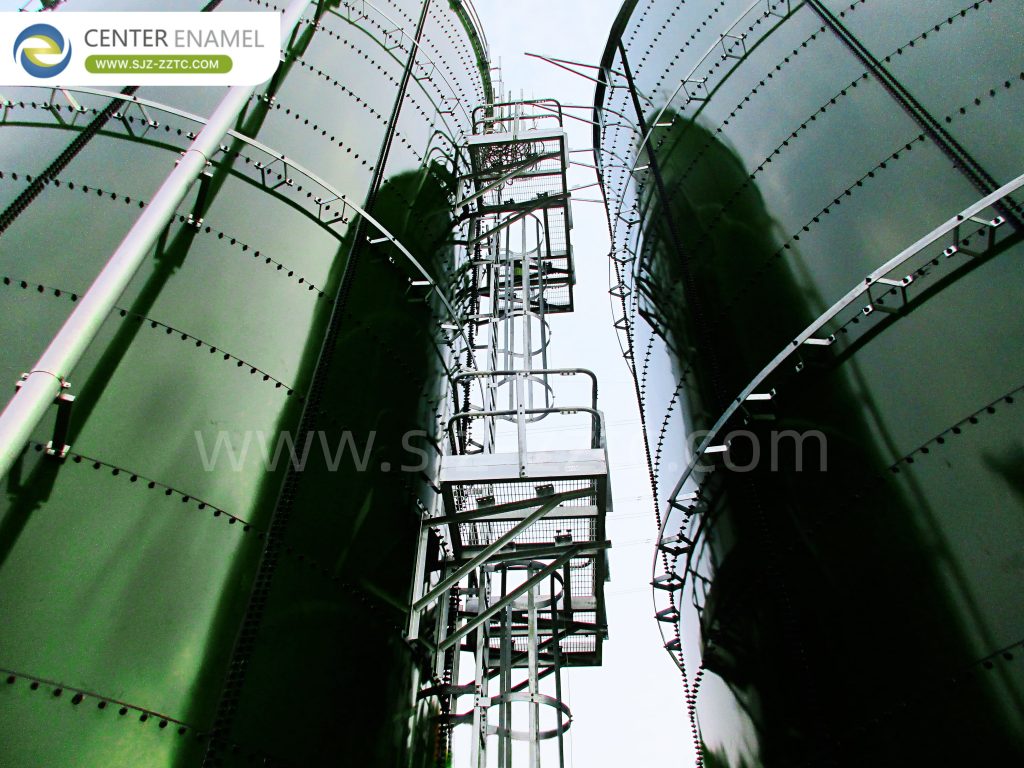
GFS Tanks represent the premium containment solution for biogas projects in Egypt. These tanks undergo firing at 820°C-930°C high temperatures, creating an inert and inorganic bond between molten glass and steel surfaces. This fusion combines the strength and flexibility of steel with exceptional corrosion resistance of glass.
The double coating layer structure features surface coating and ground coating on both interior and exterior faces, providing comprehensive protection against the aggressive conditions present in anaerobic digestion. GFS tanks demonstrate outstanding resistance to organic acids and corrosive hydrogen sulfide gases generated during household waste digestion—an essential feature given that sulfide gases are a primary component of raw biogas.
The modular, bolted construction enables rapid on-site assembly with minimal labor requirements compared to traditional concrete digesters. All tank components are precision-fabricated in Center Enamel's ISO-certified factory and shipped directly to the project site anywhere in Egypt—from the greater Cairo area to Alexandria, from Port Said to Aswan, and to industrial zones in the Nile Delta and Upper Egypt. With an operational lifespan exceeding 30 years and minimal maintenance needs, GFS tanks offer exceptional long-term value for Egyptian biogas projects.
Double Membrane Roof Systems
Double Membrane Roofs serve as the preferred solution for biogas storage under normal working conditions, offering significant advantages for biogas projects in Egypt. These innovative structures directly reduce roof costs while significantly decreasing floor area requirements compared to traditional structural designs.
The Double Membrane Roof saves foundation construction costs by eliminating the need for ground-mounted gas holders—the biogas is stored directly within the double membrane chamber on top of the GFS tank. This space-efficient design proves particularly valuable for urban biogas projects where available land may be limited. The integrated design reduces the overall footprint of the treatment plant, saves foundation construction costs, and simplifies site layout.
For anaerobic digestion processes and biogas applications, Double Membrane Roofs provide superior performance through integrated design with AD tanks, representing a cost-effective solution for Egypt's biogas infrastructure needs. The outer membrane is weather-resistant, protecting against Egypt's intense sun, high temperatures, and occasional winter rains, while the inner membrane maintains constant gas pressure for stable delivery to downstream equipment. The airtight design ensures effective biogas collection and odor control, essential for household waste processing facilities located near urban areas.
Diverse Tank Cover Solutions for Biogas Projects
Center Enamel offers a comprehensive range of cover solutions to meet diverse biogas project requirements across Egypt:
Aluminum Geodesic Dome Roofs provide advanced corrosion resistance with expansive clear span capability, offering efficient and cost-effective construction with minimal maintenance costs.
Glass-Fused-to-Steel Roofs deliver air-tightness suitable for pressurized structures, featuring cone-shaped designs with external and internal beams as viable solutions for demanding applications requiring superior corrosion protection.
Aluminum Alloy Trough Deck Roofs serve as economical options for potable water, wastewater, and firewater storage, effectively keeping out rain and wind while providing odor control without air-tightness requirements.
Stainless Steel Roofs offer air-tightness for pressurized structures with super anti-corrosion performance and extended service life, suitable for harsh environments requiring durable solutions.
FRP Roofs provide practical solutions for applications where air-tightness is not required, including drinking water, agriculture, fire water, and wastewater storage, with dome or flat configurations available to suit various project specifications.
Biogas Project Supporting Equipment
Complete biogas project systems require specialized supporting equipment working in concert with the primary CSTR process:
Gas Holders provide essential storage capacity for biogas generated during anaerobic digestion, balancing supply with fluctuating demand from generators, boilers, or other utilization equipment.
Black Membrane systems offer flexible gas storage options adaptable to varying production rates, providing additional hydraulic retention time or storage capacity for larger facilities.
Solid-liquid Separators process digestate material, separating liquid fertilizer from solid components—both of which have agricultural value for Egyptian farms.
Torch Systems ensure safe biogas combustion during maintenance or excess gas production periods, automatically and safely burning excess biogas when production exceeds usage, preventing unsafe pressure buildup.
Lifting Pumps facilitate consistent wastewater transfer throughout the treatment system, transferring wastewater from collection tanks to the CSTR and recirculating digestate for mixing, heating, or solids suspension.
Dehydration and Desulfurization Tanks purify raw biogas by removing moisture and corrosive hydrogen sulfide, ensuring clean energy output and protecting downstream equipment such as generators and boilers from damage.
Screw Sludge Dewatering Machines efficiently manage residual solids, reducing waste volumes and preparing materials for fertilizer production or final disposal, minimizing disposal costs and handling effort.
Efficient Installation Capabilities
Center Enamel's proven installation capabilities ensure rapid project completion for Egypt's biogas initiatives:
Modular tank design allows efficient on-site assembly by local crews with minimal specialized equipment requirements, completely eliminating the need for on-site welding, heavy concrete pouring with extended curing times, or specialized construction equipment.
Factory-fabricated components ship ready for installation, significantly reducing construction time compared to field-erected alternatives. For a typical biogas project—for example, a 3,000m³ to 5,000m³ GFS tank with a Double Membrane Roof—a trained local crew can complete the erection in just 2-3 weeks.
Experienced technical supervisors provide comprehensive on-site guidance throughout installation, ensuring proper torque settings, sealant application, panel alignment, and roof installation.
Quality assurance protocols guarantee that all equipment meets operational specifications and safety requirements, delivering biogas systems that perform reliably from day one.
Established relationships with international shipping and logistics providers ensure timely delivery of equipment to project sites throughout Egypt, from the greater Cairo area to Alexandria, from Port Said to Aswan, and to industrial zones in the Nile Delta and Upper Egypt.
Extensive experience with large-scale storage tank projects enables seamless coordination of multiple workstreams for efficient project execution, significantly reducing labor costs and minimizing disruption to ongoing operations.
One-Stop Biogas Solutions for Egypt
Center Enamel functions as a comprehensive one-stop solution provider for biogas projects in Egypt, delivering complete system integration from concept to commissioning. The company's EPC capabilities encompass specialized process design, precision equipment manufacturing, and expert installation into seamless turn-key solutions.
By integrating all project components including GFS tanks, double membrane roofs, CSTR technology, and supporting equipment, Center Enamel ensures optimal system performance and operational reliability. This integrated approach eliminates the coordination challenges associated with managing multiple vendors and contractors, allowing clients to work with a single, accountable contractor for the entire scope: pre-treatment equipment, the CSTR reactor, GFS tanks, double membrane roofs, and all auxiliary systems.
Center Enamel's in-depth understanding of Egypt's household waste characteristics, climate conditions, and regulatory environment—including compliance with Law No. 48/1982 and its amendments—enables tailored solutions that maximize energy recovery while meeting local requirements. Backed by international certifications including CE/EN1090, ISO9001, NSF61, WARS, and EN28765, and proven global experience across more than 100 countries, Center Enamel delivers compliant, cost-effective biogas systems that support Egypt's sustainable energy transition and Vision 2030 goals.
Conclusion
Egypt's household waste presents both an environmental challenge and a substantial opportunity for renewable energy generation. Through advanced biogas projects utilizing CSTR technology, GFS tanks, and double membrane roofs, the nation can transform its organic waste burden into clean energy resources while reducing environmental pollution and greenhouse gas emissions.
Center Enamel's comprehensive EPC solutions, coupled with 36+ years of industry expertise and international certifications, provide the technical foundation for successful biogas implementations across Egypt. By partnering with experienced technology providers, Egypt can develop the biogas infrastructure needed to address its waste management challenges while building a more sustainable and energy-secure future—turning a mounting environmental crisis into a driver of economic growth and environmental stewardship.
Frequently Asked Questions
Q: How does Egypt's climate affect biogas production from household waste?
Egypt's warm climate actually benefits anaerobic digestion, as higher ambient temperatures reduce the energy needed to maintain optimal mesophilic conditions (35–37°C) in the CSTR reactor. However, the intense summer heat also accelerates organic waste decomposition at collection points, making timely processing essential. GFS tanks with their glass-fused coating protect against UV degradation and thermal shock, ensuring reliable year-round performance in Egypt's diverse climate conditions.
Q: Can household waste from Egyptian cities be effectively processed in CSTR systems?
Yes. Research confirms that the organic fraction of Egyptian municipal solid waste—which comprises 58–75% of the total waste stream in Cairo—is highly suitable for CSTR-based anaerobic digestion. Household waste including kitchen scraps, food residues, and biodegradable materials can be efficiently processed. Studies demonstrate that biogas production from food waste can reach 2.75 m³ weekly under optimal conditions, with methane content ranging from 58–62%.
Q: What happens to the digestate after biogas production?
The digestate produced after anaerobic digestion is a nutrient-rich material containing nitrogen, phosphorus, and potassium, which can be used as a high-quality organic fertilizer for agricultural applications. This is particularly valuable in Egypt, where soil fertility is a concern and fertilizer costs continue to rise. The solid fraction can be further processed using screw sludge dewatering machines and solid-liquid separators, while the liquid fraction can be applied directly to crops or used for irrigation, creating a complete circular economy solution.