
Biogas Project in Myanmar: Converting Chicken Manure to Energy with GFS Tanks and CSTR Process
Myanmar's poultry industry has expanded significantly over the past decade, driven by rising domestic demand for chicken meat and eggs. Across the country, from the outskirts of Yangon to Mandalay and beyond, hundreds of thousands of chickens are raised daily on medium to large-scale farms. While this growth supports food security and rural employment, it also presents a serious environmental challenge: the proper management of chicken manure. A typical commercial chicken farm in Myanmar produces several tons of manure each day. This waste is rich in organic matter, ammonia, and pathogens. When left untreated or simply piled near the farm, it contaminates local water sources, releases strong odors that annoy nearby communities, and attracts disease-carrying insects.
Many Myanmar poultry farmers currently rely on traditional waste disposal methods such as open lagoon storage, direct land application, or simple composting. These approaches are slow, inefficient, and release methane-a potent greenhouse gas-directly into the atmosphere without capturing its energy value. Moreover, manual handling of wet chicken litter is labor-intensive and exposes workers to harmful bacteria and ammonia fumes. In rural areas where electricity supply can be unreliable and fertilizer costs are rising, these untreated wastes represent a missed economic opportunity. Therefore, there is an urgent need for a modern, efficient Biogas Project that can treat chicken manure cleanly while generating usable energy and valuable byproducts.
Advantages of Converting Chicken Manure into Biogas
Converting chicken manure into biogas offers multiple, tangible benefits for Myanmar's poultry industry. First and foremost, biogas is a renewable energy source that can be used for on-farm electricity generation, heating brooders, or even cooking. This reduces reliance on expensive diesel generators or firewood, lowering operational costs and deforestation pressure. Secondly, the anaerobic digestion process effectively kills pathogens, parasites, and weed seeds present in fresh manure, producing a sanitized digestate that can be safely applied as a high-quality organic fertilizer for rice, corn, tea, and vegetable crops.
Thirdly, capturing biogas prevents uncontrolled methane release, helping Myanmar poultry farms comply with emerging environmental regulations and potentially qualify for carbon credit programs. Fourthly, the process dramatically reduces foul odors, improving working conditions for farm laborers and maintaining good relations with neighboring villages. Finally, a well-designed Biogas Project significantly reduces the volume of waste requiring disposal, cutting down on hauling and storage costs. With proven technology like the CSTR Process, chicken manure can be transformed from an environmental liability into a valuable farm asset that generates daily income.
Center Enamel Provides Professional Design Solutions for Biogas Projects
Shijiazhuang Zhengzhong Technology Co., Ltd (Center Enamel) is a comprehensive high-tech enterprise specializing in wastewater engineering and equipment manufacturing for global markets. With over 35 years of history, a 150,000 m² R&D and manufacturing center, and an annual production capacity of 300,000 tank sheets, Center Enamel has successfully executed numerous Biogas Project installations across Southeast Asia, including Myanmar.
For poultry farms, Center Enamel provides fully customized engineering design, equipment supply, and project construction management. Their technical team understands the unique characteristics of chicken manure-high ammonia levels, high total solids content, rapid acidification, and the presence of feathers and bedding materials-and designs robust Biogas Project solutions that ensure stable, efficient biogas production without common issues such as scum formation, foaming, or digester clogging.
Biogas Generation Principle and Pre-treatment Process Introduction
The scientific principle behind biogas generation is anaerobic digestion: in the complete absence of oxygen, a diverse community of microorganisms breaks down complex organic matter, producing biogas (typically 55–70% methane and 30–45% carbon dioxide) and a nutrient-rich liquid digestate. However, before raw chicken manure can enter the main reactor, it must undergo thorough pre-treatment to protect downstream equipment and optimize bacterial activity.
The pretreatment stage includes screening, crushing, and sand settling.
First, the raw chicken manure-often mixed with feathers, spilled feed, bedding material such as rice hulls or sawdust, and small stones-is passed through a mechanical screen to remove large solid impurities.
Next, a crushing device reduces the particle size of the remaining organic matter, creating a more uniform slurry that bacteria can easily access during digestion.
Finally, sand and other heavy inert particles are settled out to prevent abrasion and damage to pumps, pipes, and mechanical mixers. The homogenization tank (also called a collection or mixing tank) then collects and blends the waste, adjusting water flow and solids concentration to ensure a consistent, pumpable feedstock for the CSTR Process. This pre-treatment stage is absolutely critical for the long-term reliability, efficiency, and maintenance-free operation of any commercial Biogas Project.
Introduction to the CSTR Process
The CSTR Process (Continuous Stirred-Tank Reactor) is the core biological technology that converts chicken manure into biogas and digestate through the action of anaerobic microorganisms. Unlike simple covered lagoons or plug-flow digesters, a CSTR Process system features a completely closed, insulated tank equipped with a mechanical stirring device. The reactor is fed continuously or semi-continuously at a constant temperature, typically maintained in the mesophilic range (around 35–40°C) for optimal bacterial activity. Inside the tank, the agitator shaft and paddles rotate continuously, keeping the fermenting material in a completely mixed state. This prevents the sedimentation of heavy solids at the bottom and the formation of floating scum layers on the surface.
For chicken manure, which has high suspended solids and high ammoniacal nitrogen content, the CSTR Process is particularly suitable because the intense mixing ensures uniform contact between microorganisms and the organic substrate. This leads to higher biogas yields per ton of manure, faster digestion rates, and much better process stability compared to unmixed systems.
The reactor also includes a shell-breaking device to disrupt any floating layers, positive and negative pressure protectors for tank safety, and a glass-fused-to-steel roof for corrosion resistance. After the required hydraulic retention time (typically 20–40 days depending on temperature and feedstock), the digested sludge is discharged to post-treatment, while the captured biogas is sent to gas treatment, storage, and utilization units.
GFS Tanks + Double Membrane Roof for Biogas Projects
For reliable, long-term biogas containment and storage, Center Enamel offers two main products specifically engineered for the CSTR Process and overall Biogas Project integrity: GFS Tanks (Glass-Fused-to-Steel Tanks) and the Double Membrane Roof.
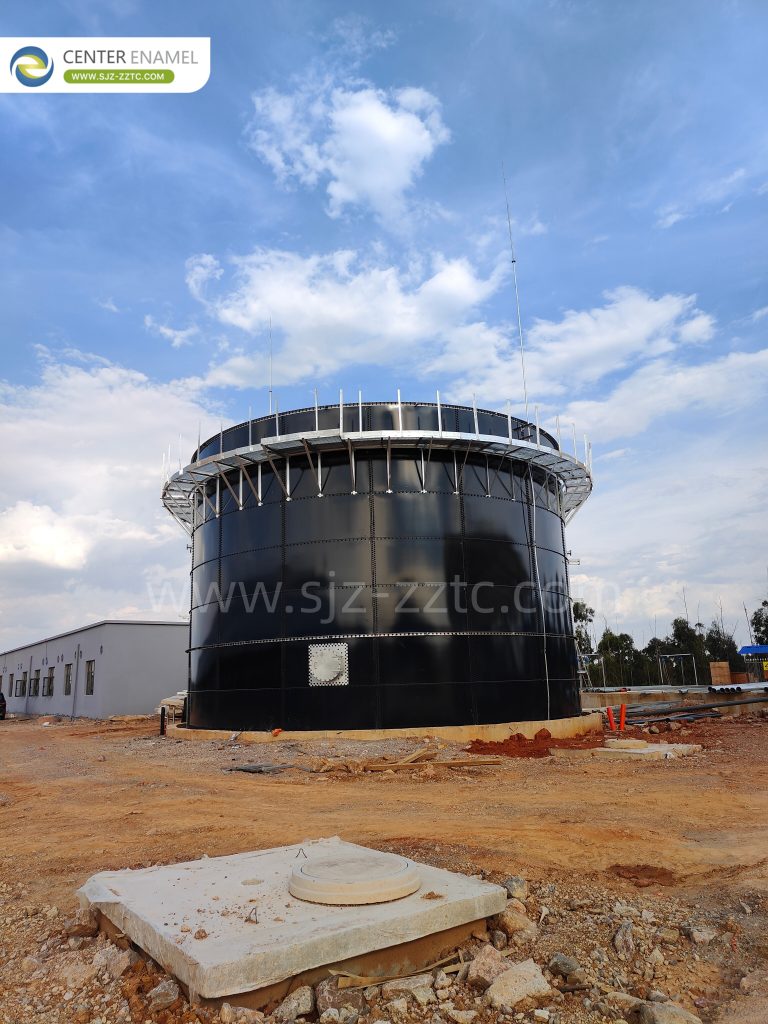
GFS Tanks are bolted steel tanks with a unique glass-fused-to-steel coating. This coating is fired at over 800°C, creating an inert, hard, and exceptionally corrosion-resistant surface. It provides outstanding protection against hydrogen sulfide (H₂S), organic acids, and ammonia, all of which are present in raw biogas and digestate. The tanks are modular, meaning all components are pre-manufactured in a factory and simply bolted together on-site.
This allows fast installation even in remote Myanmar locations where access to heavy fabrication equipment is limited. GFS Tanks have a proven service life of over 30 years and require very minimal maintenance. For most Biogas Project applications, the GFS tank body serves as the anaerobic digester itself.
The Double Membrane Roof is the preferred roof solution under normal working conditions for Biogas Project gas storage. Its main advantages include significant cost optimization-directly reducing the roof cost compared to solid steel structures-and excellent space efficiency. Compared to traditional fixed roofs, the Double Membrane Roof eliminates the need for a separate, ground-mounted gas holder, thereby saving valuable land area and reducing foundation construction costs. The outer membrane provides weather protection against rain, sun, and wind, while the inner membrane forms a variable-volume gas holder that rises and falls as biogas is produced and consumed.
However, under harsh environmental conditions such as the high wind speeds or heavy snow loads occasionally found in Myanmar's northern mountainous areas, a solid GFS roof is recommended. For tank diameters less than 23 meters, the GFS roof is also a viable option when a ground-mounted separate gas holder is specifically requested.
Overview of Auxiliary Equipment
In addition to the main digester and gas storage system, a complete chicken manure-to-biogas Biogas Project includes several essential auxiliary components. These are typically supplied by Center Enamel as part of a full package:
Gas Holder: Stores the produced biogas at low pressure before it is used or flared.
Black Membrane: Often used as an economical lining for lagoon-based post-treatment or long-term digestate storage.
Solid-liquid Separator: Mechanically separates the digested effluent into a solid fraction (used as animal bedding or organic fertilizer) and a liquid fraction (used for crop irrigation).
Torch System: Safely and automatically burns excess biogas during periods of low on-farm energy demand, preventing uncontrolled release.
Lifting Pump: Transfers waste and slurry between different treatment stages.
Dehydration and Desulfurization Tank: Removes water vapor and corrosive hydrogen sulfide gas from raw biogas to protect downstream engines, boilers, and pipelines.
Screw Sludge Dewatering Machine: Further reduces the moisture content of the solid digestate for easier handling, lower transport costs, and better fertilizer quality.
These pieces of equipment are integrated seamlessly with the GFS Tanks + Double Membrane Roof and the CSTR Process to form a complete, efficient treatment train.
Center Enamel's Efficient Equipment Installation Capability
Minimized farm downtime: Center Enamel's highly efficient installation capabilities are crucial for Myanmar poultry farms that want to avoid long operational interruptions.
Skilled workforce: The company employs over 500 people, including a dedicated, experienced installation workforce.
Modular, pre-engineered components: All tank and equipment components are designed to bolt together on-site using simple tools, completely eliminating complex on-site welding or fabrication.
Faster construction: This modular bolted approach reduces construction time by up to 50% compared to traditional cast-in-place concrete or welded steel tanks.
No heavy equipment needed: No heavy welding machines, cranes for welding, or specialized on-site fabrication workshops are required, which is a major advantage in rural Myanmar areas with limited infrastructure.
Fast delivery: The company's standard production capacity of 300,000 tank sheets per year ensures fast material delivery to any location in Myanmar.
Quality assurance: Center Enamel provides detailed, easy-to-follow installation drawings and offers on-site technical supervision to ensure every GFS Tanks + Double Membrane Roof and CSTR Process unit is assembled correctly, safely, and strictly on schedule.
Center Enamel: One-Stop Solution Provider for Full Biogas Projects in Myanmar
Center Enamel is not merely an equipment supplier; it is a complete one-stop solution provider for the entire Biogas Project. For a chicken farm in Myanmar, this means the client deals with a single, responsible contractor for everything-from the initial feasibility study and site assessment to final commissioning and operator training. Center Enamel provides a full range of services including process engineering design, equipment manufacturing, civil works guidance, mechanical installation, electrical and control systems, commissioning, and after-sales support.
Their Biogas Project solutions cover every single step: the pre-treatment stage (screening, crushing, sand settling), homogenization, the CSTR Process (anaerobic digestion), biogas treatment (dehydration and desulfurization), biogas storage using GFS Tanks + Double Membrane Roof, and final digestate handling with solid-liquid separators and screw dewatering machines.
This fully integrated, turnkey approach ensures that all components work harmoniously together, delivering the highest possible biogas yield at the lowest total cost of ownership. For Myanmar poultry farmers looking to turn a costly waste problem into a profitable energy and fertilizer business, Center Enamel offers a proven, reliable, and hassle-free path forward.
Conclusion
In summary, converting chicken manure into biogas offers Myanmar's rapidly growing poultry industry a sustainable, economically attractive way to reduce pollution, generate renewable on-farm energy, and produce valuable organic fertilizer. The combination of robust Biogas Project design, durable GFS Tanks + Double Membrane Roof, and the highly efficient CSTR Process provides the complete technical backbone for long-term success.
Center Enamel, with its 35+ years of global experience, proven track record, and complete turnkey services, stands fully ready to design, manufacture, deliver, and commission such plants across Myanmar. By adopting these modern technologies, Myanmar's chicken farmers can comply with environmental best practices, significantly improve their bottom line, and contribute to a cleaner, greener, and more energy-independent future.
Frequently Asked Questions (FAQs)
Q1: What is the typical payback period for a Biogas Project treating chicken manure in Myanmar?
A well-designed Biogas Project using the CSTR Process and GFS Tanks + Double Membrane Roof typically achieves a payback period of 3 to 5 years, depending on local electricity and fertilizer prices. The payback comes from savings on electricity, diesel, or firewood, plus income from selling excess organic fertilizer. Center Enamel provides detailed financial analysis for each farm's specific situation.
Q2: Does the CSTR Process require continuous power supply to operate the mixers?
While the mechanical mixers in the CSTR Process do require electricity, Center Enamel designs systems with energy efficiency in mind. The mixers operate intermittently rather than continuously, and the biogas produced can power a small generator to run the mixers and pumps. This means the Biogas Project can remain operational even during grid power outages in rural Myanmar.
Q3: Can the system handle chicken manure with high bedding material content like rice hulls?
Yes. The pre-treatment stage (screening and crushing) is specifically designed to handle bedding materials such as rice hulls, sawdust, and straw. The screen removes oversized particles, while the crusher breaks down remaining fibrous material. The CSTR Process with its mechanical mixing can digest moderate amounts of carbon-rich bedding along with the manure, and the solid-liquid separator will later remove fibrous material for use as organic fertilizer.