
Biogas Project Plant: Setting Gas Scale From The Feedstock Basis
A biogas project plant's scale is set by how much volatile solids are fed per day and how much gas those solids yield - not by a generic plant size. Fix the daily feed quantity and composition, convert to volatile solids, apply a documented specific yield, and you get a defensible gas scale. Anchoring the plant to a feed basis prevents the common error of buying a reactor sized for a feed that never arrives.
Feed Quantity And Composition Come First
The first design input is not a reactor; it is the feed: tonnes per day, dry matter and volatile solids fraction. Manure, food waste and straw differ sharply in VS and yield, so the same tonnage can produce very different gas. Characterize the feed before discussing plant size, and state whether the figure is design or actual - the two are often confused.
| Feed characteristic | Why it matters | Design use |
| Wet tonnes per day | Sets handling capacity | Feed system |
| Dry matter % | Concentrates the load | VS conversion |
| Volatile solids % of DM | Sets gas potential | Gas scale |
| Seasonal variation | Sets buffer need | Storage / equalization |
From Volatile Solids To Gas Scale
Daily volatile solids multiplied by a specific gas yield gives the expected daily gas. The yield must be tied to the actual feed and process; generic factors are only planning estimates and should be labelled as such. Once the gas scale is fixed, reactor volume follows from the retention time and loading rate the chosen process requires.
Design Scale Versus Actual Supply
A frequent failure is a plant designed for a feed quantity the site cannot consistently supply. If the feed falls short, the reactor is underloaded and gas output disappoints - not because the plant is wrong but because the basis was optimistic. Size to the feed you can contract and deliver, and provide buffer for the seasonal swings that are inevitable in agricultural supply.
| Basis | Definition | Risk if wrong |
| Contracted feed | Guaranteed supply | Basis for scale |
| Seasonal average | Year-round mean | Understates peak |
| Actual delivered | What really arrives | May underload plant |
An Agricultural Scale Reference
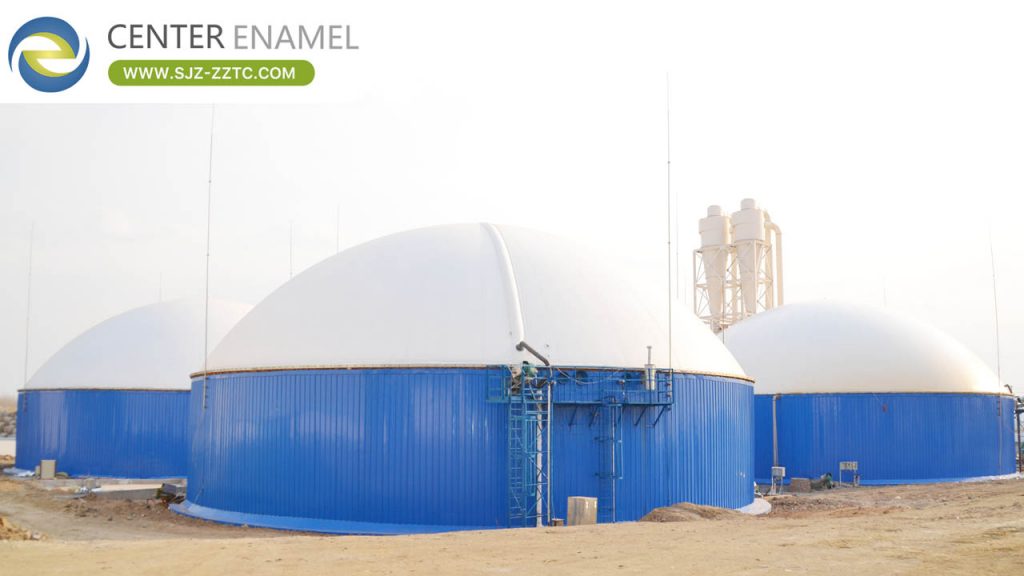
The library records a biogas project in Inner Mongolia feeding animal manure and grass straw with a reported daily output of 30,000 m3 of biogas. It is a real example of a gas scale tied to an agricultural feedstock. The source confirms feedstock and output; the volatile-solids figures and reactor dimensions are Not Specified in the Available Source, so the yield chain is not reconstructed here.
About Company
Shijiazhuang Zhengzhong Technology Co., Ltd (Center Enamel) is a comprehensive high-tech enterprise specializing in wastewater engineering, process section contracting, and equipment manufacturing. The company delivers biogas and wastewater projects through three main lines - EPC (turnkey) contracting, equipment supply, and process packages - covering livestock and municipal wastewater, biomass energy, industrial wastewater, and food waste. Its reactor portfolio spans CSTR, USR, UBF, UASB, IC, and EGSB, backed by in-house Glass-Fused-to-Steel tank manufacturing (enamel firing at 820-930 C) and certifications including ISO 9001, NSF/ANSI 61, and CE-EN 1090. With 35+ years of operation, a 150,000 m2 manufacturing base, and projects in 100+ countries, Center Enamel provides the single-responsibility engineering behind biogas plants sized from a documented feedstock basis - where daily gas scale follows volatile solids and contracted supply, not a generic capacity label.
Set biogas plant scale from the feed: daily tonnes, dry matter and volatile solids, applied with a documented yield. Design to the feed you can actually supply and buffer the seasonal swings.
Frequently Asked Questions
Q1: What sets a biogas plant's gas scale? A1: Daily volatile solids fed and the specific gas yield for that feed.
Q2: Why not size by tonnage alone? A2: Different feeds have very different VS and yield, so tonnage alone is misleading.
Q3: Are generic gas yields safe to use? A3: Only as planning estimates; the design yield must be tied to the actual feed and process.
Q4: What is the difference between design and actual feed? A4: Design is the contracted basis; actual is what arrives - confusing them causes underperformance.
Q5: How does reactor volume follow? A5: From the gas scale via retention time and organic loading rate.
Q6: Why buffer seasonal feed? A6: Agricultural supply swings; storage keeps the reactor fed at a steady rate.
Q7: What if feed falls short? A7: The reactor is underloaded and gas output drops - the basis was too optimistic.
Q8: Can output be claimed from the source alone? A8: Only if the source states it; otherwise it is Not Specified and not inferred.
Suggested CTA
Share your daily feed quantity and analysis with an engineer to set a defensible gas scale for your biogas plant.