
Center Enamel-Biogas Project Provider with High-Performance GFS Tanks for POME Treatment
The competitive landscape shows divergence, with leading companies building integrated service capabilities through technical integration and capital operations, and industry concentration gradually increasing. Chinese companies continue to consolidate their advantages in mid-tier equipment exports. International giants target high-end customers and complex industrial wastewater markets, while local players occupy the mid-to-low-end and industrial park centralized treatment markets with service responsiveness and cost advantages.
In the anaerobic process segment, UASB, EGSB, and IC anaerobic reactors, with advantages of high loading rates, small footprints, and stable operation, are widely used in high-concentration organic wastewater pretreatment in food processing, pharmaceutical fermentation, alcohol brewing, chemical, and other industries. These reactors use steel tank shells, and their corrosion resistance and gas-tightness directly determine long-term operational stability. As a trusted Biogas Project Provider, the application value of GFS Tanks in such scenarios is increasingly prominent.
CSTR Process Definition
CSTR, or Continuously Stirred Tank Reactor, is a suspended-growth continuous-flow anaerobic digestion process suitable for high-solids, high-concentration organic pollutant treatment, and is the most widely used classic anaerobic treatment technology. The process relies on a mechanical stirring system to solve the technical challenges of material stratification, sludge sedimentation, and surface crusting in traditional anaerobic reactors, achieving homogeneous mixing of wastewater, anaerobic sludge, functional microorganisms, and organic substrates throughout the reactor, ensuring full contact between microorganisms and pollutants. Unlike attached-growth anaerobic processes, CSTR requires no media carriers, relying on suspended sludge bacterial communities for degradation reactions. It withstands high-suspended-solids and high-viscosity wastewater shocks, making it the mainstream process for food waste, livestock manure, and municipal sludge anaerobic digestion. The process architecture is simple, operation logic straightforward, and it is adaptable to various high-pollution organic solid-liquid mixed systems, often implemented using robust GFS Tanks for maximum structural reliability.
Palm Oil Mill Wastewater Sources
Palm oil mill effluent (POME) originates from the entire processing chain of fresh fruit bunches (FFB) in palm oil milling-the highest pollution load and largest volume high-concentration organic industrial wastewater in tropical agricultural processing. Palm oil mills typically process 30-120 tons of FFB daily, generating approximately 0.5-1.0 m³ of wastewater per ton of FFB processed-single mills discharging hundreds to thousands of cubic meters daily, representing a core environmental challenge forтека the palm oil industry.
Wastewater comes from three main sources:
(1) Sterilization: FFB enter sterilization vessels for high-temperature steaming to deactivate lipase and prevent free fatty acid increase-producing sterilization condensate, the largest volume source at 80-90°C, rich in soluble sugars, amino acids, organic acids, COD 15,000-30,000 mg/L;
(2) Clarification: Pressed crude oil undergoes centrifugal separation and gravity settling to remove water and impurities-producing large volumes of oily wastewater with extremely high oil content and suspended solids, COD 50,000-80,000 mg/L, the highest organic load source;
(3) Kernel recovery: Palm kernels are separated by hydrocyclones and washed for recovery-producing sandy wash water with high suspended solids but relatively lower organic concentration. Auxiliary discharges include CIP cleaning, floor wash, boiler blowdown, and cooling tower water.
POME is acidic (pH 4.0-5.0), high-temperature (60-80°C), brown colloidal, rich in oils, suspended solids, colloidal proteins, and soluble sugars-a typical high-concentration, high-oil, high-suspended-solids organic industrial wastewater that requires specialized treatment engineering from an experienced Biogas Project Provider.
Malaysia Palm Oil Biogas Project
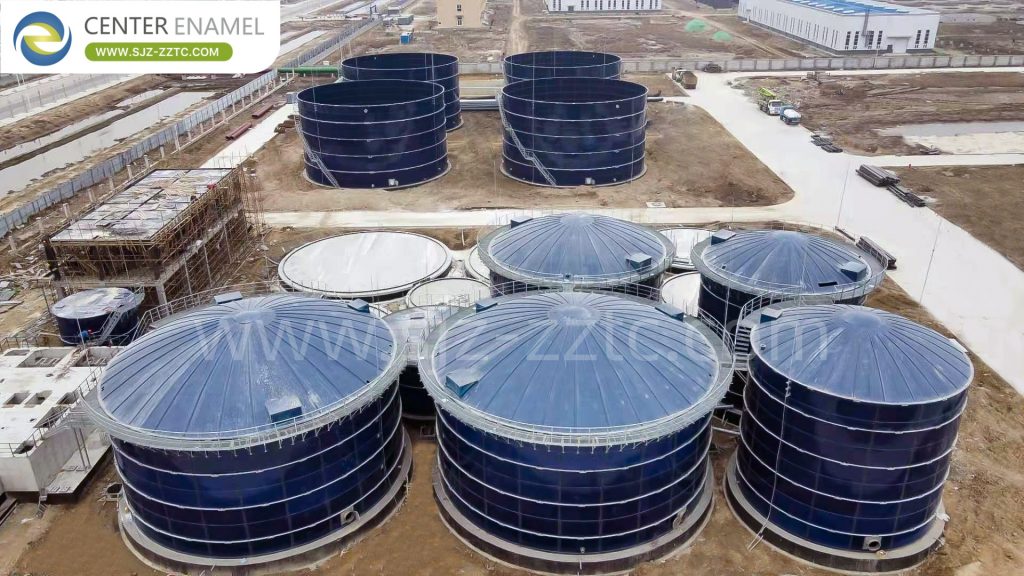
Demonstrating large-scale renewable energy execution, the project uses Center Enamel GFS Tanks as the core anaerobic digestion facility with 5 tanks, each with effective volume of 5,400 m³, total effective volume 27,000 m³. Influent COD ≥ 60,000 mg/L, BOD ≤ 25,000 mg/L. After anaerobic digestion, effluent COD drops to below 12,000 mg/L, BOD ≤ 5,000 mg/L-overall organic removal efficiency approximately 80%. Single tank daily biogas production 4,400 m³, total project daily biogas 22,000 m³-stable biogas yield of 0.45 m³ per kg COD removed-efficient biogas energy recovery while solving palm oil processing wastewater pollution, highlighting the technical strength of a premier Biogas Project Provider.
Professional Construction Team Manpower Reserve
To ensure seamless project delivery, Center Enamel has established its own domestic and international certified construction teams, with regular practical training on GFS Tanks installation and overseas construction standards for various countries. Domestically, regional construction teams cover multiple zones, capable of simultaneously deploying multiple teams for large tank farm projects. Internationally, cross-border professional installation teams are equipped to various country construction standards-sufficient manpower reserves ensure uninterrupted construction delivery for remote African sites, high-standard European/American facilities, and other complex engineering demands.
Dedicated Professional R&D Team
Center Enamel has built a full-chain professional team covering R&D, design, marketing, installation, and after-sales. The R&D team is led by national-level materials technology experts, specializing in enamel frit and tank anti-corrosion core technologies. External senior environmental engineering and mechanical structure engineers are retained to strengthen R&D capabilities, focusing on anti-corrosion coating formulations, specialty corrosion-resistant tanks, and anaerobic supporting integrated equipment-continuously breaking through industry technological barriers. The team operates through proprietary laboratories with external university research collaboration-conducting year-round new material and new process durability pilot testing and long-term corrosion simulation testing. Specialized enamel formulations are iteratively developed for extreme conditions such as high-salinity wastewater, strong acid/alkali POME, and high-organic livestock manure-providing core technical support for the company's annual new invention and utility patents.
Glass-Fused-to-Steel Roof Cover Solution
Glass-Fused-to-Steel Roof is a specialized tank cover solution designed for high air-tightness applications, primarily suited for CSTR anaerobic fermentation tanks and other biogas reactor tanks, serving as a core supporting component in organic waste anaerobic treatment projects. The roof is manufactured with the same material system as GFS Tanks, with steel substrate and high-temperature fused glass coating integrated into one unit.
The roof panel joints are equipped with specialized sealant strips and fasteners, achieving high-level overall air-tightness that completely seals biogas generated from anaerobic reactions inside the tank, preventing methane and odorous gas leakage while enabling biogas recovery and on-site odor control. The product resists long-term corrosion from fermentation liquid and acid/alkaline biogas slurry, and will not be corroded or delaminate due to microorganisms or sulfides in the anaerobic environment. Its service life is synchronized with the main tank structure, significantly reducing maintenance frequency and providing unmatched reliability for any global Biogas Project Provider.