
Advanced Biogas Solution Provider for Food Waste Treatment Projects Leveraging Cutting-Edge CSTR Process
The core challenges of industrial wastewater treatment center on the "three highs"-high difficulty, high cost, and high energy consumption. Wastewater from new energy, chemical, and pharmaceutical industries is complex in composition with numerous characteristic pollutants, and traditional treatment processes are difficult to remove effectively. Chinese companies have significant price advantages in the mid-to-low-end equipment segment. The industry also faces continuous technological upgrade pressure from increasingly stringent emission standards, as well as new requirements for digitalization and low-carbon transformation on operational refinement management capabilities.
As environmental regulations tighten globally, industrial sectors must continuously upgrade their facility infrastructure to meet rigorous compliance demands. Addressing these complex environmental hurdles requires robust engineering expertise and highly adaptable containment systems tailored to multi-condition operational workflows.
GFS Tanks Adaptable to Complex Operating Conditions Across All Industries
Center Enamel has independently developed over 200 specialized enamel frit formulations and supporting patents, capable of customizing anti-corrosion enamel based on customer storage media, with adaptability comprehensively superior to concrete tanks. Concrete tanks use a single material, only suitable for neutral clean water storage. When storing corrosive materials such as livestock manure, palm oil mill effluent, chemical wastewater, food waste digestate, high-salinity wastewater, etc., additional anti-corrosion linings must be applied. These linings are prone to failure, preventing long-term stable operation and cannot adapt to alternating high/low concentration storage conditions.
GFS tanks can be specifically formulated with specialized enamels resistant to strong acids, strong alkalis, high organic content, and high salinity. A single tank can switch between multiple wastewater and fermentation feedstock storage requirements. They are universally applicable across biogas anaerobic digestion, municipal wastewater, livestock farming, food processing, and industrial water treatment scenarios, eliminating the need to rebuild tanks for media changes, perfectly meeting the needs of diversified, multi-condition environmental protection projects.
Integrating versatile containment structures lays a solid physical foundation for complex biochemical reactions. To maximize organic waste degradation and energy generation efficiencies, implementing proven biological reactor designs is essential for modern plant optimization.
CSTR Applicable Scenarios
Primarily for high-solids organic pollutant treatment, widely used in food waste leachate, large-scale livestock manure, slaughterhouse wastewater, and food processing high-strength wastewater. Also suitable for municipal sludge and industrial organic sludge anaerobic digestion. In the agricultural and environmental sector, it is used for large-scale farm manure resource recovery, achieving wastewater reduction, harmless treatment, and energy recovery. In the food and brewing industry, it is suitable for high-oil, high-protein, high-suspended-solids wastewater. It is also suitable for small to medium-sized wastewater treatment projects, township decentralized wastewater treatment, and as a pretreatment process for high-strength organic wastewater in large industrial parks to reduce downstream load. It is particularly suitable for difficult-to-treat organic wastewater with complex composition, high solids content, and easy crusting.
Deploying specialized biochemical processes naturally leads to considerations regarding long-term operational expenditures and economic returns. Evaluating these lifecycle parameters ensures that resource recovery facilities maintain sustainable commercial viability alongside environmental compliance.
Food Waste Operation and Maintenance Cost Analysis
O&M costs are moderate to high, but resource recovery benefits are substantial-good overall economics. Pretreatment oil removal equipment and three-phase separators have high capital investment, but recovered oil can be sold-biodiesel feedstock oil has good market value, providing core revenue for food waste treatment. Stable biogas from anaerobic digestion can be used for power generation or heating, offsetting energy costs. CSTR process has simple equipment with no precision wear parts-low maintenance costs. High-salt, high-oil conditions require premium corrosion protection (GFS tanks), with higher initial investment but long service life and low maintenance. Chemical consumption is mainly flocculants and desulfurizers-moderate expenditure. Oil and salt cause pipe fouling and membrane pollution, requiring periodic cleaning-moderate labor requirements. Overall resource recovery revenues (oil sales + biogas energy + digestate fertilizer) generally cover O&M costs-good overall economics.
Real-world engineering applications validate the economic and structural feasibility of these advanced organic treatment frameworks. Examining established international benchmarks demonstrates how integrated anaerobic systems perform under rigorous field environments.
Indonesia Palm Oil Biogas Project
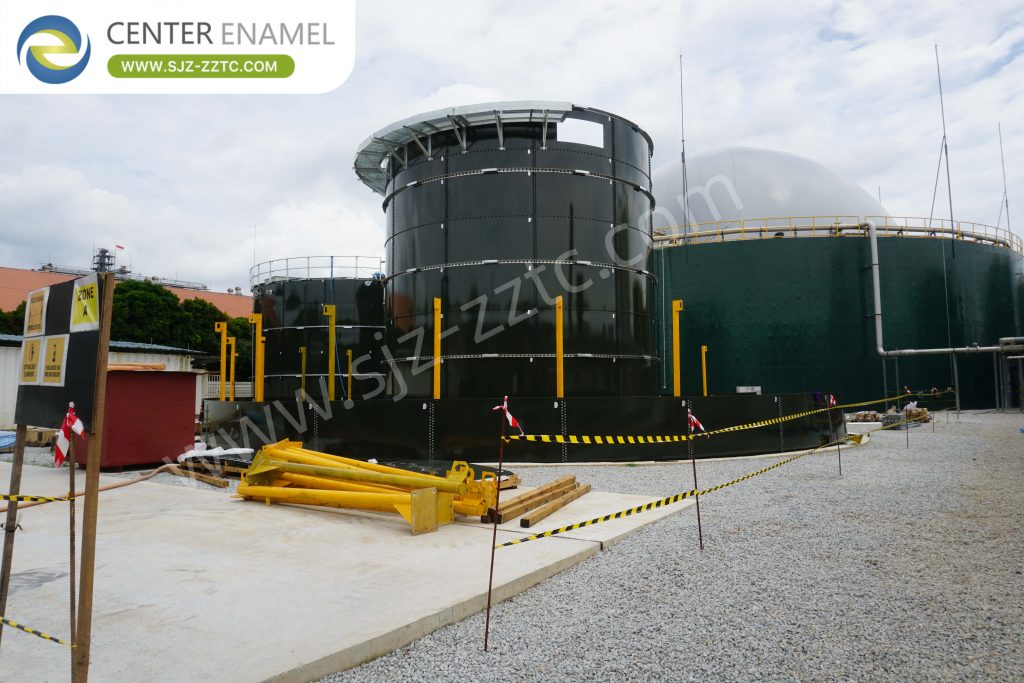
Specifically designed for high-concentration palm oil wastewater treatment with 3 GFS fermentation tanks, each 19.86 m diameter × 8.4 m height. Installation began November 2009 with only 7 construction personnel, completing all tank assembly in 40 days-highly efficient and time-saving. Tanks are fitted with dual-membrane gas storage covers for POME anaerobic digestion-degrading organics and recovering biogas energy while eliminating palm industry pollution. This is an early benchmark POME biogas treatment project in Southeast Asia.
The success of milestone regional initiatives reflects a broader corporate capability to scale innovations across international borders. Strategic global positioning ensures that cutting-edge environmental technologies reach diverse industrial markets worldwide.
Center Enamel's Global Market Presence
Center Enamel's global business covers over 100 countries and regions, with 30,000+ successful overseas projects. Products are exported to all major regions including Europe, the Americas, the Middle East, Africa, Southeast Asia, and Latin America, with a well-established global localized service network.
Domestically, the company is organized into North, South, Central, East, and Southwest marketing regions, covering environmental, water utility, livestock, and petrochemical customers nationwide. Internationally, the company adopts a "standardized products + localized adaptation" model-adjusting tank corrosion protection, sealing, and pressure standards for different national water quality and environmental regulations-with multiple global landmark projects: large-volume GFS tanks in Italy, 20 m tower water supply tanks in Colombia, coastal seawater treatment tanks in Costa Rica, large municipal wastewater aluminum dome projects in Saudi Arabia, etc. The company has established long-term stable strategic partnerships with many Fortune 500 companies.
Delivering complex environmental engineering solutions globally requires comprehensive logistical management and on-site execution capabilities. Seamless deployment networks guarantee structural integrity and operational readiness across any geographic terrain or climatic challenge.
Center Enamel Overseas Installation Coverage Countries and Delivery Capability
Center Enamel is the pioneer of Chinese GFS equipment exports, with installation service coverage across over 100 countries and regions-possessing full delivery capability across climates, regulations, and geographies.
Overseas coverage includes Southeast Asia (Vietnam, Thailand, Malaysia, Indonesia, Cambodia, Bangladesh, Nepal, etc.), Africa (Ghana, South Africa, Mali, Guinea, Zambia, Kenya, Pakistan, etc.), Europe/Americas (Sweden, USA, Russia, etc.), the Middle East, and Latin America-adaptable to tropical rainy high-salt spray, high-altitude mountainous, Nordic severe cold, and high-standard European/American facility conditions.
The company uses a dual-service model of "own cross-border construction teams + overseas local agent coordination"-whether clients are in developed countries or remote developing regions-providing one-stop services including on-site survey, on-site installation, process commissioning, and operator training. Complete coverage covers biogas engineering, municipal wastewater, industrial wastewater, livestock manure, drinking water storage, and other global mainstream environmental engineering projects-possessing the full delivery capability to undertake large-scale tank farm projects in any country worldwide.