
Comprehensive Biogas Solution Provider: Advancing Wastewater Treatment with GFS Tanks
Global industrial wastewater treatment policies are escalating from "compliance discharge" to mandatory "resource recovery" and "zero liquid discharge." The EU, through its Circular Economy Action Plan, requires member states to increase industrial wastewater reuse rates and extends carbon footprint accounting to the full life cycle of wastewater treatment. China continuously updates and tightening industrial water pollutant discharge standards, with increasingly stringent limits on total nitrogen, total phosphorus, and characteristic pollutants for industries such as chemicals, pharmaceuticals, and printing and dyeing. Some water-scarce regions and highly polluting industries are mandated to adopt zero or near-zero liquid discharge technologies. Germany has established a differentiated pretreatment technical standard system by industry, requiring industrial wastewater to meet specific quality requirements before discharge into municipal wastewater treatment plants, implementing strict source control.
As stringent environmental regulations reshape industrial compliance worldwide, selecting reliable infrastructure has never been more critical. Industrial operators increasingly rely on a trusted Biogas Solution Provider to navigate complex emission mandates while turning organic waste into valuable energy assets.
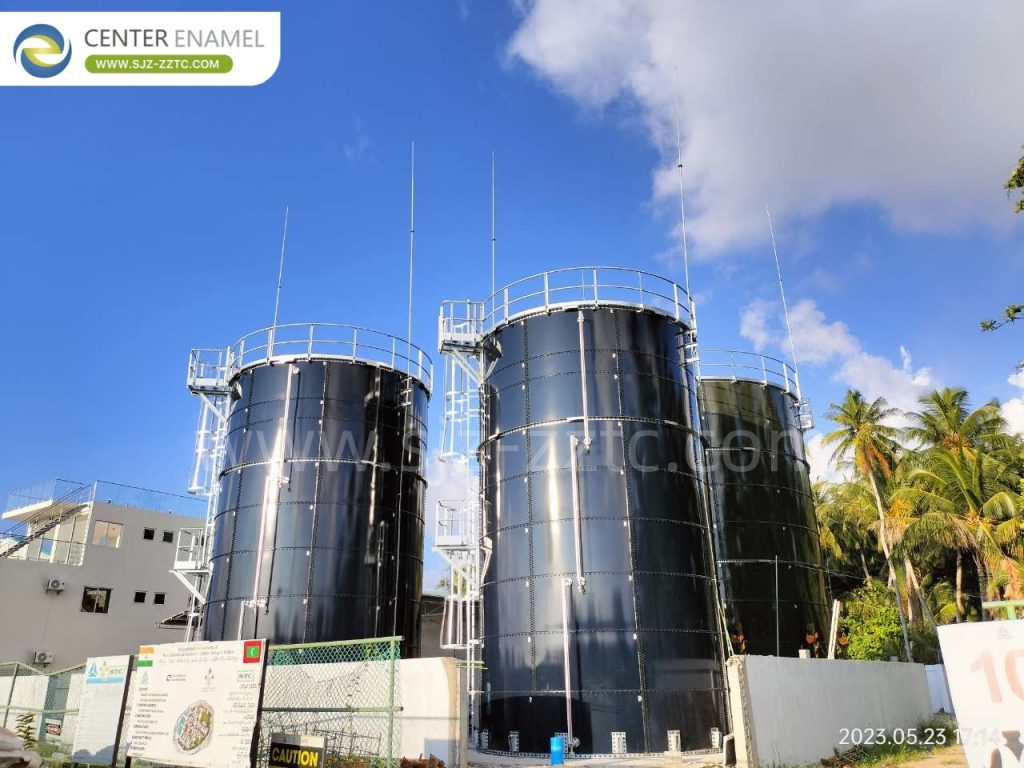
GFS tanks Bolted Assembly Construction
GFS tanks are assembled on-site from prefabricated panels, with short construction periods and support for expansion, relocation, and reuse-advantages distinctly different from immovable concrete tanks. Concrete tank pouring requires formwork, rebar tying, pouring, and long curing periods, with a single tank construction taking months. Rain, snow, and low temperatures force work stoppages and delays. Once poured, they are permanent fixed structures that cannot be dismantled, expanded, or relocated-project relocation means complete abandonment.
GFS tank panels are all factory-prefabricated, transported to site, and directly assembled in panels with simple procedures. Construction can proceed even in low-temperature, light-rain conditions, with installation time only one-third that of concrete tanks-construction schedules are controllable. For expansion, additional steel panels can be installed to increase volume; for plant relocation, tanks can be fully disassembled with panels transported to new sites for reassembly and reuse, significantly reducing material and construction costs for new construction and reconstruction. This is ideally suited for short-term environmental projects, phased expansion projects, and relocated construction projects.
Accelerating project timelines without sacrificing structural integrity requires advanced modular engineering. Incorporating high-performance GFS tanks into environmental facilities ensures rapid deployment, exceptional durability, and long-term cost efficiency.
Supporting Equipment in CSTR Process
The core equipment is a vertical sealed anaerobic reactor tank, with Center Enamel GFS tanks as the mainstream choice for high-corrosion, high-viscosity wastewater conditions. The key operating equipment is a low-speed mechanical stirrer, comprising motor, gearbox, and impeller blades, achieving uniform mixing throughout the reactor and preventing sedimentation and crusting. Supporting equipment includes corrosion-resistant feed pumps, flow control valves, and inlet piping for precise feed flow control; biogas collection systems (piping, water seals, dual-membrane gas holders, desulfurization units) for biogas collection, purification, and storage. Online monitoring equipment for temperature, pH, and liquid level is integrated for real-time reaction parameter monitoring. Sludge discharge pumps, return piping, and emergency drain systems complete the equipment package, with convenient operation and maintenance, low failure rates, and support for long-term continuous stable operation.
Optimizing biological treatment performance relies heavily on seamless equipment integration within the reactor system. A comprehensive Biogas Solution Provider ensures that every component-from mixing units to gas holders-operates in perfect harmony to maximize energy recovery.
Palm Oil Mill Effluent Standardized Treatment Solutions
Core treatment uses a mature train of "oil separation/cooling pretreatment + CSTR/USR anaerobic digestion + aerobic treatment + advanced treatment"-perfectly suited for POME's high-concentration, high-oil, high-temperature, low-pH characteristics.
Pretreatment: Raw POME first enters oil separation tanks/oil separators to remove free and dispersed oil-recovered palm oil can be sold as a resource, significantly reducing organic load. Cooling towers/heat exchangers reduce temperature from 60-80°C to 35-38°C for mesophilic anaerobic digestion. Lime/NaOH addition adjusts pH from 4.0-5.0 to 6.8-7.2 for optimal anaerobic conditions. Screens and sedimentation tanks remove fruit shell fibers, fruit pulp residues, and other large suspended solids to prevent distribution system and pipe clogging.
Main anaerobic treatment: Center Enamel CSTR or USR anaerobic reactors with GFS tanks as core reaction equipment, suited to POME's high-concentration, high-oil, high-suspended-solids conditions. CSTR mechanical mixing addresses oil floating layers, suspended solids sedimentation, and surface crusting-the three major challenges-ensuring thorough material-microbe contact. USR simplifies internal structure with anti-clogging, high-solids tolerance-suited for high-suspended-solids POME. Single GFS anaerobic tank effective volume 3,000-10,000 m³, with multiple tanks configurable for different mill capacities. Anaerobic digestion HRT 20-30 days, COD removal 80-90%, BOD removal 85-92%, with simultaneous large-volume biogas production.
Aerobic treatment: Anaerobic effluent still has COD 3,000-10,000 mg/L-requiring aerobic polishing. A/O, A²O, or SBR processes further degrade residual organics and remove nitrogen/phosphorus, reducing COD to 200-500 mg/L and BOD to 50-100 mg/L. Advanced treatment: Depending on discharge standards or reuse requirements, BAF, coagulation/sedimentation, sand filtration, or constructed wetlands reduce COD to below 100 mg/L and ammonia to below 10 mg/L for irrigation reuse or surface discharge compliance.
Biogas utilization: POME anaerobic digestion produces exceptionally high biogas yields-8-15 m³ biogas per m³ wastewater-after desulfurization and dehydration, biogas can be used for CHP, meeting 30-50% of mill electricity demand, with waste heat used for digester heating and FFB sterilization preheating-achieving energy self-sufficiency.
Addressing challenging industrial effluents like palm oil mill wastewater demands proven, large-scale engineering methodologies. Utilizing robust GFS tanks within specialized treatment trains effectively neutralizes high organic loads while converting waste streams into renewable power.
Malaysia Palm Oil Biogas Project
The project uses Center Enamel GFS tanks as the core anaerobic digestion facility with 5 tanks, each with effective volume of 5,400 m³, total effective volume 27,000 m³. Influent COD ≥ 60,000 mg/L, BOD ≤ 25,000 mg/L. After anaerobic digestion, effluent COD drops to below 12,000 mg/L, BOD ≤ 5,000 mg/L-overall organic removal efficiency approximately 80%. Single tank daily biogas production 4,400 m³, total project daily biogas 22,000 m³-stable biogas yield of 0.45 m³ per kg COD removed-efficient biogas energy recovery while solving palm oil processing wastewater pollution.
Real-world implementations validate the exceptional performance of industrial anaerobic systems under demanding operational conditions. As an industry-leading Biogas Solution Provider, Center Enamel consistently delivers high-capacity projects that turn environmental challenges into profitable clean energy ventures.
Full-Category Complete Product Matrix of Center Enamel
Center Enamel has built a complete product matrix of "core storage tanks + supporting covers + specialty pressure vessels + complete environmental engineering services"-the only company globally to achieve integrated enamel frit R&D, self-manufacturing, and GFS tank application.
- Core: Proprietary GFS Tanks Using proprietary double-sided hot-rolled double-layer enamel anti-corrosion technology-resistant to strong acids/alkalis, high salinity, and microbial corrosion-modular quick assembly-suitable for all strong-corrosion conditions in wastewater, biogas, and chemical applications.
- Supporting: Fusion Bonded Epoxy Tanks Produced on China's first intelligent standardized production line-primarily for drinking water, fire water, and neutral medium storage.
- Sealing: Aluminum Dome Covers Proprietary high-strength aluminum alloy self-supporting structure-meeting international waterproof and load-bearing standards-suitable for tank sealing and biogas collection.
- Other Tanks: Carbon Steel Tanks, Stainless Steel Tanks, Composting Tanks, Various Non-Standard Pressure Vessels.
- Engineering Services: Environmental EPC General Contracting, Anaerobic Process Section Subcontracting-one-stop coverage across food waste, leachate, municipal wastewater, livestock biogas, petrochemical/metallurgical, and seawater desalination industries-customizable tank volume, corrosion protection grade, and complete process solutions with integrated equipment manufacturing and engineering construction.
Delivering turnkey environmental projects requires an extensive product ecosystem built on manufacturing excellence and quality assurance. Superior engineering standards and versatile GFS tanks form the bedrock of a complete portfolio designed to meet diverse global industrial requirements.
Global Integrated Standardized Service System
Leveraging regional sales centers in China and overseas local agent networks, Center Enamel has established a complete after-sales service loop covering all markets. The system provides four core service pillars: 24/7 rapid response mechanism, on-site domestic/overseas installation services, full-project-cycle after-sales support, and long-term warranty protection-forming a complete service chain from preliminary site survey, mid-term construction management, to long-term inspection and maintenance. The entire system is uniformly adapted to both domestic and international project service standards, coordinating personnel scheduling, material support, and on-site coordination for simultaneous projects across multiple regions-significantly reducing customer multi-party coordination costs and ensuring efficient domestic and overseas project delivery.