
How a Trusted Biogas Solution Provider Uses GFS Tanks for Global Food Waste Treatment
The Asia-Pacific region, particularly China, has become the world's largest industrial wastewater treatment market, with the operation and maintenance service segment's contribution continuing to rise-marking a shift from project construction to long-term operational management. The North American market focuses on upgrading existing facilities, while Europe emphasizes high-value-added resource recovery technologies. Wastewater from the new energy industry chain (lithium batteries, photovoltaics, hydrogen) has become the most notable emerging growth area due to its complex composition and high treatment difficulty, generating significant demand for customized solutions.
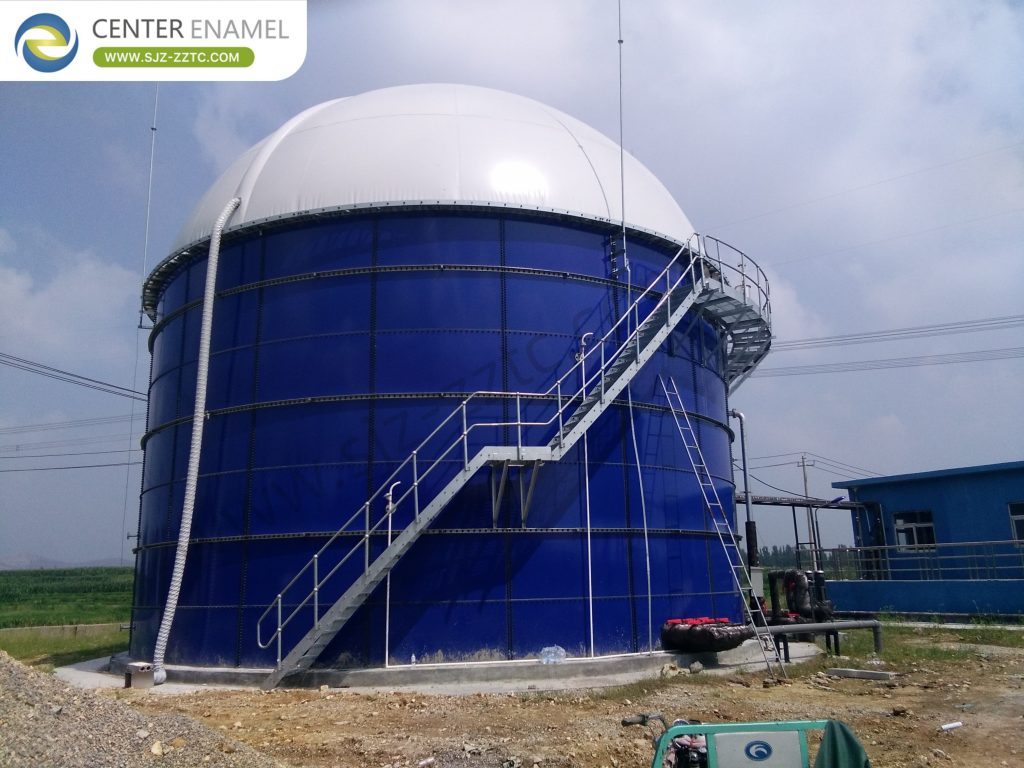
Meeting these diverse regional demands requires more than equipment supply-it requires an experienced Biogas Solution Provider with proven GFS Tanks and advanced process integration. This article explores how Center Enamel delivers end-to-end solutions across regional markets, compact plant layouts, USR process advantages, food waste treatment, and real-world project performance.
GFS Tanks Adaptable to Modern Intensive Plant Layouts
GFS tanks offer flexible customization of size and appearance, with higher land utilization rates, ideally suited for modern compact plant layouts, with significant advantages over fixed poured concrete tanks. Concrete tanks cannot alter volume or shape after pouring, with heavy bases occupying large areas, making placement difficult on narrow or irregular plots. Their rough, uniform appearance cannot match modern facility aesthetic requirements.
GFS tank volume can be precisely customized as needed, with capacities ranging from dozens of cubic meters to 50,000 cubic meters freely selectable. Tank height and diameter can be flexibly combined to fit narrow or irregularly shaped plots, effectively saving plant land occupation. Enamel color customization is also supported, achieving visual harmony with plant buildings and environmental facilities. During later plant expansion, GFS tanks can be directly adjusted in layout and expanded; concrete tanks, being monolithic structures, must be demolished and rebuilt, offering less flexibility in land resource utilization. This aligns well with the intensive construction and aesthetic operation and maintenance needs of industrial parks.
USR Process Advantages for High-Solids Wastewater
High solids tolerance, clog resistance, and strong adaptability make the USR Process perfectly suited for high-suspended-solids, high-impurity, high-solids organic wastewater. Extremely simple equipment structure, no precision wear parts, low capital investment, long service life, virtually no clogging failures, and extremely low subsequent maintenance costs.
No strict requirements on sludge morphology-no need to cultivate mature granular sludge, flocculent sludge can operate stably, with fast start-up and short sludge acclimation period for rapid commissioning. Gentle hydraulic disturbance results in low sludge washout and high sludge utilization, with stable organic pollutant degradation. Simple operation with low automation requirements and high error tolerance, suitable for remote sites, farms, and other settings with limited O&M capabilities-outstanding stability and practicality advantages.
Food Waste Environmental Toxicity of Pollutants
Pollutants are primarily natural organics with no synthetic toxic chemicals-low acute chemical toxicity, but biological pollution and eutrophication risks are significant. High-concentration oil discharged to natural waters forms a surface film blocking oxygen exchange, causing aquatic organism suffocation; oil adheres to gills and body surfaces, directly harming fish. High salinity causes osmotic imbalance in freshwater organisms, inhibiting growth and reproduction. High-concentration organics decompose consuming dissolved oxygen, causing oxygen depletion and black-odor conditions. Food waste decomposition breeds pathogens, flies, and parasite eggs-posing public health risks. Long-term discharge causes oil scaling and pipe blockages, corrosion of sewer systems. Digestate with high nitrogen/phosphorus causes rapid eutrophication and algal blooms. Overall pollution is primarily organic pollution and ecological damage, with no heavy metal or persistent organic accumulation risks-environmental recovery periods are relatively short.
Bangladesh Poultry Farm Manure Resource Recovery Project
This benchmark project targets local poultry farm manure resource recovery with daily treatment of 47 tons. Influent COD, BOD, and SS were as high as 50,000 mg/L, 25,000 mg/L, and 50,000 mg/L. After CSTR + UASB anaerobic treatment, all three parameters were reduced to below 200 mg/L, 100 mg/L, and 100 mg/L-effluent compliant with local environmental discharge standards. The project produces approximately 4,900 m³ biogas daily-each m³ biogas can generate 2 kWh of electricity, with daily power generation of 9,800 kWh-simultaneously achieving pollutant reduction and clean energy recovery. This is a benchmark project for livestock waste recycling in Southeast Asia.
Bangladesh Poultry Farm Manure Project Performance Data
| Parameter | Influent | Effluent | Removal Rate |
| COD | 50,000 mg/L | <200 mg/L | >99.6% |
| BOD | 25,000 mg/L | <100 mg/L | >99.6% |
| SS | 50,000 mg/L | <100 mg/L | >99.8% |
| Daily Treatment | 47 tons | - | - |
| Daily Biogas | 4,900 m³ | - | - |
| Daily Power Generation | 9,800 kWh | - | - |
Installation and Construction Team Excellence
The installation team has practical experience from over 10,000 GFS tank projects globally, strictly following standardized construction procedures-full control over project mobilization, civil coordination, tank assembly, piping, and commissioning schedules and quality.
The team is proficient in complete standardized installation processes for GFS tanks, dual-membrane gas storage covers, USR/CSTR/IC anaerobic reactors, and biogas desulfurization/piping systems-adaptable to large-scale farms, industrial parks, remote mountainous sites, coastal high-corrosion sites, and other complex locations-strictly implementing unified global safety construction standards. For large overseas cross-border projects, the team can be deployed as complete units for on-site construction, technical training, and local worker practical instruction-full control over construction details, air-tightness testing, and corrosion protection-ensuring timely and stable commissioning of global environmental projects through standardized delivery capability.
Extensive Global Benchmark Project Cases
Center Enamel's project portfolio covers over 100 countries across Southeast Asia, Africa, Europe, and the Americas-30,000+ mature projects-accumulating complete industry solutions across palm oil, livestock, municipal, brewing, and food waste biogas-rapidly matching customized solutions for different regional climates, water quality, and regulations.
Center Enamel Global Project Portfolio
| Region | Countries/Regions | Industry Solutions | Project Scale |
| Southeast Asia | Vietnam, Thailand, Malaysia, Indonesia, Bangladesh, etc. | Palm oil, livestock, food waste biogas | 30,000+ total projects |
| Africa | Ghana, South Africa, Mali, Guinea, Zambia, Kenya, etc. | Municipal, livestock, drinking water | 100+ countries covered |
| Europe/Americas | Sweden, USA, Russia, etc. | Industrial wastewater, biogas | 10,000+ GFS tank projects |
| Middle East | Multiple countries | Advanced treatment, reuse | 2,000+ wastewater projects |
| Latin America | Multiple countries | Municipal, industrial | 1,000+ biogas projects |
As a trusted Biogas Solution Provider, Center Enamel combines GFS Tanks with proven process integration to deliver reliable results across every region and industry.
FAQ
1. What makes GFS Tanks suitable for modern compact plant layouts?
GFS tanks offer flexible volume customization from dozens to 50,000 cubic meters, with adjustable height and diameter to fit narrow or irregular plots. They support enamel color customization and can be directly expanded during plant expansion-unlike concrete tanks that must be demolished and rebuilt.
2. What are the key advantages of the USR Process for high-solids wastewater?
The USR Process offers high solids tolerance, clog resistance, and strong adaptability. It requires no complex three-phase separators, no granular sludge cultivation, and has low capital investment with minimal maintenance costs-ideal for remote sites and farms with limited O&M capabilities.
3. How does Center Enamel support global biogas projects as a Biogas Solution Provider?
Center Enamel has 30,000+ projects across 100+ countries, with installation teams experienced in GFS tanks, dual-membrane covers, and USR/CSTR/IC reactors. The company provides full-cycle support from design to commissioning, with standardized delivery for complex sites worldwide.
Ready to partner with a trusted Biogas Solution Provider for your next GFS Tanks project? Contact Center Enamel today for a customized solution covering design, manufacturing, installation, and long-term O&M support.
With 30,000+ projects across 100+ countries, we turn complex wastewater challenges into compliant, resource-recovery success. Reach out now and let's build your next project together.