
How a Biogas Solution Provider Uses GFS Tanks to Solve Livestock Manure Challenges
Livestock manure treatment is one of agriculture's most persistent environmental problems-and one of its greatest untapped energy opportunities. Solving it requires more than a single product; it demands an integrated approach that combines durable containment, proven biological processes, and expert execution. As an experienced Biogas Solution Provider, Center Enamel delivers exactly this combination, pairing high-performance GFS Tanks with the USR process to help farms convert waste into biogas while meeting strict discharge standards. This guide examines the core industry challenges, the climate resilience of GFS Tanks, the advantages of the USR process, and the global project experience that underpins every installation.
The Core Dilemma Facing Livestock Manure Treatment Today
The core dilemma of livestock manure treatment lies in the structural contradiction of "decentralized generation vs. centralized treatment." Manure generation surges during intensification, but supporting treatment facilities lag behind. Digestate resource utilization channels are obstructed, with safety risks from heavy metal and antibiotic residues constraining farmland application.
At the enforcement level, farmers' environmental awareness varies, with illegal discharges occurring frequently. At the policy level, subsidies and incentives are insufficient to effectively drive voluntary compliance. Biogas grid connection difficulties and limited digestate transport radius further compress the economic viability of resource utilization.
These interconnected barriers explain why so many manure treatment projects stall. Overcoming them requires a Biogas Solution Provider capable of addressing technology, durability, and operational simplicity together-precisely the role Center Enamel fills with its GFS Tanks and USR-based systems.
GFS Tanks Built to Withstand Extreme Climates and Seismic Loads
Any long-life biogas project depends on containment that survives its environment. GFS Tanks can undergo customized wind and seismic design based on project site climate and geological conditions, with environmental adaptability far superior to concrete tanks. Concrete tanks are cast-in-place monolithic structures, with seismic and wind resistance entirely dependent on on-site construction quality. In remote areas, typhoon-prone zones, and earthquake belts, construction quality is difficult to control. Under strong earthquakes or typhoons, concrete tanks are prone to cracking and base settlement damage, with subsequent reinforcement costs equivalent to rebuilding.
GFS Tanks take a fundamentally different approach. Before construction, local seismic intensity, maximum wind pressure, and foundation bearing capacity data are collected, with customized thickened steel panels, stiffening ribs, and anchored base components-all factory-prefabricated to standardized specifications. The bolted panel structure has excellent stress distribution capability, making it less prone to overall fracture under seismic and typhoon impacts, and minor foundation settlement will not cause through-cracking. Structural parameters can be flexibly adjusted for mountainous, coastal typhoon-zone, and high-seismic-zone projects, providing long-term protection against extreme natural climate damage. This resilience is a defining advantage for a Biogas Solution Provider operating across diverse global markets.
USR Process Advantages for High-Solids Organic Wastewater
Durable tanks need an equally robust biological process. The USR process offers high solids tolerance, clog resistance, and strong adaptability, perfectly suited for high-suspended-solids, high-impurity, high-solids organic wastewater. Its equipment structure is extremely simple, with no precision wear parts, low capital investment, long service life, virtually no clogging failures, and extremely low subsequent maintenance costs.
The process places no strict requirements on sludge morphology-there is no need to cultivate mature granular sludge, as flocculent sludge can operate stably, with fast start-up and a short sludge acclimation period for rapid commissioning. Gentle hydraulic disturbance results in low sludge washout and high sludge utilization, with stable organic pollutant degradation. Operation is simple with low automation requirements and high error tolerance, suitable for remote sites, farms, and other settings with limited O&M capabilities-outstanding stability and practicality advantages. For any Biogas Solution Provider serving rural and remote farms, this combination of simplicity and reliability is indispensable.
Understanding the Environmental Toxicity Profile of Livestock Wastewater
Effective treatment also requires understanding what is-and is not-in the waste. Livestock wastewater contains no synthetic chemical toxicity and no hazardous substances, meaning a very low risk of acute or chronic toxicity. Pollution impacts are primarily biological and nutrient pollution. All pollutants are natural organics from livestock metabolites and feed residues, with no inhibition of microbial activity and no toxicity to soil, water, or aquatic organisms.
However, the wastewater is rich in nitrogen, phosphorus, and suspended impurities, carrying E. coli, parasite eggs, and pathogens. Direct discharge without treatment rapidly causes eutrophication, black-odor conditions, mosquito breeding, and disease transmission. Long-term discharge causes soil compaction and elevated nutrient levels in groundwater-persistent ecological pollution, but with no hazardous substance accumulation or carcinogenic or mutagenic risks. This profile confirms that the right GFS Tanks and anaerobic treatment approach can safely and effectively neutralize the real risks.
Proven Performance-The Bangladesh Poultry Farm Reference Project
The combined strengths of GFS Tanks and anaerobic treatment are best illustrated by real results. The Bangladesh Large-Scale Poultry Farm Manure Resource Recovery Project targets local poultry farm manure resource recovery with daily treatment of 47 tons.
Influent COD, BOD, and SS measure as high as 50,000 mg/L, 25,000 mg/L, and 50,000 mg/L. After CSTR + UASB anaerobic treatment, all three parameters are reduced to below 200 mg/L, 100 mg/L, and 100 mg/L-effluent compliant with local environmental discharge standards. The project produces approximately 4,900 m³ of biogas daily. Each cubic meter of biogas can generate 2 kWh of electricity, with daily power generation of 9,800 kWh-simultaneously achieving pollutant reduction and clean energy recovery. This is a benchmark project for livestock waste recycling in Southeast Asia.
Table 1: Bangladesh Poultry Farm Manure Recovery Project-Performance Data
| Parameter | Influent | After Anaerobic Treatment | Outcome |
| COD | 50,000 mg/L | Below 200 mg/L | >99.6% removal |
| BOD | 25,000 mg/L | Below 100 mg/L | >99.6% removal |
| SS | 50,000 mg/L | Below 100 mg/L | >99.8% removal |
| Daily Treatment | 47 tons poultry manure | - | - |
| Biogas Output | 4,900 m³/day | - | - |
| Power Generation | 9,800 kWh/day | - | 2 kWh per m³ biogas |
Installation and Construction Expertise That Protects Your Investment
Even the best-designed system depends on precise execution. The Center Enamel installation team has practical experience from over 10,000 GFS tank projects globally, strictly following standardized construction procedures-full control over project mobilization, civil coordination, tank assembly, piping, and commissioning schedules and quality.
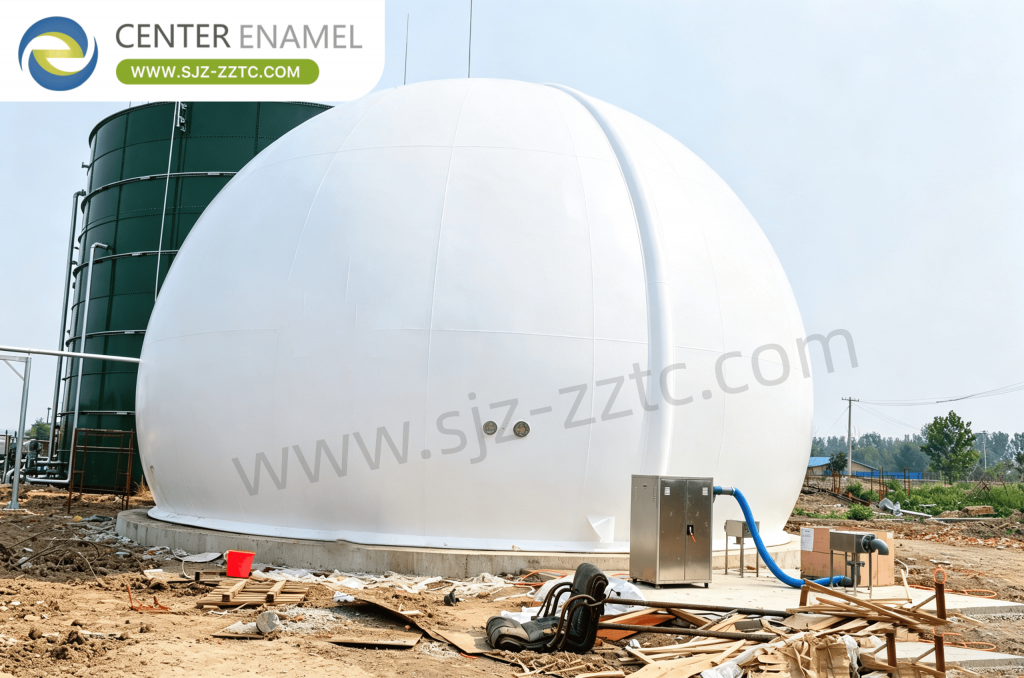
The team is proficient in complete standardized installation processes for GFS tanks, dual-membrane gas storage covers, USR/CSTR/IC anaerobic reactors, and biogas desulfurization and piping systems-adaptable to large-scale farms, industrial parks, remote mountainous sites, coastal high-corrosion sites, and other complex locations-strictly implementing unified global safety construction standards. For large overseas cross-border projects, the team can be deployed as complete units for on-site construction, technical training, and local worker practical instruction-full control over construction details, air-tightness testing, and corrosion protection-ensuring timely and stable commissioning of global environmental projects through standardized delivery capability. This field-proven execution is what distinguishes a reliable Biogas Solution Provider from a mere equipment supplier.
Global Benchmark Projects Across 100+ Countries
The depth of this experience is reflected in the company's global footprint. Center Enamel's project portfolio covers over 100 countries across Southeast Asia, Africa, Europe, and the Americas-30,000+ mature projects-accumulating complete industry solutions across palm oil, livestock, municipal, brewing, and food waste biogas. This enables rapid matching of customized solutions for different regional climates, water quality, and regulations.
Table 2: Center Enamel Global Capability Overview
| Capability Area | Specification | Client Benefit |
| Global Reach | 100+ countries | Localized solutions worldwide |
| Project Experience | 30,000+ projects | Proven across diverse sectors |
| Installation Team | 10,000+ GFS tank projects | Standardized, high-quality delivery |
| Product Range | GFS tanks, membrane covers, USR/CSTR/IC reactors | Complete system integration |
| Industry Coverage | Palm oil, livestock, municipal, brewing, food waste | Rapid solution matching |
| Climate Adaptation | Mountainous, coastal, typhoon, high-seismic zones | Long-term structural protection |
From extreme-climate GFS Tanks to field-proven USR process integration, Center Enamel delivers the complete package that livestock manure projects demand. Contact our team today to discuss your project requirements and receive a customized biogas solution. Let us show you why farms and developers in over 100 countries trust Center Enamel as their Biogas Solution Provider.
Frequently Asked Questions
Why choose GFS Tanks over concrete for biogas projects?
GFS Tanks are factory-prefabricated, corrosion-resistant, and withstand seismic and typhoon loads. They avoid the cracking and settlement risks of cast-in-place concrete, especially in remote or extreme sites.
What makes the USR process suitable for livestock manure?
USR tolerates high solids and impurities, resists clogging, requires no granular sludge, and operates simply-ideal for farms with limited O&M capabilities and fluctuating wastewater loads.
How does Center Enamel support overseas biogas projects?
As a global Biogas Solution Provider, we deploy complete installation units, provide technical training, and follow unified safety standards across 100+ countries, ensuring timely commissioning.