
How a Biogas Solution Provider Uses GFS Tanks to Turn Food Waste into Clean Energy
Food waste is one of the most difficult feedstocks in anaerobic digestion-high in oil, salt, suspended solids, and organic load, yet low in synthetic toxicity and highly biodegradable. This paradox makes it an ideal candidate for biogas recovery, provided the containment system and process design can withstand its aggressive characteristics.
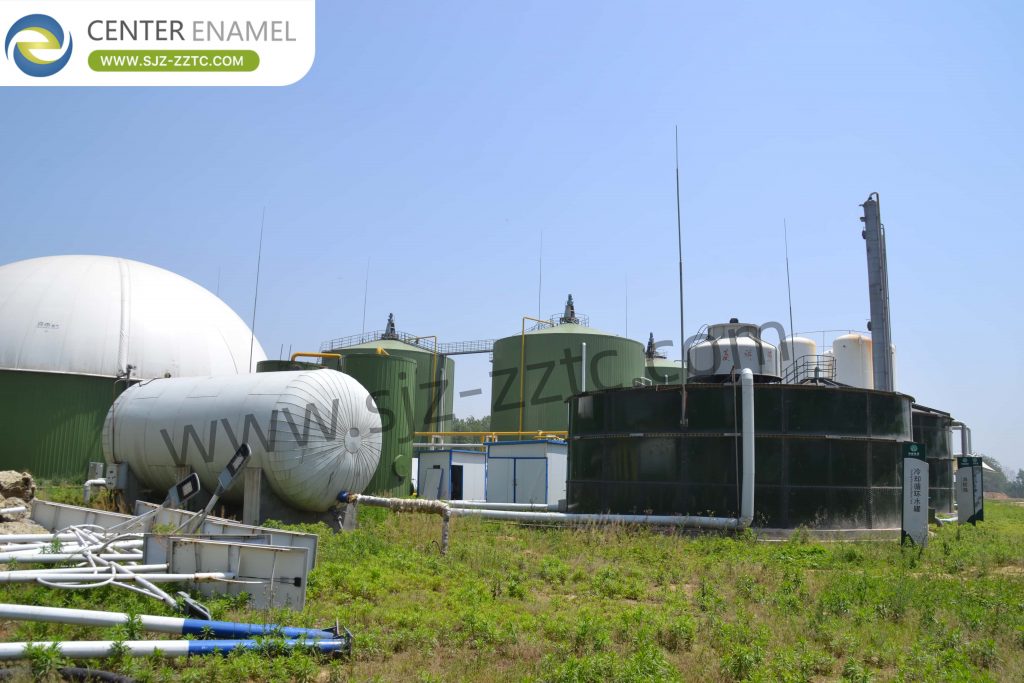
As a specialized Biogas Solution Provider, Center Enamel combines corrosion-resistant GFS Tanks with proven anaerobic process engineering to convert food waste from an environmental burden into biogas, compliant effluent, and recovered resources. This article explains the industry challenges driving demand for such solutions, why GFS Tanks outperform conventional concrete containment, how the USR Process handles difficult feedstocks, and what full-process quality control means for long-term project performance.
The "Three Highs" Defining Industrial Wastewater Today
Any discussion of food waste treatment must begin with the broader industry context. The core challenges of industrial wastewater treatment center on the "three highs"-high difficulty, high cost, and high energy consumption. Wastewater from new energy, chemical, and pharmaceutical industries is complex in composition with numerous characteristic pollutants, and traditional treatment processes struggle to remove them effectively. Chinese companies have established significant price advantages in the mid- to low-end equipment segment. The industry also faces continuous technological upgrade pressure from increasingly stringent emission standards, as well as new requirements for digitalization and low-carbon transformation on operational refinement management capabilities. These pressures are precisely what drive demand for integrated solutions-a Biogas Solution Provider must deliver not only treatment performance but also cost control, energy recovery, and long-term operational stability. Food waste sits at the center of this challenge: its high organic content makes biogas recovery attractive, but its oil, salt, and solids content punishes any equipment not specifically designed for harsh conditions.
Why GFS Tanks Outlast Concrete in Corrosive Wastewater Environments
Containment is the foundation of any biogas project, and it is where conventional materials most often fail. Center Enamel's independently developed double-sided double-layer enameling technology represents the industry's leading coating anti-corrosion solution, with corrosion resistance completely surpassing traditional concrete tanks.
Concrete tank interiors are inherently riddled with pores, allowing wastewater and acid/alkaline media to easily penetrate and corrode the structural layer. Long-term exposure leads to irreversible problems including internal wall spalling, water seepage, and rebar corrosion-issues that are difficult to repair and cannot be fundamentally resolved. GFS Tanks address this directly through high-temperature enameling on both interior and exterior surfaces of steel panels, creating a dense, non-porous enamel finish that completely blocks corrosive liquids and biogas permeation. The enamel layer possesses extremely strong chemical stability, resisting acids, alkalis, salts, and microbial corrosion.
The operational difference is decisive. Concrete tanks typically develop extensive corrosion and leakage after 5–8 years of use, while GFS Tanks anti-corrosion service life can exceed 30 years, with no need for frequent internal lining repairs throughout the service life. This significantly reduces long-term anti-corrosion maintenance investment and fundamentally eliminates environmental risks of medium leakage contaminating sites and groundwater. Compared to traditional concrete and FRP tanks, GFS Tanks coatings have no risk of peeling or blistering and are adaptable to highly corrosive conditions such as palm oil mill effluent, livestock manure, and chemical high-salinity wastewater. For a Biogas Solution Provider, this durability translates directly into project economics: fewer unplanned shutdowns, lower maintenance budgets, and reliable gas production over decades of operation.
USR Process Advantages for High-Solids Organic Waste
With containment secured, process design determines treatment performance. The USR Process offers high solids tolerance, clog resistance, and strong adaptability, making it perfectly suited for high-suspended-solids, high-impurity, high-solids organic wastewater. Its equipment structure is extremely simple, with no precision wear parts, resulting in low capital investment, long service life, virtually no clogging failures, and extremely low subsequent maintenance costs.
The process imposes no strict requirements on sludge morphology-there is no need to cultivate mature granular sludge, as flocculent sludge can operate stably, enabling fast start-up and a short sludge acclimation period for rapid commissioning. Gentle hydraulic disturbance results in low sludge washout and high sludge utilization, with stable organic pollutant degradation. Operation is simple with low automation requirements and high error tolerance, making the USR Process suitable for remote sites, farms, and other settings with limited O&M capabilities-outstanding stability and practicality advantages. For food waste specifically, these characteristics matter enormously: the feedstock varies with season, collection volume, and dietary habits, and a process that tolerates fluctuation without failing is far more valuable than one that achieves peak performance only under ideal conditions.
Environmental Risks of Food Waste Pollutants
Understanding why food waste requires careful treatment reinforces the value of a properly designed biogas solution. Food waste pollutants are primarily natural organics with no synthetic toxic chemicals-low acute chemical toxicity, but biological pollution and eutrophication risks are significant. High-concentration oil discharged to natural waters forms a surface film blocking oxygen exchange, causing aquatic organism suffocation; oil adheres to gills and body surfaces, directly harming fish. High salinity causes osmotic imbalance in freshwater organisms, inhibiting growth and reproduction. High-concentration organics decompose consuming dissolved oxygen, causing oxygen depletion and black-odor conditions. Food waste decomposition breeds pathogens, flies, and parasite eggs-posing public health risks. Long-term discharge causes oil scaling and pipe blockages, plus corrosion of sewer systems. Digestate with high nitrogen and phosphorus causes rapid eutrophication and algal blooms. Overall pollution is primarily organic pollution and ecological damage, with no heavy metal or persistent organic accumulation risks-meaning environmental recovery periods are relatively short when treatment is implemented promptly. This combination of high impact and high treatability is exactly what makes food waste an attractive feedstock for biogas recovery rather than mere disposal.
Full-Process Installation Quality Control Backed by Global Project Data
Even the best-designed system depends on disciplined execution. Demonstrating high-standard installation quality through long-term stable global project performance, Center Enamel has established full-chain quality control standards across four dimensions: factory protection, on-site assembly construction, completion inspection, and long-term warranty-ensuring quality control for every GFS Tanks unit.
At the factory stage, all enameled panels, seals, and structural components receive rust-proof and moisture-proof independent packaging with dedicated protective supports-preventing damage during sea and land transport and avoiding enamel coating damage. On-site construction strictly follows unified assembly process specifications-panel by panel tightening and leak testing in layers, with air tightness and verticality testing after each tank section completion. Dual-membrane covers and anaerobic piping undergo simultaneous pressure testing and acceptance.
Differentiated quality acceptance standards are customized for different regions: EU and US projects follow stringent CE/NSF inspection criteria; Southeast Asian hot humid regions receive enhanced corrosion protection and sealing acceptance; remote African sites have additional foundation settlement re-inspection procedures. Upon project completion, complete construction inspection reports, pressure test records, and anti-corrosion appearance acceptance documents are issued, with full photo and video archives retained.
Global Delivery and Quality Control Metrics
| Metric | Value |
| Countries served | 100+ across Southeast Asia, Africa, Europe, and the Americas |
| Mature projects delivered | 30,000+ |
| Tanks delivered globally | Over 10,000 |
| Long-term performance record | No large-scale leakage or structural deformation |
| Industry solutions accumulated | Palm oil, livestock, municipal, brewing, and food waste biogas |
Over 10,000 tanks delivered globally have operated long-term without large-scale leakage or structural deformation-preventing future O&M issues at source. This track record is what allows a Biogas Solution Provider to offer performance guarantees rather than mere equipment supply.
FRP Roof Cover Solution for Atmospheric Storage Applications
Not every tank in a treatment facility requires gas-tight sealing, and matching the right cover to the right application controls cost without compromising performance. The FRP Roof is a general-purpose economical roof for atmospheric pressure storage tanks without air-tightness requirements, suitable for drinking water storage, agricultural irrigation water, firewater reserve, and general production wastewater temporary storage. It is available in two styles-flat and dome-allowing flexible selection based on tank specifications and site aesthetic requirements.
The roof is integrally molded from resin and fiberglass, lightweight, with natural water resistance and mild acid/alkali corrosion resistance. It will not rust or rot in long-term humid environments, eliminating the frequent anti-corrosion maintenance required for metal roofs. The dome style features excellent drainage performance due to its curved structure, resisting water accumulation, dust buildup, snow load, and strong winds. The flat style facilitates the installation of maintenance walkways, level gauges, and vents on top, making inspection and operation convenient.
The product is fully insulated with no risk of galvanic corrosion, will not contaminate drinking water quality, and meets environmental standards for domestic water storage. The modular design with low individual component weight allows for simple on-site hoisting and assembly, offering high construction efficiency and affordable procurement and installation costs. It is only suitable for atmospheric pressure water storage tanks without biogas collection or pressurization requirements, and is not recommended for anaerobic fermentation gas-producing conditions. It is widely used in rural agricultural water storage tanks, industrial park firewater tanks, waterworks buffer tanks, and small to medium-sized domestic wastewater temporary storage facilities-making it a cost-effective general-purpose roof choice for conventional water storage applications.
Looking for a Biogas Solution Provider who can guarantee both containment and gas production? Center Enamel delivers integrated GFS Tanks and anaerobic process systems under one contract. Send us your feedstock analysis and treatment targets for a customized proposal and ROI estimate.
Frequently Asked Questions
Q: How does a Biogas Solution Provider turn food waste into energy?
Food waste is fed into anaerobic reactors where microorganisms produce biogas. Center Enamel's GFS Tanks provide gas-tight, corrosion-resistant containment, while the USR Process tolerates high solids and oils-converting waste into biogas for electricity and heat.
Q: Why are GFS Tanks preferred over concrete for biogas projects?
GFS Tanks use non-porous enamel coatings that resist acids, salts, and oils. Concrete corrodes and leaks within 5–8 years, while GFS Tanks last 30+ years with minimal maintenance-protecting biogas yield and eliminating groundwater contamination risk.
Q: What quality control does Center Enamel apply to GFS Tanks?
We enforce four-stage quality control: factory protective packaging, on-site leak and verticality testing, completion inspection with documented records, and long-term warranty. Regional standards adapt to EU/US, Southeast Asian, and African conditions.