
How a Biogas Solution Provider Uses Anaerobic Digestion to Treat Chemical Wastewater
For a long time, chemical wastewater was treated purely as a disposal problem-a toxic, high-strength stream to be neutralized and discharged. Today, the most forward-looking plant owners are beginning to see it differently: the same dissolved organic load that makes the stream so difficult is, in fact, stored chemical energy that can be recovered as biogas. As an established Biogas Solution Provider, Center Enamel designs and builds complete anaerobic digestion systems that capture that energy while meeting strict discharge limits. The sections below explain why chemical effluent carries such ecological risk, how the IC reactor turns that burden into usable fuel, and what a delivered project actually looks like in the field.
The Global Demand Behind Every Chemical-Wastewater Plant
Before engineering any reactor, it is worth understanding where the market pressure comes from. The Asia-Pacific region, led by China, is already the world's largest industrial wastewater treatment market, with operation and maintenance services contributing a rising share-a clear shift from one-off construction toward long-term asset management. North America focuses on retrofitting aging facilities, while Europe emphasizes high-value resource recovery. The most striking emerging segment is the new-energy supply chain itself: wastewater from lithium-battery, photovoltaic and hydrogen production is growing fastest precisely because its composition is so complex and hard to treat.
The Middle East is driving advanced treatment and reuse under severe water scarcity, and manufacturing transfer into Southeast Asia is fueling new-build demand. This regional spread matters for a Biogas Solution Provider: a design approved for a temperate Chinese site cannot simply be copied to a tropical coastal or arctic-cold location without re-engineering tanks, covers and insulation. That is why Center Enamel standardizes the process logic but tailors the physical package site by site.
Why Chemical Wastewater Carries Such Ecological Risk
The reason so much engineering effort goes into this stream is that chemical wastewater has the strongest environmental toxicity and highest ecological risk of any industrial effluent. Benzene-series compounds, phenols, cyanides and halogenated hydrocarbons at even moderate concentrations are acutely toxic to aquatic life and inhibitory or lethal to the microbial communities on which biological treatment depends. Phenols and cyanides can kill fish directly; halogenated hydrocarbons and polycyclic aromatic hydrocarbons are persistent organic pollutants that bioaccumulate and carry carcinogenic, teratogenic and mutagenic risk.
High-salinity discharge damages soils and mineralizes groundwater; heavy metals accumulate in sediments and magnify up the food chain; some streams even contain endocrine disruptors that disturb aquatic reproduction at trace concentrations. The implication for design is direct: you cannot dilute your way out of this problem, and you cannot rely on a single polishing step. You need a biological core-anaerobic digestion-powerful enough to remove the bulk of the organic load before any downstream discharge, and engineered so that toxic shocks do not wash out the active biomass.
How Anaerobic Digestion Turns Toxic Load Into Biogas
That biological core is where anaerobic digestion earns its place. Inside an anaerobic reactor, a consortium of methanogenic bacteria breaks down dissolved organic matter in the absence of oxygen, converting COD into methane-rich biogas rather than wasting it as excess sludge. For chemical wastewater, this is a double win: the organic load entering the downstream aerobic stage shrinks dramatically, cutting aeration energy, and the recovered biogas can displace boiler gas or generate electricity.
A well-run anaerobic digestion line also produces far less waste sludge than purely aerobic treatment, lowering dewatering and disposal costs over decades of operation. Of course, anaerobic digestion is not a stand-alone silver bullet-it must be fed by proper equalization, pH buffering and, where toxicity requires, upstream oxidation or dilution. As an integrated Biogas Solution Provider, Center Enamel engineers the whole train: equalization, the IC reactor, biogas cleaning, aerobic polishing and the surrounding GFS tank farm-as one accountable package.
Why the IC Reactor Is the Preferred Workhorse
Among anaerobic digestion configurations, the IC (Internal Circulation) reactor is the one most often selected for large-flow, high-concentration chemical wastewater. Its advantages over traditional anaerobic processes are summarized below.
| Performance Dimension | Traditional Anaerobic Process | IC Reactor |
| Footprint (same capacity) | Baseline | Only ~1/3 of conventional |
| Internal mixing | External pumps / weak | Gas-lift self-circulation, no external return pumps |
| Shock-load resistance | Moderate | Strong hydraulic & organic shock tolerance |
| Zone layout | Single reaction zone | Dual-zone: high-load degradation + polishing |
| Sludge quality | Prone to washout | Highly granulated, active, low washout |
| Biogas output | Moderate | Large yield, strong resource recovery |
| Long-term O&M cost | Higher | Far lower over the asset life |
The dual-zone design pairs an efficient lower reaction bed with an upper polishing chamber, so effluent quality stays stable even when influent fluctuates. High automation, low failure rates and the absence of external recirculation hardware further reduce operating labor. These characteristics are exactly why large-scale chemical, POME and livestock biogas projects specify IC as the anaerobic digestion core rather than older UASB or contact-digestion alternatives.
GFS Bolted Tanks: Built to Outlast Concrete on Site
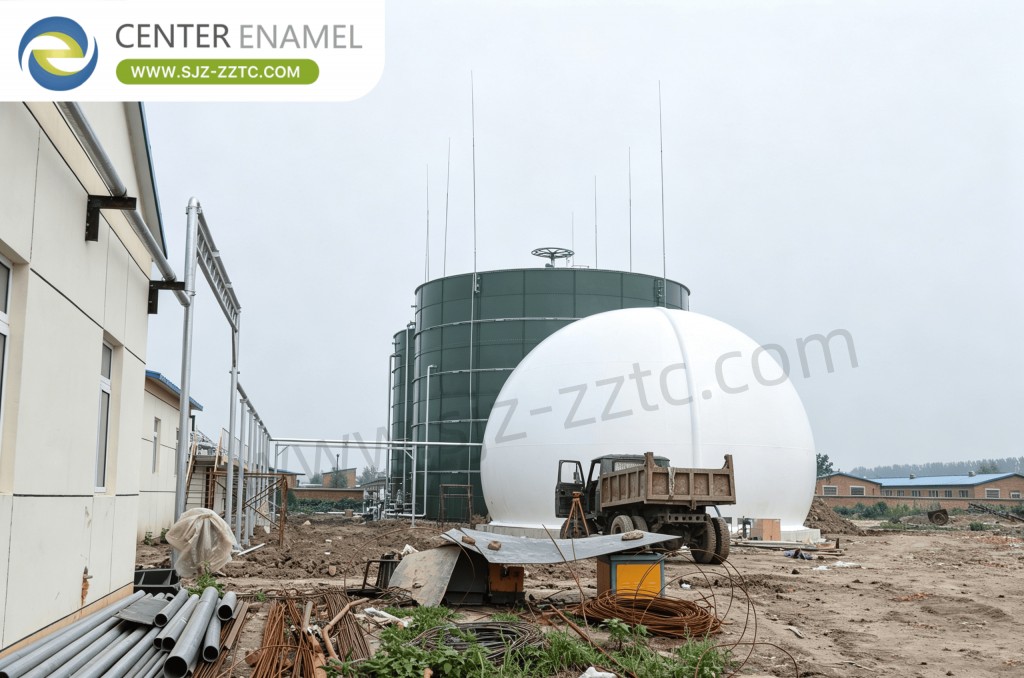
An IC reactor is only as good as the vessel that holds it. Center Enamel builds its anaerobic reactors and equalization tanks from factory-prefabricated GFS (glass-fused-to-steel) panels bolted together on site-a construction method that behaves very differently from poured concrete.
A concrete tank demands formwork, rebar, pouring and a long cure cycle; a single vessel can take months, and rain, snow or low temperature halts work entirely. Once poured, it is a fixed permanent structure that cannot be expanded, dismantled or moved. GFS panels, by contrast, arrive prefabricated and bolt together on site in roughly one-third the time, and work continues even in light rain or low temperatures. If capacity needs to grow, extra panels are simply added; if the plant relocates, the whole tank can be unbolted, shipped and reassembled at the new site. For phased projects, temporary environmental sites and remote construction locations, that flexibility is a decisive cost and schedule advantage-and the enamel lining itself is the corrosion-resistant interface that makes the tank survive chemical wastewater for decades.
A Proven Reference: Pakistan Food Waste + Napier Grass Demo
The cleanest evidence that anaerobic digestion performs under real field conditions is a project already handed over and running. Center Enamel served as general contractor on a food-waste plus Napier grass biogas demonstration project in Pakistan, using a CSTR as the core anaerobic digestion reactor. Key delivery parameters are listed below.
| Item | Project Detail |
| Project location | Pakistan (government demonstration site) |
| Center Enamel scope | General contractor / EPC |
| Core anaerobic process | CSTR co-digestion |
| Feedstock | Food waste + Napier grass |
| Mixing system | Mechanical agitation, full reactor volume |
| Stable biogas output | 100 m³/day |
| Project purpose | Validate gas yield & long-term operating stability |
| Follow-up pipeline | Multiple larger Napier-grass biogas plants planned locally |
The plant runs stably and acts as the local official demonstration for gas-production efficiency and continuous operation. After successful pilot, several larger-scale Napier grass biogas projects are planned in the region to scale biomass clean energy and support regional low-carbon development.
Backed by 10,000+ Installations Across 100+ Countries
Delivering that kind of project on schedule depends on the crew on the ground. Center Enamel's installation team draws on hands-on experience from more than 10,000 GFS tank projects worldwide, following standardized procedures across mobilization, civil coordination, tank assembly, piping and commissioning. The crew is proficient in GFS tanks, dual-membrane biogas storage covers, USR/CSTR/IC anaerobic reactors and biogas desulfurization and piping systems-and can be deployed as complete units to large farms, industrial parks, remote mountain sites and coastal high-corrosion locations, carrying out on-site construction, technical training and air-tightness and corrosion testing under unified global safety standards.
That site capability sits inside a much larger track record: Center Enamel's portfolio spans over 100 countries across Southeast Asia, Africa, Europe and the Americas, with more than 30,000 delivered projects covering palm oil, livestock, municipal, brewing and food-waste biogas. The accumulated playbook lets the team rapidly match a customized anaerobic digestion and GFS tank solution to each region's climate, water quality and discharge code-rather than learning on the client's budget.
FAQs
Q1: Is anaerobic digestion suitable for high-toxicity chemical wastewater?
Yes, provided upstream pretreatment (oil separation, oxidation, dilution) reduces inhibitor levels; the IC reactor then handles bulk COD and recovers biogas, with aerobic polishing for final compliance.
Q2: Why do Biogas Solution Providers choose GFS tanks over concrete?
GFS panels bolt together on site in about one-third the construction time, tolerate bad weather, and can be expanded or relocated; the enamel lining also resists the acids, salts and corrosion of biogas and wastewater service.
Q3: What biogas processes does Center Enamel supply?
Center Enamel supplies IC, UASB, CSTR and USR anaerobic digestion reactors, dual-membrane gas holders, GFS tanks and full biogas EPC scope for chemical, POME, livestock and food-waste projects.
Send us your influent COD, flow rate and discharge target, and our engineers will come back with a preliminary anaerobic digestion process layout and GFS tank configuration tailored to your site.
Contact Center Enamel today to turn your high-strength chemical wastewater or agro-waste stream into a compliant, energy-positive biogas project-delivered by a Biogas Solution Provider with 30,000+ references across 100+ countries.