
Biogas Solutions for Treating Biogas Plant Wastewater with Anaerobic Digestion
The global biogas industry competitive landscape shows divergence, and this directly influences how biogas solutions are designed and delivered. Leading companies dominate major project market shares through the "EPC + Operation" integrated model, while small and medium-sized enterprises focus on county-level distributed projects and specialized equipment segments.
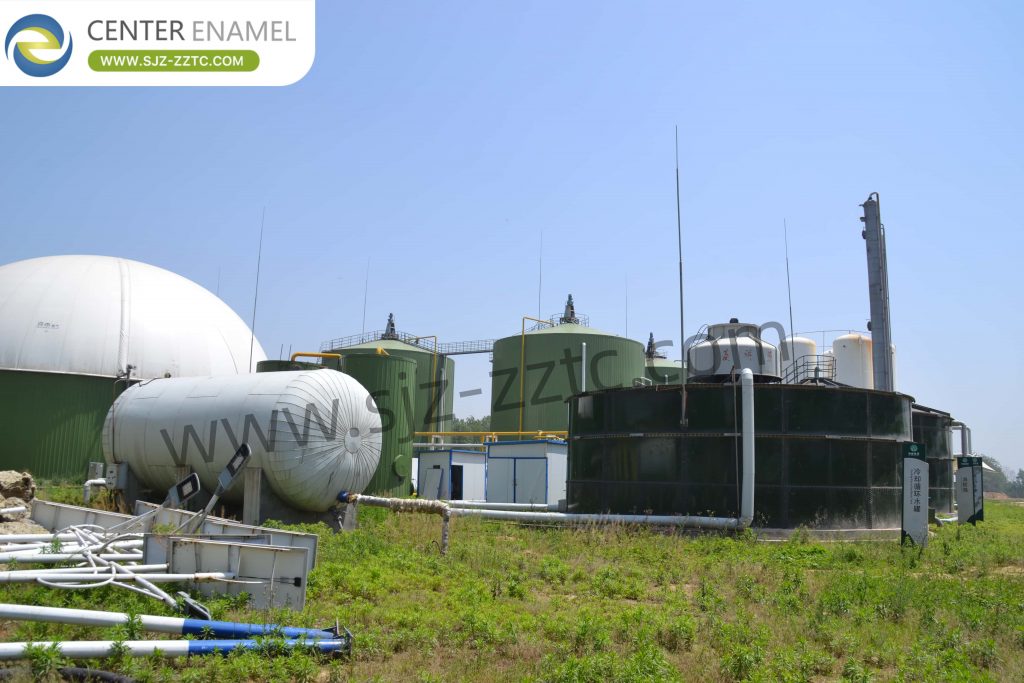
China's biogas equipment exports continue to expand, with generator sets primarily flowing to emerging markets. Business model innovation is accelerating, with carbon asset development becoming a standard feature of large projects, converting methane emission reductions into tradable carbon credits. Some countries have piloted digestate fertilizer carbon credit trading, encouraging the integration of digestate application to farmland with carbon accounting. The "biogas operation outsourcing" service model is emerging, improving operational efficiency of county-level projects through professional management.
From a technology and equipment perspective, anaerobic digestion is the core process of biogas engineering. Glass-fused-to-steel (GFS) tanks, with their excellent sealing, corrosion resistance, and construction convenience, have become the mainstream choice for large anaerobic digestion tanks. Their modular design can be combined with membrane gas holders to form an integrated "fermentation + gas storage" solution, with penetration rates continuing to rise in new projects in biogas industry clusters.
| Market Trend | Impact on Biogas Solutions |
| "EPC + Operation" integrated model | Larger contracts, longer service cycles |
| Carbon asset development | New revenue from methane reduction credits |
| Digestate fertilizer carbon credits | Farmland application linked to carbon accounting |
| Biogas operation outsourcing | Professional management of county-level projects |
| GFS tank + membrane gas holder | Integrated fermentation and gas storage design |
USR Reaction Process: How Anaerobic Digestion Handles High-Solids Wastewater
Within anaerobic digestion, the USR reaction process is specifically engineered for high-solids organic wastewater. After simple pretreatment to remove large debris, wastewater is uniformly fed into the reactor through the bottom distribution system.
The upward flow drives solid substrates and anaerobic sludge to slowly rise and thoroughly mix. In the sealed anaerobic environment, microorganisms sequentially hydrolyze/acidify and then methanogenically ferment, degrading macromolecular organic pollutants and generating biogas and treated water. Without complex separation structures, gentle hydraulic disturbance prevents clogging.
The mixed liquor rises to the upper portion of the reactor where natural gas-liquid-solid separation occurs. Biogas is collected, effluent overflows, and solid sludge and unreacted substrate settle back to the lower reaction zone for continued reaction. A small amount of aged sludge is periodically discharged, ensuring continuous stable operation.
| Process Stage | What Happens | Outcome |
| Pretreatment | Removal of large debris | Protection of downstream equipment |
| Bottom distribution | Uniform feed into reactor | Even hydraulic loading |
| Upflow mixing | Solids and sludge rise together | Thorough substrate-sludge contact |
| Hydrolysis/acidification | Microorganisms break down macromolecules | Liquefaction of organic matter |
| Methanogenesis | Methanogenic fermentation | Biogas generation |
| Gas-liquid-solid separation | Natural separation at upper zone | Biogas collected, effluent overflows, sludge settles |
Biogas Plant Wastewater Sources: Understanding What Needs Treatment
Biogas plant wastewater is secondary wastewater from organic waste resource recovery-primarily digestate from anaerobic digestion, distinct from primary production wastewater. Understanding these sources is essential for designing effective biogas solutions.
It originates from anaerobic digestion of livestock manure, crop straw, food waste, and brewery residues, as a byproduct of biogas fermentation. Auxiliary wastewater includes equipment washing, digester tank cleaning, desulfurization system drainage, and plant floor washdown. Production is continuous and stable, with only minor variations with feedstock input and fermentation cycles.
Pollutants are significantly transformed through anaerobic digestion, with composition distinct from primary high-concentration organic wastewater-it is the core wastewater requiring treatment in biogas plants.
| Wastewater Source | Origin | Treatment Consideration |
| Digestate | Byproduct of anaerobic digestion of manure, straw, food waste, brewery residues | High ammonia nitrogen, high phosphorus, moderate salinity |
| Equipment washing water | Tank and equipment cleaning | Lower organic load, variable volume |
| Digester tank cleaning water | Periodic maintenance | High solids, intermittent discharge |
| Desulfurization system drainage | Biogas purification | Specific contaminants, requires targeted treatment |
| Plant floor washdown | General housekeeping | Low concentration, easily combined with other streams |
Smart Manufacturing Base: The Production Backbone Behind Biogas Solutions
Center Enamel's core intelligent manufacturing base is located in Hebei Province, China, covering a total area of over 150,000 m². It includes Phase I mature manufacturing facility and Phase II high-end environmental equipment industrial park-dual-base synergy ensures stable production capacity.
| Facility Feature | Specification |
| Total area | Over 150,000 m² |
| Base structure | Phase I manufacturing + Phase II high-end equipment park |
| Quality systems | ISO, NSF, CE, and other international standards |
| Environmental certification | Provincial Green Factory |
| Marketing centers | 6 across China |
| Staff | Over 500 employees |
| Logistics | Adjacent to expressways and major logistics hubs, complete container shipping capability |
| Production capacity | Multiple parallel automated production lines, global top tier of GFS tank manufacturers |
The base includes dedicated R&D office buildings, proprietary material laboratories, and finished product testing centers, with full-process quality control systems. This manufacturing scale is what allows biogas solutions to be delivered on schedule for large international projects.
Over a Decade of Global Installation Experience
Center Enamel has unmatched global practical experience among domestic peers-over a decade covering multiple regions and all industry sectors. In 2009, the company completed its first overseas GFS tank installation, sending a team to Niger, Africa for drinking water storage tank installation. In 2015, it broke industry ground with China's first GFS tank export and installation to the US-passing strict US acceptance standards.
All installed projects have operated stably for many years, covering livestock biogas, POME, municipal wastewater, and drinking water storage applications. Construction has covered Southeast Asia, Africa, the Americas, and other regions-accumulating specialized solutions for complex sites including mountainous terrain, coastal salt spray, tropical high temperatures, and high-standard European/American facility conditions.
| Milestone | Year | Significance |
| First overseas GFS tank installation | 2009 | Niger, Africa-drinking water storage |
| First GFS tank export to US | 2015 | Passed strict US acceptance standards |
| Global project coverage | 2009–present | Southeast Asia, Africa, Americas, Europe |
| Industry applications | Multi-sector | Livestock biogas, POME, municipal wastewater, drinking water |
This track record directly benefits clients seeking proven biogas solutions rather than untested designs.
Design Team: Engineering Biogas Solutions for Every Site Condition
The design team includes senior engineers registered in the Hebei Provincial Science and Technology Expert Database, with design standards aligned with strict European/American high-end equipment safety standards. The team can provide complete integrated design for differentiated overseas projects in livestock biogas, POME, municipal wastewater, hazardous waste storage, seawater desalination, and more-covering tank structure, anti-corrosion/sealing systems, biogas piping, and anaerobic process integration.
Pre-design thoroughly investigates local seismic zone, wind pressure, soil bearing capacity, water quality corrosivity, and local environmental discharge standards-applying thickened panels, reinforced anchored bases, and optimized sealing/corrosion structures as needed. Complete customized equipment solutions can be tailored to customer plant area, wastewater load, treatment targets, and budget-balancing safety, economics, and local adaptation.
Full-Industry-Chain Integrated Delivery Capability
Center Enamel is the only company globally integrating proprietary enamel frit R&D, self-manufactured tanks, and EPC general contracting-full-process self-control from solution design, equipment production, cross-border logistics, overseas construction, to post-construction O&M-significantly reducing client coordination and time costs.
This integrated model ensures that every anaerobic digestion system and biogas solution is delivered with consistent quality, optimized performance, and seamless project execution.
Ready to Solve Your Biogas Plant Wastewater Challenge?
Center Enamel combines 30+ years of engineering expertise with proven anaerobic digestion processes, USR reactors, and GFS tanks to deliver complete biogas solutions for plant wastewater treatment. Contact us to discuss your wastewater sources, treatment targets, and site conditions-and receive a customized proposal.
Get your tailored biogas solution today-our engineers are ready to help.
Frequently Asked Questions
What is biogas plant wastewater and why does it need treatment?
It is the digestate and auxiliary wastewater left after anaerobic digestion of manure, straw, food waste, and brewery residues. It contains high ammonia nitrogen and phosphorus, so it requires treatment to prevent eutrophication before discharge or reuse.
How does anaerobic digestion treat high-solids biogas wastewater?
The USR process feeds wastewater upward through a sludge blanket, where microorganisms hydrolyze and methanogenically ferment organic matter. It tolerates high solids, resists clogging, and requires no granular sludge-ideal for manure and agricultural waste.
What makes Center Enamel's biogas solutions reliable for global projects?
We integrate enamel R&D, tank manufacturing, and EPC contracting in-house, with 30,000+ projects in 100+ countries and over a decade of overseas installation experience. This ensures consistent quality and on-schedule delivery.