
How Our Biogas Solutions Solve Food Waste Wastewater Challenges
Global industrial wastewater treatment policies are escalating from "compliance discharge" to mandatory "resource recovery" and "zero liquid discharge." The EU, through its Circular Economy Action Plan, requires member states to increase industrial wastewater reuse rates and extends carbon footprint accounting to the full life cycle of wastewater treatment. China continuously updates and tightens industrial water pollutant discharge standards, with increasingly stringent limits on total nitrogen, total phosphorus, and characteristic pollutants for industries such as chemicals, pharmaceuticals, and printing and dyeing. Some water-scarce regions and highly polluting industries are mandated to adopt zero or near-zero liquid discharge technologies. Germany has established a differentiated pretreatment technical standard system by industry, requiring industrial wastewater to meet specific quality requirements before discharge into municipal wastewater treatment plants, implementing strict source control.
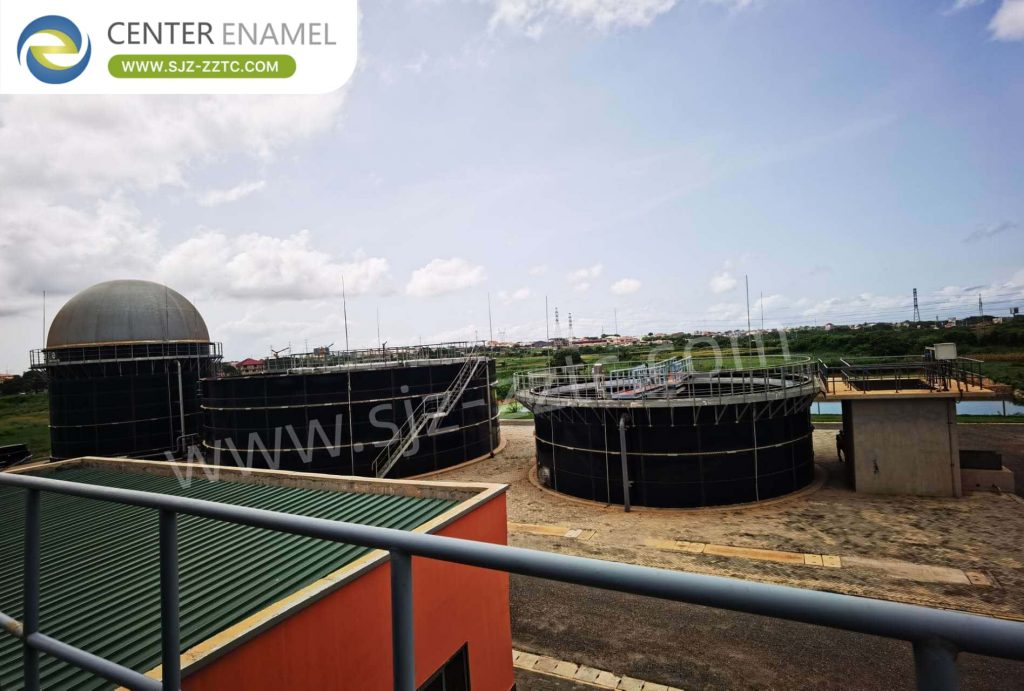
Complying with these tightening regulations-especially for high-strength organic streams like food waste-requires treatment infrastructure that performs reliably for decades. This is where the right equipment platform becomes as important as the process itself.
Bolted Assembly Construction for Flexible Project Delivery
Equipment selection directly affects how quickly a project can be delivered. GFS tanks are assembled on-site from prefabricated panels, with short construction periods and support for expansion, relocation, and reuse-advantages distinctly different from immovable concrete tanks. Concrete tank pouring requires formwork, rebar tying, pouring, and long curing periods, with a single tank construction taking months. Rain, snow, and low temperatures force work stoppages and delays. Once poured, they are permanent fixed structures that cannot be dismantled, expanded, or relocated-project relocation means complete abandonment.
GFS tank panels are all factory-prefabricated, transported to site, and directly assembled in panels with simple procedures. Construction can proceed even in low-temperature, light-rain conditions, with installation time only one-third that of concrete tanks-construction schedules are controllable. For expansion, additional steel panels can be installed to increase volume; for plant relocation, tanks can be fully disassembled with panels transported to new sites for reassembly and reuse, significantly reducing material and construction costs. This is ideally suited for short-term environmental projects, phased expansion projects, and relocated construction projects-and it is exactly this flexibility that makes GFS Tanks a natural fit for food waste treatment plants, which often expand as collection volumes grow.
USR Reaction Process for High-Solids Organic Waste
With the tank platform established, the biological process determines treatment performance. High-solids organic wastewater, after simple pretreatment to remove large debris, is uniformly fed into the reactor through the bottom distribution system. The upward flow drives solid substrates and anaerobic sludge to slowly rise and thoroughly mix. In the sealed anaerobic environment, microorganisms sequentially hydrolyze and acidify, then methanogenically ferment, degrading macromolecular organic pollutants and generating biogas and treated water.
Without complex separation structures, gentle hydraulic disturbance prevents clogging. The mixed liquor rises to the upper portion of the reactor where natural gas-liquid-solid separation occurs. Biogas is collected, effluent overflows, and solid sludge and unreacted substrate settle back to the lower reaction zone for continued reaction, with a small amount of aged sludge periodically discharged-enabling continuous stable operation.
Key Water Quality Characteristics of Food Waste
Understanding feedstock characteristics is essential for designing effective treatment. Food waste presents prominent "four highs"-high COD, high oil and grease, high salinity, and high suspended solids-with extremely high pollution load and complex composition.
COD typically ranges from 15,000-80,000 mg/L, with oil separation wastewater exceeding 100,000 mg/L. Animal and vegetable oil content is extremely high at 5,000-20,000 mg/L-oil easily adheres and accumulates on pipe and equipment walls, causing blockages and membrane fouling. High salinity with sodium chloride content of 5,000-15,000 mg/L originates from seasonings and salt residues. High suspended solids are rich in food residue particles, bone fragments, and fibrous impurities. The material is rich in proteins and amino acids, readily decomposing, emitting odors, and breeding flies. pH is slightly acidic to neutral, with BOD/COD approximately 0.4-0.5-good biodegradability, but oils and salts pose microbial inhibition risks. Water quality varies with collection volume, season, and dietary habits-higher summer volumes with higher oil content.
Food Waste Wastewater Characteristics
| Parameter | Typical Range | Treatment Challenge |
| COD | 15,000-80,000 mg/L | High organic load |
| Oil & Grease | 5,000-20,000 mg/L | Pipe blockage, membrane fouling |
| Salinity (NaCl) | 5,000-15,000 mg/L | Microbial inhibition |
| Suspended Solids | High | Clogging, pretreatment demand |
| BOD/COD Ratio | 0.4-0.5 | Good biodegradability |
Smart Manufacturing Base Ensuring Global Delivery
Delivering reliable equipment at scale requires serious manufacturing capacity. Center Enamel's core intelligent manufacturing base is located in Hebei Province, China, covering a total area of over 150,000 m², with Phase I mature manufacturing facility and Phase II high-end environmental equipment industrial park-dual-base synergy ensures stable production capacity.
The base includes dedicated R&D office buildings, proprietary material laboratories, and finished product testing centers, with full-process quality control systems meeting ISO, NSF, CE, and other international standards. The facility operates to green manufacturing standards, certified as a Provincial Green Factory-balancing efficient production with energy conservation and emission reduction. The company has 6 marketing service centers across China, establishing a nationwide production-sales network ensuring stable global order delivery. The base is adjacent to expressway networks and major logistics hubs, with complete container shipping capabilities-supporting simultaneous large-scale tank projects globally. The base employs over 500 staff, with multiple parallel automated production lines-facility scale and production capacity firmly placing it among the global top tier of GFS tank equipment manufacturers.
Manufacturing & Delivery Capability
| Metric | Value |
| Manufacturing Base Area | 150,000+ m² |
| Staff | 500+ |
| Marketing Service Centers | 6 (China) |
| Total Projects | 10,000+ |
| Biogas Projects | 1,000+ |
| Certifications | ISO, NSF, CE, WRAS, ASME |
Design Team Tailoring Solutions to Local Conditions
Manufacturing strength is matched by engineering expertise. The design team includes senior engineers registered in the Hebei Provincial Science and Technology Expert Database, with design standards aligned with strict European and American high-end equipment safety standards. The team can provide complete integrated design for differentiated overseas projects in livestock biogas, POME, municipal wastewater, hazardous waste storage, seawater desalination, and more-covering tank structure, anti-corrosion and sealing systems, biogas piping, and anaerobic process integration.
Pre-design thoroughly investigates local seismic zone, wind pressure, soil bearing capacity, water quality corrosivity, and local environmental discharge standards-applying thickened panels, reinforced anchored bases, and optimized sealing and corrosion structures as needed. Complete customized equipment solutions can be tailored to customer plant area, wastewater load, treatment targets, and budget-balancing safety, economics, and local adaptation-providing compliant, stable, and highly adaptable equipment structural design support for global environmental projects. As a Biogas Solution Provider, this design capability ensures every system is engineered for its specific site rather than copied from a template.
Single and Double Membrane Roof for Biogas Storage
Completing the system, Single and Double Membrane Roofs are proprietary airtight tank cover systems for anaerobic digestion and biogas storage projects, specifically developed for biogas collection and odor containment, representing a benchmark lightweight sealing solution for fermentation tanks.
The single-layer membrane roof features a simple structure with economical cost, meeting basic biogas containment needs. The double-layer membrane roof consists of inner and outer corrosion-resistant membrane materials, with pressurized air in the interlayer forming rigid support, providing outstanding thermal insulation that reduces biogas condensate formation inside the tank, with enhanced wind and snow load resistance suitable for high-altitude and windy outdoor sites.
The membrane material is specialized aging-resistant and biogas-slurry-corrosion-resistant PVDF membrane, which will not leak or degrade from long-term contact with biogas or hydrogen sulfide. The flexible structure accommodates tank settlement and slight deformation without cracking or gas leakage. The lightweight design eliminates heavy steel support trusses, significantly reducing the load on the tank and foundation, saving construction costs.
The roof integrates biogas outlets, safety pressure relief valves, and access channels, fully enabling closed gas collection for anaerobic fermentation tanks, recovering biogas for power generation and heating while blocking odor diffusion to meet environmental odor control requirements. It is widely used in large-scale livestock biogas projects, municipal sludge anaerobic digestion, and food waste fermentation projects, compatible with large-volume glass-fused-to-steel anaerobic tanks, with fast construction and simple maintenance requiring only periodic membrane seal integrity checks, offering significant overall engineering advantages.
Dealing with high-oil, high-salt food waste wastewater that keeps fouling your existing system? Share your project requirements with us and our engineers will design a biogas solution built to last.
From feedstock assessment to full commissioning, contact Center Enamel today for a tailored proposal backed by 10,000+ projects and a 150,000 m² manufacturing base.
FAQ
How do GFS Tanks handle food waste's high oil and salt content?
GFS Tanks use proprietary double-sided enamel resistant to acids, alkalis, and high salinity. This prevents corrosion from food waste's 5,000-15,000 mg/L NaCl and extends tank life beyond 30 years.
What makes a good Biogas Solution Provider for food waste projects?
A qualified Biogas Solution Provider combines corrosion-resistant tank manufacturing, anaerobic process design, and global installation experience-ensuring the system handles high COD and oil loads while recovering biogas.
Can food waste treatment systems be expanded later?
Yes. GFS Tanks assemble from bolted panels, so additional panels can increase capacity as collection volumes grow-without the demolition costs of concrete tanks.