
Biogas Storage, Buffering And Utilization: Holders, CHP And Boiler Use
Biogas must be buffered - stored - because production from the digester and consumption by a CHP or boiler rarely match hour to hour. Flexible-membrane gas holders or tank-roof storage hold the gas, and the buffered gas feeds combined heat and power (CHP), boilers, or - after upgrading - grid injection, smoothing supply and protecting equipment from pressure swings.
Why Buffer Biogas
A digester makes gas around the clock at a fairly steady rate, but a CHP set runs to a heat or power demand that is anything but steady. Without storage, the plant either flares excess gas or starves the engine. A buffer of a few hours of production lets the engine run at its efficient base load while the holder absorbs the mismatch, raising uptime and cutting flaring.
Holder Types
The common choices are a double-membrane flexible holder sitting on a concrete ring or tank top, a fixed or floating roof on a steel or Glass-Fused-to-Steel tank, and a pressurized steel vessel for smaller, higher-pressure duty. Membrane holders are cheap and large; tank-roof storage doubles as the digester or gas-holder shell and is corrosion-resistant; pressurized vessels suit compact, high-pressure needs.
| Holder Type | Pros | Cons |
| Membrane (double) | Large, low cost | Needs blower, weather care |
| Tank-roof (GFS/steel) | Corrosion-resistant, dual use | Higher capital |
| Pressurized vessel | Compact, high pressure | Small volume, cost per m3 |
Utilization Pathways
The buffered gas has three main fates. A boiler burns it for heat where the site has a steady thermal demand. A CHP set generates power and recovers heat, the highest-value use when both are needed. After upgrading (T5), the biomethane goes to grid, CNG, or LNG. The holder sits in front of all three, decoupling production from whichever path runs.
Project Case Study: Malaysia Biogas
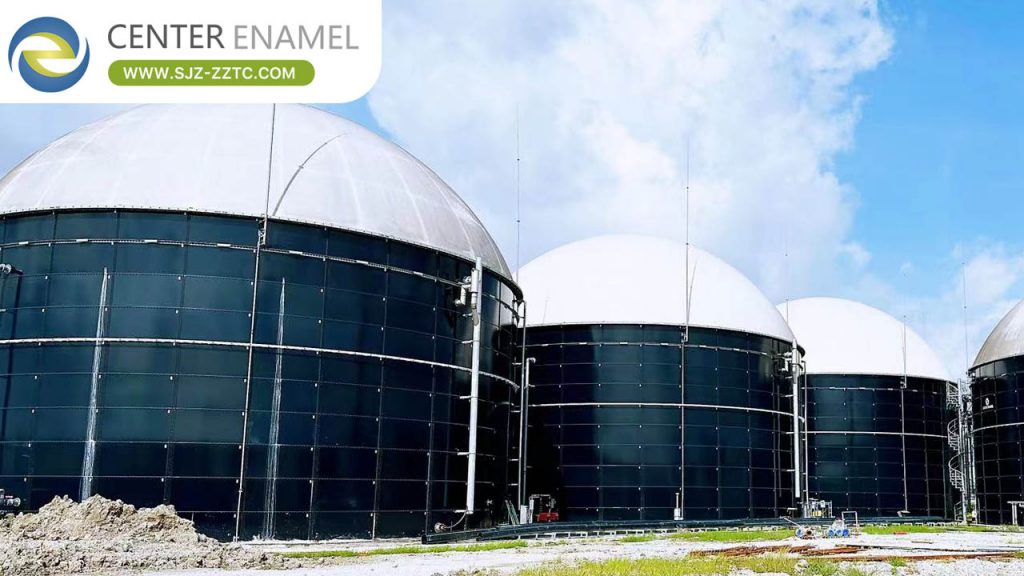
Project / Application: Large-scale biogas with Glass-Fused-to-Steel digester tanks, Malaysia. Industry: Biogas / waste-to-energy. Tank Type: GFS digester tanks (also relevant to gas holding). Key Requirements: Steady, large biogas supply from organic waste. Note: the source records 22,000 m3/day biogas; dedicated holder dimensions are Not Specified In The Available Source.
| Field | Value | Source / Evidence |
| Tank Quantity | 5 sets | Company project reference |
| Tank Model | O24.46 x 12 m | Company project reference |
| Total Effective Volume | 27,000 m3 (5 tanks) | Company project reference |
| Daily Biogas Production | 22,000 m3 total | Company project reference |
| Digestibility | About 80% | Company project reference |
| Biogas Yield | 0.45 m3 / kg COD removed | Company project reference |
About Company
Shijiazhuang Zhengzhong Technology Co., Ltd (Center Enamel) is a comprehensive high-tech enterprise specializing in wastewater engineering, process section contracting, and equipment manufacturing. The company delivers biogas and wastewater projects through three main lines - EPC (turnkey) contracting, equipment supply, and process packages - covering livestock and municipal wastewater, biomass energy, industrial wastewater, and food waste. Its reactor portfolio spans CSTR, USR, UBF, UASB, IC, and EGSB, backed by in-house Glass-Fused-to-Steel tank manufacturing (enamel firing at 820-930 C) and certifications including ISO 9001, NSF/ANSI 61, and CE-EN 1090. With 35+ years of operation, a 150,000 m2 manufacturing base, and projects in 100+ countries, Center Enamel provides the single-responsibility engineering behind biogas engineering where the digester, the gas holder, and the utilization set are specified together - Glass-Fused-to-Steel tanks provide both the corrosion-resistant digester shell and the gas volume, as on the Malaysia project producing 22,000 m3 of biogas per day.
Comparison: Store Vs Use Directly
| Element | With Buffer | Direct (no storage) |
| CHP uptime | High | Low (flare/starve) |
| Flaring | Minimal | Frequent |
| Equipment life | Protected | Stressed |
Biogas storage is the buffer that decouples steady digester production from uneven demand - membrane, tank-roof, or pressurized holders feeding CHP, boiler, or grid injection for higher uptime and less flaring.
Frequently Asked Questions
Q1: Why buffer biogas? A1: Production and demand rarely match; storage lets the engine run at base load.
Q2: What holder types exist? A2: Double-membrane, tank-roof (GFS/steel), and pressurized vessels.
Q3: What are the utilization paths? A3: Boiler heat, CHP power+heat, or grid/CNG after upgrading.
Q4: Is a holder always needed? A4: Practically yes for CHP; direct use flares or starves without it.
Q5: Which holder resists corrosion? A5: A Glass-Fused-to-Steel tank roof resists the acidic biogas environment.
Q6: How much storage is typical? A6: Hours of production, set by the CHP duty and demand swing.
Q7: Does storage need a blower? A7: Membrane holders usually do, to maintain pressure.
Q8: Can the digester double as storage? A8: A tank-roof design can, within pressure limits.
Suggested CTA
Share your biogas flow and end-use profile with an engineer, or request a storage-and-utilization outline for your plant.