
Biogas Technology in Pakistan: GFS Tanks + Double Membrane Roof for Cattle Farms
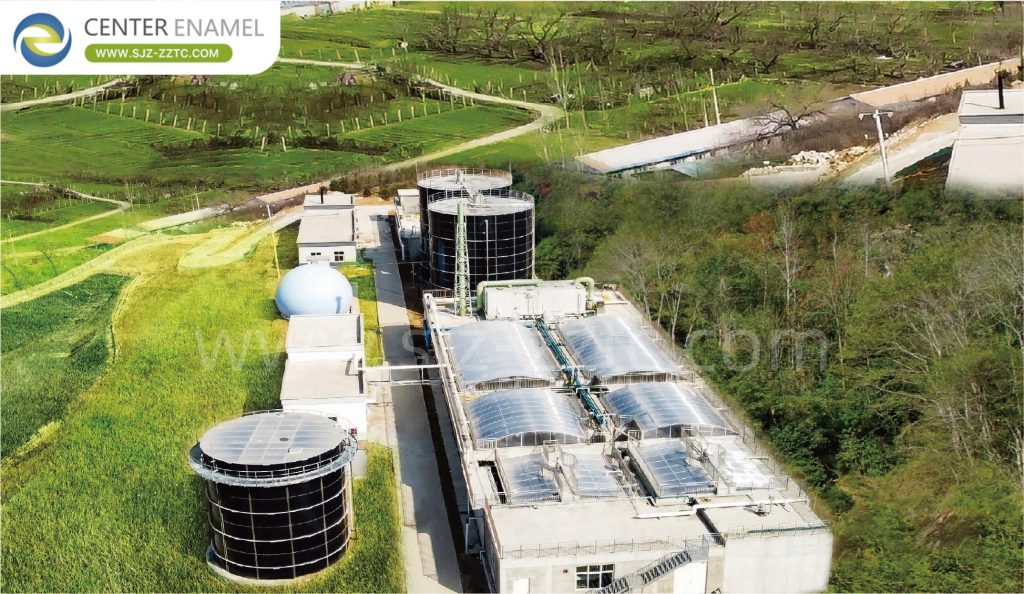
Pakistan has one of the largest livestock populations in the world, with over 50 million cattle and buffaloes. The provinces of Punjab and Sindh are particularly dense with dairy farms, from small family-owned operations to large commercial feedlots. While this industry is a critical source of milk, meat, and livelihoods, it faces a mounting environmental problem: manure management.
A single large cattle farm can produce tens of thousands of liters of effluent daily. Traditional disposal methods-open piles, raw land application, or drainage into low-lying areas-lead to groundwater contamination, foul odors, and the spread of vector-borne diseases. The pre-treatment stage is especially difficult. Farmers struggle to remove sand, stones, and coarse solids from the slurry, leading to clogged pipes and damaged pumps. Without proper homogenization, the organic load of cattle manure becomes a health and environmental liability rather than a valuable resource.
The Advantages of Converting Cow Manure to Biogas
For Pakistani farmers facing rising fuel costs and frequent power outages, converting cattle manure into biogas offers compelling advantages.
First, energy independence. Biogas can be used directly for cooking, water heating, or running generators. In rural areas where grid electricity is unreliable, a biogas plant provides a stable, on-farm power source.
Second, environmental benefits. Open manure storage releases methane-a potent greenhouse gas. Capturing this methane through anaerobic digestion significantly reduces the farm's carbon footprint and improves local air quality.
Third, high-quality fertilizer. The digestate left after biogas production is a stable, nutrient-rich, low-odor organic fertilizer. Unlike raw manure, it does not burn crops when applied fresh, and it suppresses some soil-borne pathogens. This allows farmers to reduce their reliance on expensive imported synthetic fertilizers.
Center Enamel: Professional Design for Biogas Projects
Shijiazhuang Zhengzhong Technology Co., Ltd (Center Enamel) has been a global leader in environmental engineering . With a 150,000㎡ R&D and production base, over 500 employees, and an annual output of 250,000 GFS tank sheets, Center Enamel is the largest manufacturer of Glass-Fused-to-Steel tanks in Asia.
For Pakistani cattle farmers and agribusinesses, Center Enamel offers more than equipment-they provide professional EPC (Engineering, Procurement, and Construction) services. Certified to ISO 9001, AWWA D103, and NSF61, their Biogas Technology solutions are specifically engineered to handle the high-solids, high-temperature conditions common in Pakistan. Whether for a single large farm or a community biogas project, Center Enamel delivers durable, corrosion-resistant systems designed for long-term performance.
Biogas Generation Principles and Pre-Treatment
Biogas is produced through anaerobic digestion (AD)-a natural biological process where microorganisms break down organic matter in an oxygen-free environment. This occurs in four stages: hydrolysis, acidogenesis, acetogenesis, and methanogenesis.
However, successful AD begins before the manure enters the digester. Raw cattle manure in Pakistan often contains sand, stones, straw bedding, and other impurities. The pre-treatment stage therefore includes:
Screening and crushing to remove large solids and debris.
Sand settling to eliminate heavy particles that would damage agitators and pumps.
Homogenization in a mixing tank to balance flow, temperature, and solids concentration.
This initial cleaning protects downstream equipment and ensures that the biological process runs stably, without blockages or grit accumulation.
The CSTR Process: Core Technology for High-Yield Biogas
At the heart of a successful biogas plant lies the CSTR Process (Continuous Stirred-Tank Reactor). Unlike simple covered pits or batch digesters, a CSTR is an engineered system designed for high efficiency and consistent gas production.
The CSTR reactor is equipped with a mechanical stirring device (mixer, agitator shaft, and specially designed paddles) that continuously mixes high-concentration organic waste with anaerobic microorganisms. This constant agitation ensures maximum contact between bacteria and substrate, accelerating degradation and increasing biogas yield.
Key features of the CSTR process include:
Continuous or semi-continuous feeding for stable, predictable gas output.
Constant temperature control (mesophilic range) suitable for Pakistan's climate.
Shell-breaking devices to prevent crust formation on the liquid surface-a common problem with cattle manure.
For Pakistani farms, the CSTR is ideal because it handles high suspended solids and provides reliable gas production even with variations in manure quality.
GFS Tanks + Double Membrane Roof: The Ideal Combination for Biogas Technology
In anaerobic digestion, corrosion is a constant threat. Hydrogen sulfide, ammonia, and organic acids attack conventional materials. Center Enamel’s GFS Tanks (Glass-Fused-to-Steel) are specifically designed to resist this harsh environment. The glass coating is fused to steel at over 800°C, creating an inert, hard, and chemically resistant surface (pH range 1-14).
When combined with a Double Membrane Roof, the system becomes a complete biogas capture and storage solution.
Why choose a Double Membrane Roof for your Biogas Technology project?
Cost optimization: Significantly lower capital cost than rigid steel roofs-critical for price-sensitive markets like Pakistan.
Space efficiency: The gas holder is integrated into the roof, eliminating the need for a separate ground-mounted gas holder. This is especially valuable on land-constrained farms.
Visual impact: Lower profile than external gas holders, which is beneficial for farms near residential areas.
While a rigid GFS roof is available for extreme wind or snow loads (such as in northern Pakistan), the double membrane roof is the preferred standard solution for most of the country's cattle farms.
Supporting Equipment Overview
A complete biogas plant requires more than just a reactor and roof. Center Enamel supplies a full range of auxiliary equipment to ensure smooth, safe operation:
Gas Holder & Torch System: Stores the produced biogas and safely combusts excess gas during maintenance or emergencies.
Dehydration and Desulfurization Tank: Removes corrosive hydrogen sulfide (H₂S) and water vapor from raw biogas, protecting generators and appliances.
Solid-Liquid Separator & Screw Sludge Dewatering Machine: Separates digestate into solid and liquid fractions. The solid fraction can be used as cattle bedding or sold as organic soil conditioner.
Black Membrane: Used for secondary storage of liquid effluent before land application.
Efficient Installation and Manufacturing Capacity
For Pakistani farmers and investors, project speed matters. Center Enamel’s manufacturing capacity-250,000 GFS tank sheets per year-ensures rapid delivery, even for large-scale biogas projects.
The bolted, modular design of GFS tanks offers major advantages over on-site concrete construction, which is slow and weather-dependent:
No curing time: Tanks are erected in days or weeks, not months.
All-weather installation: Work can continue during Pakistan's hot summers or monsoon rains.
Quality control: Panels are factory-engineered to exact tolerances, reducing on-site errors and delays.
With a global logistics network and experienced field crews, Center Enamel has erected tanks in remote locations worldwide. In Pakistan, this means faster commissioning and earlier revenue from biogas production. Furthermore, modular design allows for future expansion-if the herd grows, the biogas plant can grow with it.
Center Enamel: One-Stop EPC Solutions for Pakistani Cattle Farms
Many Pakistani cattle farmers are experts in animal husbandry, not in anaerobic digestion. Center Enamel removes the complexity through their One-Stop EPC Solution (Engineering, Procurement, Construction).
As a single-point contractor, Center Enamel takes full responsibility for:
Custom design: Matching the system to herd size, manure composition, and local climate-from the hot plains of Punjab to the cooler valleys of Khyber Pakhtunkhwa.
Equipment supply: All tanks, mixers, piping, roofs, and auxiliary units.
Construction and commissioning: Ensuring the biology is active and the gas flows from day one.
Training: Teaching farm staff how to operate and maintain the system safely and efficiently.
By choosing Center Enamel, a Pakistani cattle farm can modernize waste management, achieve energy independence, and reduce fertilizer costs-all with a single point of contact. This is particularly valuable for large dairy operations and for community biogas projects serving multiple smallholder farmers.
Converting cattle manure into biogas is not a futuristic technology-it is a practical, proven solution for Pakistani farms facing rising energy costs, fertilizer prices, and environmental pressure. By implementing advanced Biogas Technology using the efficient CSTR Process, durable GFS Tanks, and a cost-effective Double Membrane Roof, farmers can turn a waste problem into a reliable source of cooking fuel, electricity, and organic fertilizer. Center Enamel provides the engineering, equipment, and EPC expertise to make this transition smooth and profitable. It is time for Pakistan's livestock sector to harvest the energy that is already being produced every day.
Frequently Asked Questions (FAQ)
Q1: Can a biogas plant using CSTR technology operate during Pakistan's hot summers?
A: Yes. The CSTR process can be designed for mesophilic (30-40°C) or thermophilic (50-55°C) operation. In Pakistan's climate, passive solar heating or minimal active heating is often sufficient to maintain optimal temperatures. Center Enamel's design includes temperature monitoring and optional heating systems to ensure year-round performance, even during cooler winter months in northern regions.
Q2: Is the digestate from the biogas plant safe to use on crops grown for human consumption?
A: Yes. Properly managed anaerobic digestion significantly reduces pathogens compared to raw manure. The combination of constant temperature, retention time, and biological competition within the CSTR reactor produces a digestate that is safer for agricultural use. However, standard food safety practices should still be followed, such as applying digestate well before harvest.
Q3: What maintenance does a double membrane roof require in Pakistan's dusty environment?
A: The double membrane roof requires periodic visual inspection for tension, airtightness, and dust accumulation-typically every 6-12 months. The outer membrane is designed to withstand UV exposure and dust. In very dusty areas (e.g., parts of southern Punjab or Sindh), occasional gentle cleaning of the outer membrane may be recommended. Under normal conditions, service life exceeds 15-20 years with minimal maintenance.