
Brewing Wastewater Treatment Project: UASB Process and GFS Tank Solutions
The brewing industry generates high-strength organic wastewater that requires specialized treatment solutions to meet stringent environmental standards. This article explores how the UASB (Upflow Anaerobic Sludge Blanket) process serves as the benchmark technology for brewing wastewater treatment projects, delivering exceptional COD removal efficiency while producing biogas as a renewable energy byproduct. Combined with Glass-Fused-to-Steel (GFS) tanks from Center Enamel, these solutions offer superior corrosion resistance, rapid installation, and a service life exceeding 30 years-making them ideal for brewery operations across diverse regional markets from Asia-Pacific to the Middle East.
Global Industrial Wastewater Treatment Market Evolution
The industrial wastewater treatment landscape has undergone significant transformation, with regional markets developing distinct characteristics that shape technology adoption. The Asia-Pacific region, particularly China, has become the world's largest industrial wastewater treatment market, where the operation and maintenance service segment's contribution continues to rise-marking a clear shift from project construction to long-term operational management . This evolution reflects a maturing industry where lifecycle performance and operational reliability take precedence over initial capital expenditure.
North American markets, by contrast, focus primarily on upgrading existing facilities, while European markets emphasize high-value-added resource recovery technologies. These regional differences highlight the importance of selecting proven, durable technologies that can adapt to varying regulatory and operational requirements. The Middle East demonstrates strong demand for advanced treatment and reuse of industrial wastewater due to water scarcity, while manufacturing transfer in Southeast Asia drives local industrial wastewater treatment facility construction demand.
Against this backdrop, wastewater from the new energy industry chain-including lithium batteries, photovoltaics, and hydrogen production-has emerged as the most notable emerging growth area due to its complex composition and high treatment difficulty, generating significant demand for customized treatment solutions. For brewing wastewater treatment projects, however, the challenges are equally demanding: high organic loading, temperature fluctuations, and seasonal discharge variations require robust treatment infrastructure that can maintain consistent performance under variable conditions .
Superior Corrosion Resistance for Brewing Wastewater Infrastructure
When evaluating containment solutions for brewing wastewater treatment projects, corrosion resistance emerges as a critical selection criterion. Center Enamel's independently developed double-sided double-layer enameling technology represents the industry's leading anti-corrosion solution, with performance that completely surpasses traditional concrete tanks. The advanced Glass-Fused-to-Steel (GFS) technology combines the strength and flexibility of steel with the high corrosion resistance of glass, creating an impermeable barrier against the aggressive organic acids and cleaning agents characteristic of brewery effluent .
Concrete tank interiors are riddled with pores, allowing wastewater and acid/alkaline media to easily penetrate and corrode the structural layer. Long-term use leads to irreversible problems such as internal wall spalling, water seepage, and rebar corrosion-issues that prove difficult to repair and cannot be fundamentally resolved. Research confirms that concrete tanks often show visible leaks and require substantial remedial maintenance, with corrosion penetrating through to reinforcing steel within five years of installation .
GFS tanks feature high-temperature enameling on both the interior and exterior surfaces of steel panels, with a dense, non-porous enamel finish that completely blocks corrosive liquids and biogas permeation. The enamel layer has extremely strong chemical stability, resisting acids, alkalis, salts, and microbial corrosion. While concrete tanks will develop extensive corrosion and leakage after 5-8 years of use, GFS tank anti-corrosion service life can exceed 30 years, with no need for frequent internal lining repairs throughout the service life . This durability significantly reduces long-term maintenance investment and fundamentally eliminates environmental risks of medium leakage contaminating sites and groundwater.
UASB Process: The Core Technology for Brewing Wastewater Treatment Projects
The UASB (Upflow Anaerobic Sludge Blanket) process stands as the benchmark mainstream technology for medium-to-high concentration soluble organic wastewater treatment, making it the ideal core for any brewing wastewater treatment project . This innovative process requires no mechanical mixing or media carriers, relying instead on the upward flow of wastewater to suspend and expand granular sludge within the reactor, forming a stable sludge bed layer.
Highly active anaerobic granular sludge efficiently degrades pollutants, with excellent settleability and high microbial concentration. Research has demonstrated that UASB reactors treating brewery wastewater can achieve 90-94% COD removal and 94-97% BOD removal, with methane production ranging from 188 to 316 liters per kilogram of COD removed . The UASB process innovatively integrates reaction, sedimentation, and gas-liquid-solid separation functions, simplifying the anaerobic treatment process with advantages of high efficiency, energy savings, and compactness.
For brewery operations, the UASB process offers particular advantages. Brewery effluent is characterized by elevated COD levels, high temperatures, and varying pH due to cleaning-in-place cycles . The UASB reactor can handle organic loading rates between 2.2 and 12.4 kg COD/m³-day while maintaining treatment efficiency, with hydraulic retention times ranging from 24 to as low as 4 hours . This flexibility makes it suitable for both large-scale breweries and smaller craft producers. Moreover, the biogas produced during anaerobic digestion can be captured and used to generate heat or electricity, supporting the circular economy objectives increasingly central to modern brewing operations .
Brewing Wastewater Characteristics and Treatment Challenges
Wastewater Sources
Brewery wastewater is high-concentration organic wastewater generated throughout the entire production process of beer, liquor, and wine-representing a high-volume wastewater type in the food industry. Key pollution stages include raw material soaking and washing, saccharification and fermentation, distillation and purification, and filling and packaging operations. Major wastewater streams include still bottoms, fermentation yellow water, spent mash, and raw material soaking wastewater, while auxiliary discharges include equipment and pipeline washing, floor cleaning, production line maintenance, and cooling water.
The discharge profile exhibits significant intermittency and seasonality-high volume during peak production seasons, reduced during off-seasons. Large breweries typically have unified collection systems, while small and medium-sized facilities have more dispersed collection with prominent uncontrolled discharge issues concentrated in brewing facility areas. These characteristics demand treatment systems with sufficient buffering capacity and operational flexibility, attributes that the combination of GFS tanks and UASB reactors readily provides.
Treatment Challenges and Solutions
The high organic loading of brewery wastewater-often exceeding 2000 mg/L COD-requires intensive biological treatment . Temperature fluctuations and pH variations from cleaning cycles can stress biological reactors, while the presence of hop acids and ethanol can inhibit methanogenic activity if not properly managed . Granular sludge must be acclimated to iso-alpha and beta acids over 4-12 weeks, typically starting at 20% design load and increasing 10-15% weekly .
To address these challenges, Center Enamel designs integrated multi-stage treatment systems for brewing wastewater treatment projects: pre-treatment for mechanical screening and pH neutralization, anaerobic treatment using the UASB process as the core, aerobic polishing for secondary treatment, and tertiary treatment with advanced filtration where required for water reuse applications . This comprehensive approach ensures compliance with increasingly stringent discharge standards while maximizing resource recovery.
Indonesia Palm Oil Biogas Upgrade Project: A Proven Solution
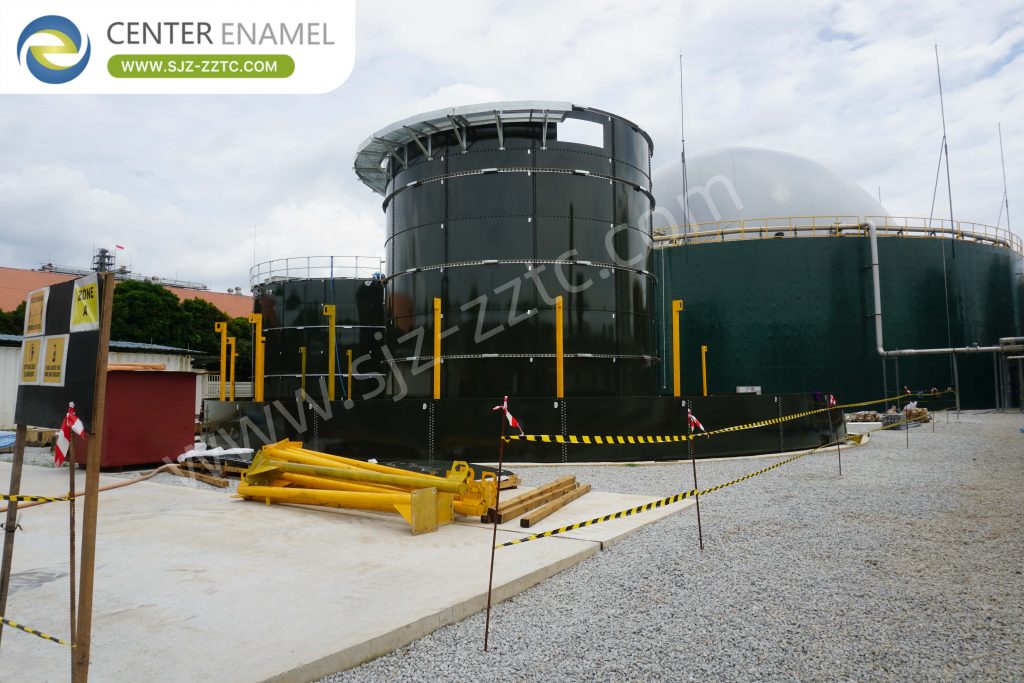
The Indonesia Palm Oil Biogas Upgrade Project, commissioned in 2013, demonstrates the successful application of GFS tank technology for challenging industrial wastewater treatment applications. The project utilized three GFS tanks serving as the core anaerobic digestion reactor for the POME (Palm Oil Mill Effluent) treatment station, with two sizes: 17.58 m diameter × 8.4 m height and 16.82 m diameter × 7.2 m height.
The tanks serve as the core anaerobic reaction equipment specifically designed for high-organic palm oil production wastewater-anaerobic digestion degrades pollutants and recovers biogas. The tanks are adapted to local palm industry wastewater needs, with GFS tank assembly proving convenient and corrosion resistance performing exceptionally well in Southeast Asia's hot, humid, high-corrosion environment. This project stands as a mature biomass energy environmental benchmark, demonstrating the applicability of GFS technology for similar brewing wastewater treatment projects where high organic loading and corrosive conditions prevail.
The success of this project in Indonesia-a challenging tropical environment with aggressive corrosion conditions-validates the technology's suitability for brewery applications across Southeast Asia and other rapidly industrializing regions where manufacturing transfer is driving treatment facility construction demand.
Center Enamel: 30+ Years of Excellence in Environmental Storage Solutions
Center Enamel has been deeply engaged in the environmental bolted storage equipment field for over 30 years, establishing itself as a leading enterprise in the global GFS tank storage industry. Starting with proprietary enamel anti-corrosion material technology, the company has gradually completed the full-industry-chain upgrade from a single tank manufacturer to a comprehensive environmental EPC service provider .
Throughout its 30+ year history, the company has been recognized as a National High-Tech Enterprise, National Specialized and Sophisticated "Little Giant," Manufacturing Single Champion, and Provincial Green Factory. It has successfully delivered over 30,000 environmental projects globally, with manufacturing processes certified to meet the world's most stringent requirements including ISO 9001, NSF/ANSI 61, and AWWA D103-09 .
For brewing wastewater treatment projects, this extensive experience translates into proven solutions that have been refined across diverse applications and operating conditions. The company has fully integrated the entire chain from enamel frit R&D, intelligent environmental equipment manufacturing, to EPC project contracting-ensuring that every business breakthrough has been achieved through proprietary core anti-corrosion technology.
Professional Construction and Global Delivery Capability
Center Enamel has established its own domestic and internationally certified construction teams, with regular practical training on GFS tank installation and overseas construction standards for various countries. This commitment to professional installation is critical for brewing wastewater treatment projects that must meet tight commissioning timelines .
Domestically, regional construction teams cover multiple zones, capable of simultaneously deploying multiple teams for large tank farm projects. Internationally, cross-border professional installation teams are equipped to various country construction standards-ensuring sufficient manpower reserves to guarantee uninterrupted construction delivery for remote African sites, high-standard European and American facilities, and all other project locations.
The modular bolted design of GFS tanks enables rapid assembly, with factory-coated panels arriving ready for installation. This approach significantly reduces labor costs and shortens project delivery timelines compared to cast-in-place concrete tanks, which require extensive on-site curing and can be seriously affected by bad weather . For breweries requiring rapid deployment to meet production schedules, this installation efficiency represents a significant competitive advantage.
FAQs
Q1: Why is UASB the top choice for brewing wastewater treatment?
The UASB process achieves 90–94% COD removal from high-strength brewery effluent without mechanical mixing, saving energy and operating costs. It handles variable organic loads and produces biogas as a renewable byproduct, making it both efficient and sustainable for brewers.
Q2: How do GFS tanks outperform concrete tanks for breweries?
Unlike concrete, which corrodes and leaks within 5–8 years, GFS tanks feature a glass enamel surface that resists acids, salts, and microbial attack for over 30 years. They install faster, require no curing, and need minimal maintenance, offering far lower long-term costs.
Q3: What makes brewery wastewater difficult, and how does UASB solve it?
Brewery effluent has high COD (>2000 mg/L), temperature swings, pH shifts, and seasonal flow variations. UASB reactors tolerate these fluctuations, maintain stable treatment, and recover biogas-reducing both environmental impact and operational expenses.