
Can a Brewing Wastewater Treatment Project Cut Costs with GFS Tanks?
Industrial wastewater policy worldwide is shifting from "compliance discharge" toward mandatory resource recovery and zero liquid discharge. The EU's Circular Economy Action Plan requires member states to raise industrial wastewater reuse rates and extends carbon footprint accounting across the full treatment life cycle.
China keeps tightening discharge limits on total nitrogen, total phosphorus, and characteristic pollutants for chemicals, pharmaceuticals, and printing and dyeing-with zero or near-zero liquid discharge mandated in water-scarce regions and heavily polluting industries. Germany has built a differentiated pretreatment standard system by industry, enforcing strict source control before discharge into municipal plants. For breweries, this regulatory squeeze makes a well-engineered Brewing Wastewater Treatment Project not a cost center but a strategic asset-and the right GFS Tanks are what make that project durable.
Why Brewing Wastewater Demands a Purpose-Built Process Train
Brewery effluent is high-concentration, easily biodegradable organic wastewater, which makes it ideal for a mature "solid-liquid separation + anaerobic digestion + aerobic polishing" train. Pretreatment with screens, sedimentation tanks, and microfiltration removes spent grain residues and colloidal suspended solids, preventing equipment clogging and reducing biochemical load. The main stage uses UASB/EGSB high-efficiency anaerobic processes to rapidly degrade high-concentration organics while recovering biogas energy-well suited to heavy pollution loads. Subsequent A/O or contact oxidation aerobic processes deeply degrade residual pollutants, with final sedimentation and disinfection ensuring stable compliance. The entire process offers strong shock-load resistance, simple flow, and convenient O&M-precisely matching the brewery industry's intermittent and seasonal discharge patterns.
The GFS Tanks at the Core of Every Anaerobic Stage
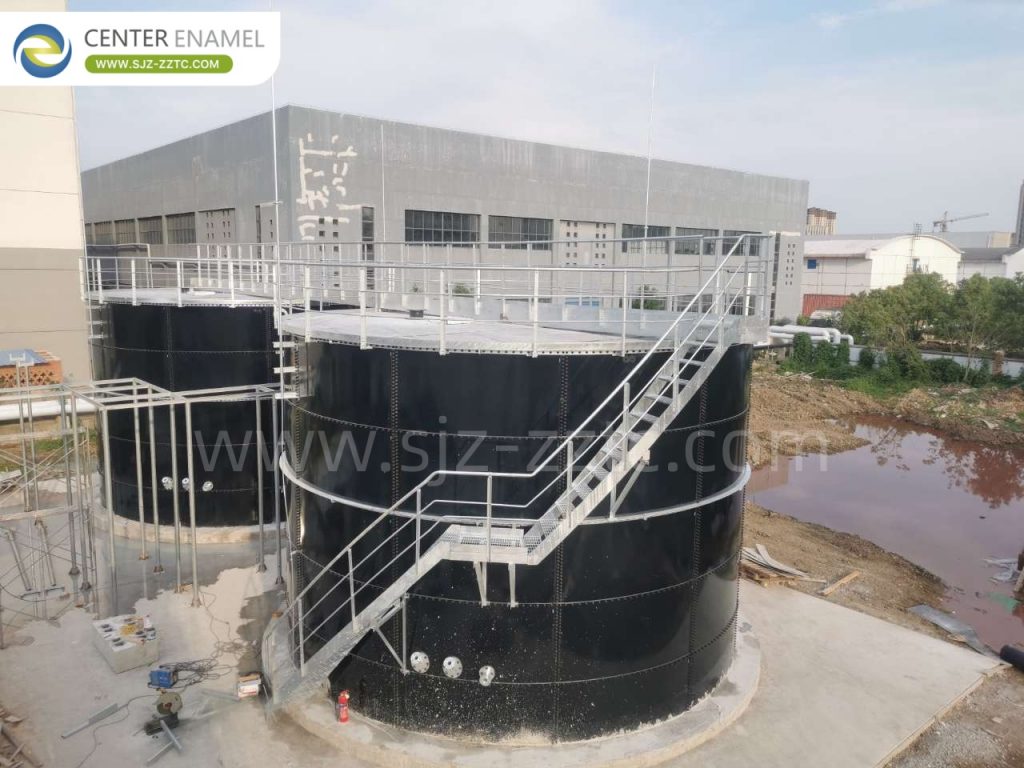
The digester is where the biology lives, so containment quality determines project success. In this process train, anaerobic digesters use Center Enamel GFS Tanks, resistant to organic acid corrosion with a long service life. The core equipment is a GFS tank with a built-in gas-lift internal circulation system and upper/lower three-phase separators-the key components for autonomous circulation and sludge-water separation. A bottom precision distribution system and pressure-regulating feed device ensure uniform, stable influent. Supporting equipment includes influent lift pumps, equalization tanks, and flow meters for precise influent control, plus top-mounted high-efficiency biogas collection, desulfurization, dehydration, and storage integrated equipment. High-precision online monitoring tracks temperature, pH, COD, and level in real time, while dedicated sludge discharge pipes and recirculation control devices eliminate the need for external return pumps. The complete system is highly integrated, compact, and highly automated.
How GFS Tanks Fit Modern Intensive Plant Layouts
Beyond process performance, GFS Tanks offer flexible customization of size and appearance with higher land utilization-ideally suited to modern compact plant layouts and clearly advantaged over fixed poured concrete. Concrete tanks cannot alter volume or shape after pouring; their heavy bases occupy large areas and are hard to place on narrow or irregular plots, and their rough finish cannot meet modern aesthetic requirements. GFS tank volume can be precisely customized from dozens of cubic meters to 50,000 cubic meters, with height and diameter freely combined to fit constrained sites. Enamel color customization achieves visual harmony with plant buildings, and during later expansion, GFS tanks can be adjusted and expanded directly-whereas monolithic concrete must be demolished and rebuilt. This aligns with the intensive construction and aesthetic O&M needs of industrial parks.
A Complete Product Matrix Behind Every Project
Delivering a Brewing Wastewater Treatment Project end to end requires more than one product line. Center Enamel has built a complete matrix of "core storage tanks + supporting covers + specialty pressure vessels + complete environmental engineering services"-the only company globally to achieve integrated enamel frit R&D, self-manufacturing, and GFS tank application. The core is proprietary GFS Tanks, using double-sided hot-rolled double-layer enamel anti-corrosion technology resistant to strong acids, alkalis, high salinity, and microbial corrosion, with modular quick assembly for all severe corrosion conditions in wastewater, biogas, and chemical service.
Supporting Fusion Bonded Epoxy Tanks are produced on China's first intelligent standardized production line. Aluminum Dome Covers use a proprietary high-strength aluminum alloy self-supporting structure meeting international waterproof and load-bearing standards. The range also includes carbon steel tanks, stainless steel tanks, composting tanks, and various non-standard pressure vessels-backed by environmental EPC general contracting and anaerobic process subcontracting across food waste, leachate, municipal wastewater, livestock biogas, petrochemical/metallurgical, and seawater desalination industries.
The Aluminum Geodesic Dome Roof That Seals the System
Where biogas collection or odor control is required, the Aluminum Geodesic Dome Roof completes the system. Independently developed by Center Enamel and stamped from high-strength aluminum alloy plates, it uses a triangular grid spherical self-supporting structure for large-span full coverage without internal support columns. The aluminum alloy offers excellent weather and corrosion resistance against acid rain, salt spray, and UV radiation across extreme climates. The design complies with international AWWA D108 standards, with plate thickness, rib cross-sections, and joint connections verified by finite element stress analysis for wind and snow loads across global regions. At only one-third to one-half the weight of a comparable steel roof, it imposes far less load on the tank top and can be installed without wall reinforcement. Double sealing between panels with specialized sealant strips and mechanical interlocking enables both airtight gas storage and enclosed odor control. The support-column-free design avoids interference with mixers and water distributors, and aluminum does not support microbial growth-requiring no anti-corrosion maintenance and keeping total life-cycle costs low.
Global Market Expertise That De-Risks Your Investment
Technical excellence must be matched by commercial fluency. Center Enamel's marketing team brings together environmental industry multi-skilled professionals and multilingual foreign trade specialists with deep expertise in global biogas, wastewater treatment, and biomass new energy markets-accumulating practical project experience across Southeast Asia, Africa, Europe, and the Americas. The team is proficient in various countries' wastewater discharge regulations, biogas subsidy policies, and carbon trading rules, providing one-stop preliminary site survey, solution planning, and investment return analysis. With multilingual capabilities in English, French, Spanish, and Arabic, the team precisely matches regional industrial resources, project budgets, and environmental requirements-customizing high-cost-performance GFS Tanks and anaerobic reactor solutions based on client production capacity, treatment targets, and gas production expectations. Leveraging extensive overseas experience, the team proactively helps clients avoid risks in approvals, equipment import, and construction implementation.
Center Enamel at a Glance
| Capability | Detail |
| Years in environmental bolted storage | 30+ years |
| Global environmental projects delivered | 30,000+ |
| GFS tank capacity range | Dozens of m³ up to 50,000 m³, customizable |
| Enamel technology | Double-sided hot-rolled double-layer enamel anti-corrosion |
| Roof standard compliance | AWWA D108, verified by finite element stress analysis |
| Roof weight vs. steel | One-third to one-half of comparable steel roof |
| Language coverage | English, French, Spanish, Arabic |
| Product / Service Line | Purpose |
| GFS Tanks (core) | Anaerobic digesters, wastewater, biogas, chemical storage |
| Fusion Bonded Epoxy Tanks | Supporting storage on intelligent standardized line |
| Aluminum Dome Covers | Tank sealing and biogas collection |
| Aluminum Geodesic Dome Roof | Large-span gas-tight and odor-control coverage |
| Carbon / Stainless Steel Tanks, Pressure Vessels | Non-standard and specialty applications |
| Environmental EPC & Anaerobic Subcontracting | One-stop engineering across multiple industries |
Frequently Asked Questions
Q: Why are GFS Tanks preferred for brewery anaerobic digesters?
A: They resist organic acid corrosion, offer long service life, assemble quickly on constrained sites, and can be expanded later without demolition.
Q: Does this process handle seasonal brewery discharge?
A: Yes. The train's strong shock-load resistance and simple O&M suit intermittent, seasonal production patterns.
Q: Can Center Enamel support overseas regulatory compliance?
A: Yes. The multilingual team tracks discharge rules, biogas subsidies, and carbon trading policies across regions.
Share your production capacity and discharge targets, and our team will return a tailored process and tank configuration proposal.
Ready to future-proof your brewery against tightening global standards? Talk to Center Enamel about a Brewing Wastewater Treatment Project built on durable GFS Tanks-we're here to help you plan the next step.