
Why Does a Brewing Wastewater Treatment Project EPC Contractor Build Around Modern Anaerobic Technologies?
Every brewery faces the same choice: treat its effluent as an unavoidable cost, or engineer it into a compliant, energy-saving asset. The difference between those two outcomes usually comes down to one decision-choosing a Brewing Wastewater Treatment Project EPC Contractor who has built the right modern Anaerobic Technologies into the plant. Center Enamel (Shijiazhuang Zhengzhong Technology Co., Ltd) has spent more than 30 years doing exactly that, combining high-rate anaerobic reactors with corrosion-resistant GFS tanks and a global construction network.
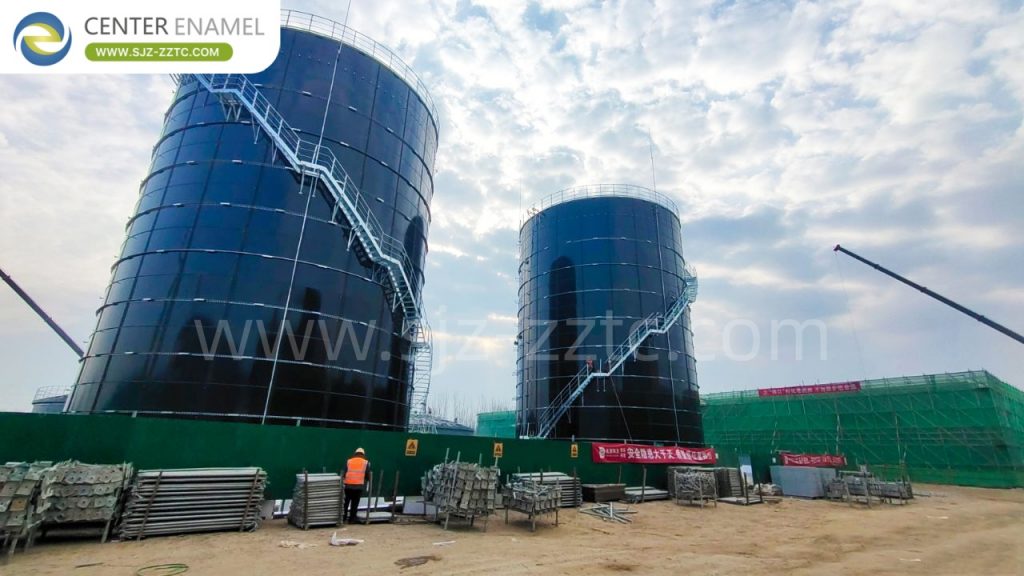
The "Three Highs" Behind Every Plant Decision
The core challenges of industrial wastewater treatment come down to what engineers call the "three highs": high difficulty, high cost and high energy consumption. Effluent from new-energy, chemical and pharmaceutical plants is complex in composition, carries numerous characteristic pollutants, and resists removal by traditional treatment processes. Chinese manufacturers have long held price advantages in the mid-to-low-end equipment segment, and the industry now faces constant pressure from tightening emission standards, plus new demands for digitalization and low-carbon transformation in day-to-day operational management. For a brewery, these abstract "three highs" show up as very specific streams at the end of the production line.
Where Brewery Wastewater Actually Comes From
Brewery wastewater is high-concentration organic effluent generated across the entire production chain of beer, liquor and wine-one of the largest wastewater volumes in the food industry. The heaviest contamination occurs during raw-material soaking and washing, saccharification and fermentation, distillation and purification, and filling and packaging. The principal streams are still bottoms, fermentation yellow water, spent mash and grain-soaking liquor, while equipment washing, floor cleaning, line maintenance and cooling water make up the auxiliary discharges. Because production is batch-driven and seasonal, flows swing sharply between peak brewing season and off-season; large breweries usually collect wastewater centrally, whereas small and medium plants often suffer from dispersed, hard-to-control discharges concentrated around the brewhouse.
| Production Stage | Main Wastewater Streams | Characteristics |
| Raw-material handling | Grain soaking/wash water, spent-grain liquor | High suspended solids, intermittent flow |
| Saccharification & fermentation | Spent mash, fermentation yellow water | Very high COD/BOD, concentrated load |
| Distillation & purification | Still bottoms, condenser waters | Extremely high strength, seasonal peaks |
| Filling & packaging | Bottle/can rinsing, washing wastewater | Lower strength, large continuous volume |
| Auxiliary operations | Equipment/pipeline washing, floor cleaning, cooling water | Variable flow, traces of sanitation chemicals |
Once those streams are characterized, the central question is how to remove the organic load efficiently-and that is where modern Anaerobic Technologies earn their place.
Modern Anaerobic Technologies-The IC Reactor at the Core
The Internal Circulation (IC) anaerobic reactor is the third-generation high-efficiency anaerobic treatment technology built upon the UASB concept. Its defining innovation is a built-in gas-lift internal circulation system that recirculates wastewater autonomously, without external return pumps. The reactor is arranged in two zones-a lower main reaction zone and an upper polishing zone-and biogas-driven gas lift creates a strong internal hydraulic loop that raises upflow velocity and improves contact between sludge and wastewater. With exceptional compactness, the IC reactor is specifically designed for high-concentration, high-flow industrial organic wastewater, combining high treatment efficiency, energy savings and a minimal footprint. It has become the core process for modern high-strength industrial wastewater treatment. A reactor this compact and high-loading is only as durable as the vessel that contains it-which is why the material technology behind Anaerobic Technologies matters as much as the process itself.
The Material That Makes Anaerobic Technologies Last
Center Enamel has independently developed more than 200 anti-corrosion enamel formulations and applies a proprietary double-sided, double-layer enameling process. Concrete tank interiors are riddled with pores, so wastewater and acid or alkaline media easily penetrate and corrode the structural layer, causing irreversible wall spalling, water seepage and rebar corrosion that are difficult to repair and cannot be fundamentally fixed. GFS Tanks, by contrast, use high-temperature enameling on both the interior and exterior of each steel panel, producing a dense, non-porous enamel finish that completely blocks corrosive liquids and biogas permeation. The enamel layer has exceptional chemical stability against acids, alkalis, salts and microbial corrosion. Concrete tanks develop widespread corrosion and leakage within 5-8 years, while the anti-corrosion service life of GFS Tanks exceeds 30 years-with no frequent internal lining repairs, lower long-term maintenance and no risk of media leaking into site soil or groundwater. Compared with concrete and FRP tanks, GFS coatings never peel or blister, making them ideal for highly corrosive conditions such as palm-oil mill effluent, livestock manure and chemical high-salinity wastewater.
| Aspect | Concrete Tanks | Center Enamel GFS Tanks |
| Surface structure | Porous interior; media penetrates through | Dense, non-porous double-layer enamel |
| Corrosion behavior | Acid/alkali ingress, spalling, rebar rust | Resists acids, alkalis, salts and microbes |
| Typical service life | Corrosion and leakage within 5-8 years | Anti-corrosion life exceeds 30 years |
| Maintenance burden | Hard to repair; repeated lining work | No frequent internal lining repairs |
| Formulation base | — | 200+ proprietary enamel formulations |
| Best fit | Mild neutral media | Brewery effluent, biogas, POME, high-salinity |
Equally important is what sits on top of each tank-and the right roof depends on the duty.
Roofs That Match the Duty-FRP and Beyond
For atmospheric storage tanks that do not require air-tightness, the FRP roof is a general-purpose economical cover, suited to drinking-water storage, agricultural irrigation water, firewater reserve and temporary production-wastewater holding. It comes in flat and dome styles, integrally molded from resin and fiberglass: lightweight, naturally water-resistant and mildly acid/alkali-resistant, and immune to the rust and rot that force frequent maintenance on metal roofs. The dome design sheds water, dust, snow and wind loads, while the flat style supports maintenance walkways, level gauges and vents. Fully insulated with no risk of galvanic corrosion, it will not contaminate drinking-water quality, and its modular low-weight components make on-site hoisting quick and affordable. The FRP roof is not, however, designed for biogas collection or pressurization, and it is not recommended on anaerobic gas-producing units. For digesters and biogas-holding vessels, Center Enamel instead specifies gas-tight dual-membrane roofs that seal in the recovered gas. Even the best equipment is only delivered on time when the contractor can mobilize crews anywhere in the world.
A Construction Team That Deploys Anywhere
Center Enamel has built its own domestic and international certified construction teams, with regular practical training on GFS tank installation and the construction standards of various countries. Domestically, regional construction teams cover multiple zones and can deploy multiple crews simultaneously for large tank-farm projects. Internationally, cross-border professional installation teams are equipped to national construction standards, and sufficient manpower reserves ensure uninterrupted construction delivery for remote African sites, high-standard European and American facilities, and every project in between.
Whether you are greenfield engineering a new brewery effluent plant or upgrading an overloaded digester, our engineers can scope an EPC package built around modern Anaerobic Technologies and GFS tankage. Contact Center Enamel today for a preliminary process scheme, tank proposal and budget tailored to your brewery.
Frequently Asked Questions
What makes Center Enamel a reliable Brewing Wastewater Treatment Project EPC Contractor?
Center Enamel integrates enamel R&D (200+ formulations), GFS tank manufacturing, anaerobic process design (IC/UASB/CSTR), roof supply and certified on-site construction under one contract, with 30,000+ projects in 100+ countries and crews deployable to remote and high-standard sites alike.
Which Anaerobic Technologies does Center Enamel recommend for brewery effluent?
For high-strength brewery wastewater, the Internal Circulation (IC) reactor-a third-generation technology built on UASB-is the workhorse: its gas-lift internal circulation needs no external pumps, handles high COD/BOD loads in a compact footprint and recovers biogas for on-site energy.
Why use GFS Tanks instead of concrete for anaerobic digesters?
Concrete develops pores, acid penetration, wall spalling and rebar corrosion within 5-8 years, while Center Enamel GFS Tanks use double-sided double-layer enameling across 200+ formulations to resist brewery effluent and biogas for 30+ years, with no peeling, blistering or frequent relining.