
How Does a Brewing Wastewater Treatment Project EPC Contractor Apply IC Process Technology for Wastewater Treatment?
The global industrial wastewater treatment market is characterized by increasing divergence and consolidation. Leading companies are building integrated service capabilities through technical integration and capital operations, and industry concentration is gradually increasing. Chinese companies continue to consolidate their advantages in mid-tier equipment exports. International giants target high-end customers and complex industrial wastewater markets, while local players occupy the mid- to low-end and industrial park centralized treatment markets with service responsiveness and cost advantages.
Within this competitive landscape, the brewing industry presents a distinctive opportunity. Brewery wastewater is high in organic load yet exceptionally biodegradable, making it ideally suited to anaerobic treatment. However, achieving consistent compliance requires more than selecting a process-it demands an experienced Brewing Wastewater Treatment Project EPC Contractor capable of integrating the right reactor technology, containment infrastructure, and supporting equipment into a reliable, automated system.
Market and Industry Landscape: Where Anaerobic Reactors Fit
In the anaerobic process segment, UASB, EGSB, and IC anaerobic reactors-with advantages of high loading rates, small footprints, and stable operation-are widely used in high-concentration organic wastewater pretreatment across food processing, pharmaceutical fermentation, alcohol brewing, chemical, and other industries.
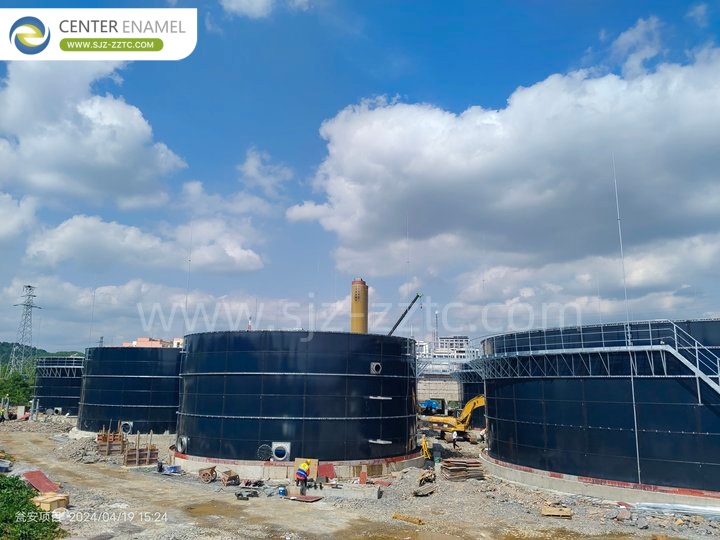
These reactors use steel tank shells, and their corrosion resistance and gas-tightness directly determine long-term operational stability. The application value of glass-fused-to-steel tanks in such scenarios is increasingly prominent, as they provide the durable, gas-tight containment that anaerobic processes require. For any Brewing Wastewater Treatment Project EPC Contractor, the selection of tank technology is therefore not a secondary consideration but a foundational decision that affects service life, maintenance costs, and biogas capture efficiency.
GFS Tanks Bolted Assembly: Faster, Expandable, Relocatable
GFS tanks are assembled on-site from prefabricated panels, with short construction periods and support for expansion, relocation, and reuse-advantages distinctly different from immovable concrete tanks.
Concrete tank pouring requires formwork, rebar tying, pouring, and long curing periods, with a single tank construction taking months. Rain, snow, and low temperatures force work stoppages and delays. Once poured, they are permanent fixed structures that cannot be dismantled, expanded, or relocated-project relocation means complete abandonment.
GFS tank panels are all factory-prefabricated, transported to site, and directly assembled with simple procedures. Construction can proceed even in low-temperature, light-rain conditions, with installation time only one-third that of concrete tanks-making construction schedules highly controllable. For expansion, additional steel panels can be installed to increase volume; for plant relocation, tanks can be fully disassembled with panels transported to new sites for reassembly and reuse, significantly reducing material and construction costs. This makes GFS tanks ideally suited for short-term environmental projects, phased expansion projects, and relocated construction projects-scenarios frequently encountered in the brewing sector.
| Feature | GFS Tanks | Concrete Tanks |
| Construction Time | 1/3 of concrete tanks | Months per tank |
| Weather Impact | Can proceed in low temp/light rain | Work stoppages in rain/snow/low temp |
| Expansion | Add panels to increase volume | Not expandable |
| Relocation | Fully disassemblable and reusable | Permanent, cannot relocate |
| Reuse | Panels transported and reassembled | Complete abandonment |
| Best For | Short-term, phased, relocated projects | Permanent fixed installations |
IC Supporting Equipment: The Integrated System Behind the Process
The IC Process depends on a carefully integrated set of supporting equipment to function reliably. Core equipment is the GFS tank with built-in gas-lift internal circulation system and upper/lower three-phase separators-key components for autonomous circulation and sludge-water separation.
Bottom precision distribution system and pressure regulating feed device ensure uniform stable influent. Supporting equipment includes influent lift pumps, equalization tanks, and flow meters for precise influent control. Top high-efficiency biogas collection, desulfurization, dehydration, and storage integrated equipment captures and conditions the biogas produced. High-precision online monitoring equipment provides real-time temperature, pH, COD, and level monitoring, enabling operators to maintain optimal conditions. Bottom and mid-section dedicated sludge discharge pipes and recirculation control devices complete the system-no external return pumps are needed for internal circulation.
The complete system is highly integrated, with no excess external equipment, compact structure, and high automation. For a Brewing Wastewater Treatment Project EPC Contractor, this integration translates directly into lower installation complexity, reduced footprint, and simpler ongoing operation.
Standardized Brewery Wastewater Treatment Solutions
Center Enamel has developed a mature "solid-liquid separation + anaerobic digestion + aerobic polishing" process train, perfectly suited for high-concentration, easily biodegradable organic wastewater.
Pretreatment uses screens, sedimentation tanks, and microfiltration to remove spent grain residues and colloidal suspended solids, preventing equipment clogging and reducing biochemical load. The main stage uses UASB/EGSB high-efficiency anaerobic processes for rapid high-concentration organic degradation with simultaneous biogas energy recovery-suitable for high pollution loads. Subsequent A/O or contact oxidation aerobic processes deeply degrade residual pollutants, with final sedimentation and disinfection ensuring stable effluent compliance.
Anaerobic digesters use Center Enamel GFS tanks, resistant to organic acid corrosion with long service life. The entire process has strong shock load resistance, simple process flow, and convenient O&M, making it suitable for the brewery industry's intermittent and seasonal discharge patterns-a critical advantage given the natural fluctuations in brewing production.
| Treatment Stage | Function | Key Equipment |
| Pretreatment | Remove spent grain, suspended solids | Screens, sedimentation, microfiltration |
| Anaerobic Digestion | High-concentration organic degradation, biogas recovery | UASB/EGSB, GFS tanks |
| Aerobic Polishing | Deep degradation of residual pollutants | A/O or contact oxidation |
| Final Treatment | Ensure stable effluent compliance | Sedimentation, disinfection |
Proven Anaerobic Digestion: The Pakistan Biogas Demonstration Project
Real-world project experience validates the effectiveness of anaerobic digestion across diverse feedstocks. Center Enamel served as the general contractor for the Pakistan Food Waste + Napier Grass Biogas Demonstration Project, a landmark initiative showcasing the viability of mixed-feedstock anaerobic digestion.
| Project Parameter | Specification |
| Location | Pakistan |
| Feedstock | Food waste + Napier grass |
| Core Process | CSTR (Continuous Stirred Tank Reactor) |
| Biogas Production | 100 m³/day |
| Project Type | Official demonstration project |
| Future Plan | Multiple large-scale biogas projects |
The project utilizes CSTR as the core anaerobic process, using food waste and Napier grass as mixed fermentation feedstock. The system is equipped with a mechanical mixing system that ensures thorough mixing of feedstock and anaerobic microorganisms, achieving efficient organic degradation with stable daily biogas production of 100 m³. This installation serves as the local official demonstration project for validating gas production efficiency and long-term continuous operational stability. Following successful pilot operation, multiple large-scale Napier grass biogas projects are planned locally to promote biomass clean energy and support regional low-carbon development.
Marketing Team: Global Expertise and Multilingual Support
Delivering successful international projects requires more than technical capability-it demands deep market knowledge and effective communication. Center Enamel's marketing team brings together environmental industry multi-skilled professionals and multilingual foreign trade specialists, with deep expertise in global biogas, wastewater treatment, and biomass new energy markets-accumulating extensive practical project experience in Southeast Asia, Africa, Europe, and the Americas.
The team is proficient in various countries' wastewater discharge regulations, biogas subsidy policies, and carbon trading rules-providing one-stop preliminary site survey, solution planning, and investment return analysis consulting services. With multilingual capabilities in English, French, Spanish, and Arabic, the team effectively communicates with clients worldwide-precisely matching regional industrial resources, project budgets, and environmental requirements. They customize high-cost-performance GFS tanks and anaerobic reactor solutions based on client production capacity, treatment targets, and gas production expectations. Leveraging extensive overseas project experience, the team proactively helps clients avoid risks in overseas approvals, equipment import, and construction implementation-building a globally adaptable integrated environmental equipment business service system.
Comprehensive International Authoritative Certifications
For international projects, credentials matter as much as capability. Center Enamel holds CE, NSF, WRAS, ISO9001, BSCI, ASME, and other global certifications-fully clearing EU, North American, Southeast Asian, and African project tendering barriers-providing critical hard credential advantages for large overseas project bidding.
| Certification | Region/Benefit |
| CE | European Union market access |
| NSF | North American water/wastewater standards |
| WRAS | UK water regulations approval |
| ISO9001 | Global quality management standard |
| BSCI | International social compliance |
| ASME | American Society of Mechanical Engineers |
FAQ
Q1: Why choose a Brewing Wastewater Treatment Project EPC Contractor with IC Process expertise? Brewery wastewater is highly biodegradable, making IC Process anaerobic treatment ideal for rapid COD removal, biogas recovery, and stable compliance.
Q2: How do GFS tanks benefit brewing wastewater projects? GFS tanks offer one-third the construction time of concrete, are expandable and relocatable, and resist organic acid corrosion for long service life.
Q3: What certifications does Center Enamel hold for global projects? Center Enamel holds CE, NSF, WRAS, ISO9001, BSCI, and ASME certifications, clearing tendering barriers in the EU, North America, Southeast Asia, and Africa.
Ready to deliver your brewing wastewater treatment project with proven IC Process technology and GFS tanks? Contact Center Enamel today for a customized EPC solution tailored to your production capacity and compliance targets.
Let our multilingual team guide you through every stage-from site survey and solution planning to construction and O&M. Reach out to Center Enamel and discover why clients across 100+ countries trust our integrated environmental equipment expertise.