
Leading Brewing Wastewater Treatment Project EPC Contractor: UASB Process & GFS Tanks for High-Strength Organic Wastewater
The competitive landscape of industrial wastewater treatment shows clear divergence, with leading companies building integrated service capabilities through technical integration and capital operations, while industry concentration gradually increases. Chinese manufacturers continue to consolidate their advantages in mid-tier equipment exports, with international giants targeting high-end customers and complex industrial wastewater markets, and local players occupying the mid-to-low-end and industrial park centralized treatment markets through service responsiveness and cost advantages.
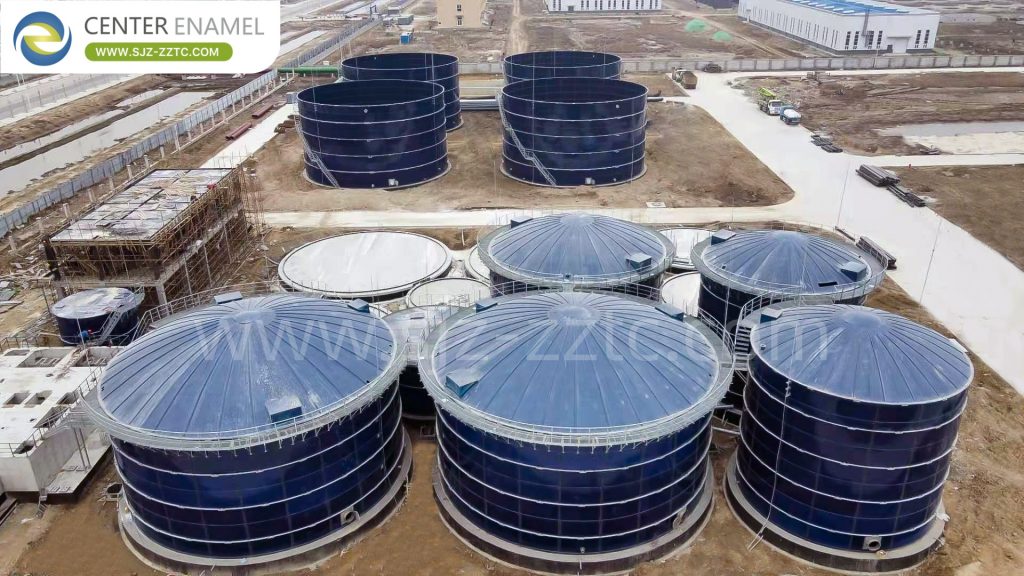
In the anaerobic process segment, UASB, EGSB, and IC anaerobic reactors-offering high loading rates, small footprints, and stable operation-are widely used in high-concentration organic wastewater pretreatment across food processing, pharmaceutical fermentation, alcohol brewing, chemical, and other industries. These reactors typically use steel tank shells, and their corrosion resistance and gas-tightness directly determine long-term operational stability. This is where the application value of Glass-Fused-to-Steel (GFS) tanks becomes increasingly prominent, making Center Enamel a trusted Brewing Wastewater Treatment Project EPC Contractor for projects worldwide.
The UASB Process: Core Technology for Brewery Effluent Treatment
For any brewing wastewater treatment project, the biological treatment process determines overall system efficiency and compliance. After pretreatment through screens and equalization tanks to remove impurities and balance water quality and flow, wastewater is uniformly fed into the UASB reactor through the bottom distribution system. The wastewater rises at a constant rate through the high-concentration granular sludge bed at the bottom, where anaerobic microorganisms rapidly degrade most organic matter, converting it into biogas, clean water, and a small amount of sludge. Gentle hydraulic mixing maintains sludge suspension, expanding microbial contact area, while remaining pollutants continue to degrade in the mid-section suspended sludge layer.
The mixed liquor finally enters the top three-phase separator for gas, solid, and liquid separation-biogas is collected upward for utilization, sludge settles back to the reaction zone, treated effluent overflows from the top, and aged sludge is periodically discharged, enabling fully automated continuous operation. This efficient UASB Process is precisely why brewing wastewater treatment projects consistently achieve 90–94% COD removal while recovering valuable biogas, and why Center Enamel's design team integrates this technology as a core component of every EPC solution.
Brewery Wastewater Characteristics: Why UASB is the Ideal Choice
The practical value of the UASB Process becomes evident when examining the specific water quality profile of brewery effluent. Brewery wastewater exhibits high concentration, high suspended solids, high color, slightly acidic pH, and excellent biodegradability-with significant fluctuations. COD typically ranges from 5,000 to 25,000 mg/L, with high-strength spent mash and still bottoms peaking at hundreds of thousands of mg/L. Suspended solids can reach up to 40,000 mg/L, with thick turbid liquor and stable slightly acidic pH of 3-5.
Pollutants are primarily natural organics from grain fermentation-starches, reducing sugars, proteins, alcohols-with no synthetic toxic substances, resulting in a BOD/COD ratio that can reach 0.5-0.6, representing industry-leading biodegradability. However, significant fluctuations with production batches and seasonal capacity, combined with susceptibility to secondary fermentation and odor if left standing, demand treatment systems that can handle variable loads. The UASB Process, with its stable granular sludge bed and inherent shock load resistance, delivers consistent performance where traditional systems often fail-reinforcing the value proposition of Center Enamel as a Brewing Wastewater Treatment Project EPC Contractor.
Proven Performance: Indonesia Palm Oil Biogas Upgrade Project
The real-world effectiveness of integrated UASB reactor and GFS tank solutions is demonstrated by the Indonesia Palm Oil Biogas Upgrade Project, commissioned in 2013 as the core anaerobic digestion reactor for the POME treatment station. The project utilized three GFS tanks in two sizes: 17.58 m diameter × 8.4 m height and 16.82 m diameter × 7.2 m height. These tanks serve as the core anaerobic reaction equipment specifically designed for high-organic palm oil production wastewater, where anaerobic digestion degrades pollutants and recovers biogas simultaneously.
The tanks were adapted to local palm industry wastewater needs, with GFS tank assembly proving convenient and corrosion resistance performing exceptionally well in Southeast Asia's hot, humid, high-corrosion environment. This project stands as a mature biomass energy environmental benchmark, demonstrating the viability of UASB-based biogas plant design in challenging tropical conditions. Its success validates the comprehensive approach offered by a professional Brewing Wastewater Treatment Project EPC Contractor, combining process engineering with durable infrastructure across diverse industrial sectors.
Over a Decade of Global Installation Experience
Supporting these diverse project deliveries requires extensive practical field experience. Center Enamel possesses unmatched global practical experience among domestic peers-over a decade covering multiple regions and all industry sectors. In 2009, the company completed the first overseas GFS tank installation, sending a team to Niger, Africa for drinking water storage tank installation. In 2015, it broke industry ground with China's first GFS tank export and installation to the United States-passing strict US acceptance standards.
All installed projects have operated stably for many years, covering livestock biogas, POME, municipal wastewater, and drinking water storage applications. Construction has covered Southeast Asia, Africa, the Americas, and other regions, accumulating specialized solutions for complex sites including mountainous terrain, coastal salt spray, tropical high temperatures, and high-standard European and American facility conditions-maturely addressing global special construction requirements. This extensive track record ensures that as a Brewing Wastewater Treatment Project EPC Contractor, Center Enamel can execute projects anywhere in the world, regardless of local conditions.
The Design Team: Engineering Excellence for Global Projects
Behind every successful EPC project lies a skilled design team that anticipates local challenges. Center Enamel's design team includes senior engineers registered in the Hebei Provincial Science and Technology Expert Database, with design standards aligned with strict European and American high-end equipment safety standards. The team can provide complete integrated design for differentiated overseas projects in livestock biogas, POME, municipal wastewater, hazardous waste storage, seawater desalination, and more-covering tank structure, anti-corrosion and sealing systems, biogas piping, and anaerobic process integration.
Pre-design thoroughly investigates local seismic zone, wind pressure, soil bearing capacity, water quality corrosivity, and local environmental discharge standards-applying thickened panels, reinforced anchored bases, and optimized sealing and corrosion structures as needed. Complete customized equipment solutions can be tailored to customer plant area, wastewater load, treatment targets, and budget-balancing safety, economics, and local adaptation-providing compliant, stable, and highly adaptable equipment structural design support for global environmental projects. This engineering rigor is what distinguishes a premier Brewing Wastewater Treatment Project EPC Contractor from equipment suppliers.
FRP Roof Cover Solution: Cost-Effective Infrastructure Complement
While the UASB Process requires sealed gas collection for biogas recovery, many water storage applications within a brewery or industrial facility do not. The FRP Roof is a general-purpose economical roof for atmospheric pressure storage tanks without air-tightness requirements, suitable for drinking water storage, agricultural irrigation water, firewater reserve, and general production wastewater temporary storage. It is available in two styles-flat and dome-allowing flexible selection based on tank specifications and site aesthetic requirements.
The roof is integrally molded from resin and fiberglass, lightweight, with natural water resistance and mild acid and alkali corrosion resistance. It will not rust or rot in long-term humid environments, eliminating the frequent anti-corrosion maintenance required for metal roofs. The dome style features excellent drainage performance due to its curved structure, resisting water accumulation, dust buildup, snow load, and strong winds, while the flat style facilitates the installation of maintenance walkways, level gauges, and vents on top, making inspection and operation convenient.
The product is fully insulated with no risk of galvanic corrosion, will not contaminate drinking water quality, and meets environmental standards for domestic water storage. The modular design with low individual component weight allows for simple on-site hoisting and assembly, offering high construction efficiency and affordable procurement and installation costs. It is only suitable for atmospheric pressure water storage tanks without biogas collection or pressurization requirements, and is not recommended for anaerobic fermentation gas-producing conditions. Widely used in rural agricultural water storage tanks, industrial park firewater tanks, waterworks buffer tanks, and small to medium-sized domestic wastewater temporary storage facilities, it is a cost-effective general-purpose roof choice for conventional water storage applications-complementing the UASB reactors that form the core of brewing wastewater treatment projects.
Conclusion
From the divergent competitive landscape of the industrial wastewater market to the specific challenges of brewery effluent, the combination of the UASB Process and comprehensive EPC contracting capabilities offers a proven, cost-effective, and globally deployable solution. Center Enamel, as a professional Brewing Wastewater Treatment Project EPC Contractor, delivers integrated systems that combine high-efficiency organic removal, biogas recovery, corrosion-resistant GFS tanks, and expert design support. With over a decade of global installation experience, a dedicated design team, and versatile infrastructure options like FRP roofs, Center Enamel provides the complete package for transforming industrial wastewater from an environmental liability into a renewable energy asset.
Frequently Asked Questions (FAQ)
1. Why should I choose Center Enamel as my Brewing Wastewater Treatment Project EPC Contractor?
Center Enamel combines over 30 years of industry experience, 200+ proprietary anti-corrosion formulations, and a proven track record as a Brewing Wastewater Treatment Project EPC Contractor with installations across 100+ countries. The company provides integrated services from design and manufacturing to installation and commissioning, backed by ISO, NSF, CE, and ASME certifications. This end-to-end capability ensures regulatory compliance, on-time delivery, and long-term operational reliability.
2. How does the UASB Process handle the fluctuating loads typical of brewery wastewater?
The UASB Process maintains a high-concentration granular sludge bed that retains active biomass even during low-flow periods. Its hydraulic upflow design provides natural mixing without mechanical parts, while the three-phase separator ensures efficient gas-liquid-solid separation. This inherent stability allows the system to withstand the intermittent and seasonal discharge patterns common in brewing operations, consistently achieving 90–94% COD removal.
3. What is the difference between FRP Roof and Aluminum Geodesic Dome Roof for my project?
The FRP Roof is a cost-effective, lightweight solution for atmospheric pressure storage tanks without gas-tightness requirements-ideal for drinking water, firewater, or temporary wastewater storage. The Aluminum Geodesic Dome Roof, conversely, provides superior sealing performance for biogas collection and odor control, with a self-supporting structure that eliminates internal columns. Your Brewing Wastewater Treatment Project EPC Contractor will recommend the appropriate option based on your specific tank function, gas collection needs, and budget constraints.