
How a Brewing Wastewater Treatment Project EPC Contractor Treat High-Strength Wastewater?
Brewing generates one of the strongest organic waste streams in the food and beverage industry, and turning that effluent into a compliant-even profitable-asset demands more than off-the-shelf treatment equipment. As an experienced Brewing Wastewater Treatment Project EPC Contractor, Center Enamel (Shijiazhuang Zhengzhong Technology Co., Ltd) integrates process design, engineered storage, anaerobic digestion and biogas recovery into a single turnkey delivery, so breweries can meet discharge limits, cut operating costs and capture renewable energy at the same time.
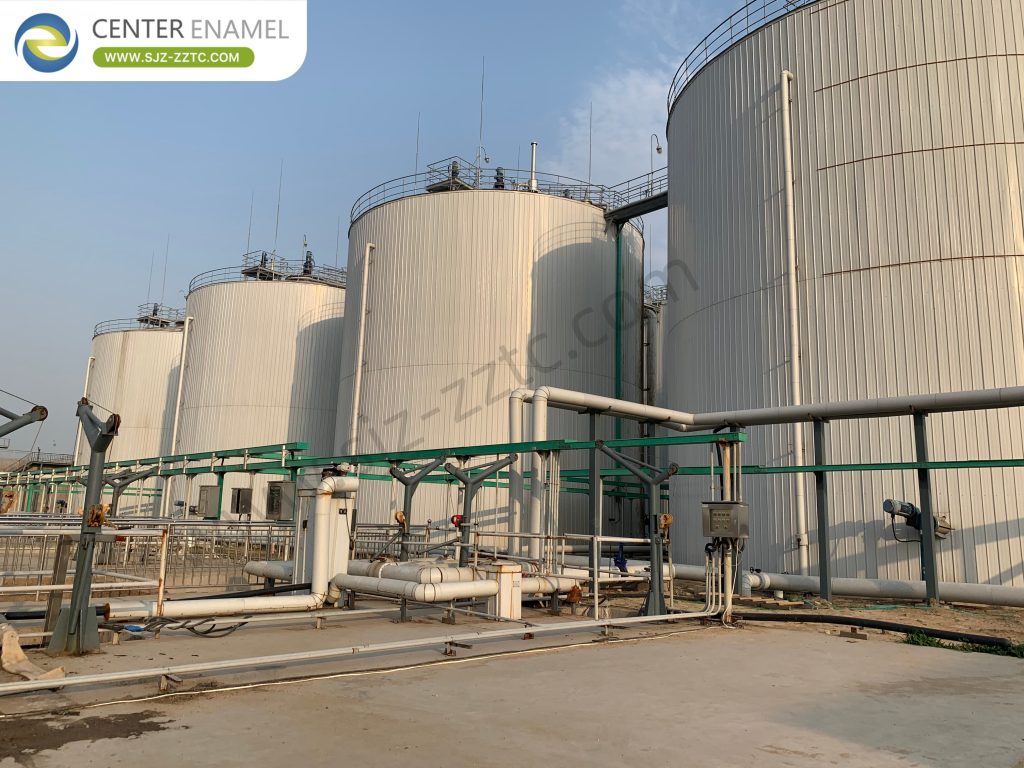
The Hidden Cost of High-Strength Brewing Effluent
The core difficulties of industrial wastewater treatment come down to what many engineers call the "three highs": high treatment difficulty, high cost and high energy consumption. Brewing effluent is a textbook example. Its composition is complex, its organic load is extreme, and tightening discharge standards leave little room for outdated aerobic-only designs. Many plants also struggle with intermittent, seasonal discharge peaks that overload undersized systems. Addressing these pressures requires a process-first approach rather than adding equipment piecemeal-and that is exactly where an EPC partner changes the economics. Understanding where the load actually comes from is the first step toward designing the right treatment train.
Mapping the Sources of Brewery Wastewater
Brewery wastewater is high-strength organic effluent generated across the entire production chain of beer, liquor and wine, and it ranks among the largest wastewater volumes in the food industry. The heaviest contamination occurs during raw-material soaking and washing, saccharification and fermentation, distillation and purification, and filling and packaging. The principal streams are still bottoms, fermentation yellow water, spent mash and grain-soaking liquor, while equipment washing, floor cleaning, line maintenance and cooling water make up the auxiliary discharges. Because production is seasonal and batch-driven, flows swing sharply between peak brewing season and off-season; large breweries usually collect wastewater centrally, whereas small and medium plants often suffer from dispersed, hard-to-control discharges concentrated around the brewhouse. The table below summarizes these streams and their typical character.
| Production Stage | Main Wastewater Streams | Key Characteristics |
| Raw-material handling | Grain soaking and wash water, spent-grain liquor | High suspended solids, intermittent flow |
| Saccharification & fermentation | Spent mash, fermentation yellow water | Very high COD/BOD, concentrated organic load |
| Distillation & purification | Still bottoms, condenser waters | Extremely high strength, seasonal flow peaks |
| Filling & packaging | Bottle/can rinsing and washing wastewater | Lower strength, large continuous volume |
| Auxiliary operations | Equipment/pipeline washing, floor cleaning, cooling water | Variable flow, traces of cleaning chemicals |
Once these streams are characterized, the central engineering question becomes how to remove the bulk of that organic load efficiently-and that is where anaerobic digestion earns its place at the core of a brewing treatment plant.
Anaerobic Digestion-From Liability to Renewable Energy
Anaerobic digestion uses a consortium of microorganisms to break down the organic matter in brewery effluent in an oxygen-free environment. Unlike conventional aerobic treatment, which must blow large amounts of air and still produce bulky excess sludge, anaerobic digestion converts most of the chemical oxygen demand into biogas-roughly 60–70% methane-that can be reused on site for heat or power. The result is a dramatic drop in discharge load, a far smaller sludge-handling bill and a measurable offset to energy costs. For high-strength, high-volume brewing effluent, this combination of compliance and energy recovery makes anaerobic digestion the logical first stage, followed by modest aerobic polishing to meet final emission limits. To capture those benefits at brewery scale, reactor choice matters a great deal.
The IC Reactor: Compact Power for High-Volume Brewery Loads
The Internal Circulation (IC) anaerobic reactor is the third-generation high-efficiency anaerobic technology built upon the UASB concept. Its defining innovation is a built-in gas-lift internal circulation system that recirculates wastewater autonomously, without external return pumps. The reactor is arranged in two zones-a lower main reaction zone and an upper polishing zone-and biogas-driven gas lift creates a strong internal hydraulic loop. This sharply raises the upflow velocity and improves contact between sludge and wastewater, so the plant treats far more load in a much smaller footprint. Its exceptional compactness makes the IC reactor specifically suited to high-concentration, high-flow industrial organic wastewater, and it has become a core process for modern high-strength brewing and food-effluent treatment. A high-performance reactor, however, is only as durable as the vessel that contains it-especially when brewery effluent and biogas are aggressively corrosive.
Corrosion-Engineered Equipment Built for Decades of Service
Center Enamel has independently developed more than 200 anti-corrosion enamel formulations and applies a proprietary double-sided, double-layer enameling process. The resulting glass-fused-to-steel (GFS) tanks resist the acidic, sulfide-laden environment of brewery wastewater and biogas fermentation for a service life exceeding 30 years-far outlasting conventional concrete and ordinary welded steel. Because every tank is bolted and modular, on-site erection is fast and predictable regardless of climate or logistics, which is critical for EPC projects delivered across diverse international locations. Equally important is what sits on top of each tank.
Roof Systems Tailored to Every Treatment Step
Not every unit in a brewing wastewater plant needs a gas-tight roof. For atmospheric storage steps such as equalization, firewater reserve or temporary buffering, Center Enamel offers an FRP roof-an economical, integrally molded resin-and-fiberglass cover available in flat and dome styles. It is lightweight, naturally water- and mild acid/alkali-resistant, will not rust or rot in humid service, and requires little maintenance. The dome design sheds water, dust, snow and wind loads, while the flat style supports walkways, level gauges and vents. However, the FRP roof is not designed for gas containment or pressurization. For the anaerobic digesters and biogas-holding vessels where recovery matters, Center Enamel instead supplies gas-tight dual-membrane biogas roofs that seal in the biogas, hold a stable gasholder pressure and protect the digester headspace. Choosing the right roof for each unit-economical where venting is fine, gas-tight where energy is recovered-is a quiet but decisive part of a well-tuned EPC design. With the process and equipment defined, the difference between a good plant and a predictable delivery is the partner who owns the whole chain.
Center Enamel: A Full-Chain EPC Partner You Can Build On
Center Enamel has worked in environmental bolted storage equipment for more than 30 years. Starting from proprietary enamel anti-corrosion materials, the company has grown step by step from a tank manufacturer into a comprehensive environmental EPC service provider, fully integrating enamel frit R&D, intelligent equipment manufacturing and project contracting. It has been recognized as a National High-Tech Enterprise, a National Specialized and Sophisticated "Little Giant," a Manufacturing Single Champion and a Provincial Green Factory, and has delivered more than 10,000 projects worldwide-including over 2,000 wastewater projects and more than 1,000 biogas projects. For a brewery, that breadth means a single contract covers process design, tank and roof supply, construction and commissioning, with no finger-pointing between vendors. Real-world operating results are the clearest proof of that capability.
A Proven Anaerobic Digestion Reference
In the Food Waste + Napier Grass Biogas Demonstration Project in Pakistan, Center Enamel acted as EPC and general contractor. The plant uses a CSTR (Continuous Stirred-Tank Reactor) as its core anaerobic process, co-digesting food waste with Napier grass. A mechanical mixing system keeps the feedstock and anaerobic microorganisms in thorough contact, degrades organic matter efficiently and sustains a stable biogas output of about 100 m³ per day. Because this is the local official demonstration project, its role is to validate gas-production efficiency and long-term continuous operational stability; after successful pilot operation, several large-scale Napier grass biogas projects are planned in the region. The same co-digestion, high-loading and gas-recovery principles scale directly to brewery waste streams, giving clients confidence that their Brewing Wastewater Treatment Project EPC Contractor has already solved the hardest process problems in the field.
| Parameter | Project Details |
| Project | Food Waste + Napier Grass Biogas Demonstration |
| Location | Pakistan |
| Center Enamel role | EPC / general contractor |
| Core anaerobic process | CSTR (Continuous Stirred-Tank Reactor) |
| Feedstock | Food waste co-digested with Napier grass |
| Mixing system | Mechanical agitation |
| Stable biogas output | Approximately 100 m³/day |
| Significance | Official local demonstration; larger follow-up projects planned |
Whether you are expanding a brewery, retrofitting an overloaded treatment plant, or evaluating the return on biogas recovery, our engineers can model your effluent characteristics and propose a fixed-scope EPC scheme. Contact Center Enamel today for a preliminary process layout and budget estimate tailored to your brewing wastewater treatment project.
Frequently Asked Questions
What makes Center Enamel a suitable Brewing Wastewater Treatment Project EPC Contractor?
Center Enamel owns the full chain-enamel frit R&D, GFS tank fabrication, IC/CSTR/UASB process design, biogas roofs and on-site erection-and has delivered 2,000+ wastewater and 1,000+ biogas projects worldwide, so a single contract covers design, equipment, construction and commissioning.
Why is anaerobic digestion preferred for brewery wastewater?
Brewery effluent carries extremely high COD and BOD. Anaerobic digestion converts most of that organic load into methane-rich biogas, lowering the discharge load and the plant's energy bill while producing far less excess sludge than aerobic systems, making it ideal for high-strength, high-volume brewery streams.
How long do GFS tanks last in brewery anaerobic digestion service?
With Center Enamel's double-sided, double-layer enameling and 200+ proprietary formulations, GFS tanks resist acidic brewery effluent and biogas corrosion reliably for more than 30 years, consistently outlasting concrete and ordinary steel in the same service.