
Can Agricultural Residue Be Digested?
Yes — most agricultural residue can be digested anaerobically, but lignocellulosic, low-moisture materials such as crop straw, corn stover, and rice husk break down slowly and are best co-digested with a wet, nutrient-rich substrate like animal manure at mesophilic 35–38°C. On their own, residues carry a high carbon-to-nitrogen (C:N) ratio that stalls microbes; paired with manure they supply the buffer, moisture, and inoculum needed for steady 55–65% methane biogas.
What Counts as Agricultural Residue
Agricultural residue covers harvest leftovers (wheat, rice, and corn straw; stover; husks; sugarcane bagasse), orchard prunings, and purpose-grown energy grasses such as napier (Pennisetum purpureum). These feedstocks are renewable, abundant, and carbon-rich — attractive for biogas — yet fibrous, often dry, and slow to hydrolyze in a digester without support.
Why Residue Digests Poorly Alone
Three factors limit lone-residue digestion: (1) C:N above 40–60:1 starves microbes of nitrogen; (2) lignocellulose resists hydrolysis, lengthening the 15–30-day mesophilic hydraulic retention time (HRT); (3) low moisture (<15% TS as harvested) leaves no liquid phase for the anaerobic consortium. A digester fed only straw stalls, foams, and produces little gas.
How Co-Digestion Fixes the Imbalance
Co-digesting residue with manure moves the blend to a target C:N of 20–30:1, adds alkalinity that buffers the pH near 7.0, and seeds active biomass. Manure supplies both nitrogen and a mature microbial community, so residue methane potential is realized without long acclimation.
| Blend | Approx. C:N | Result | Note |
| Straw only | 60–90:1 | stalls | N-limited |
| Manure only | 15–20:1 | good | low fiber |
| Straw + manure 1:1 | 22–30:1 | best | balanced buffer |
| Grass + manure | 20–28:1 | good | energy grass |
Technical Considerations
Size residue to 2–5 cm, consider light pretreatment (chopping, mild steam) for stubborn lignocellulose, and keep total solids in the 8–12% TS range for a wet CSTR. Design HRT toward the longer end (25–30 days) for high-fiber blends, and plan mixing that prevents matt—fiber floatation and scum layers.
How to Scope a Residue AD Project
Confirm annual residue tonnage and moisture, set the manure co-feed ratio for C:N 20–30:1, choose wet CSTR at 35–38°C, size by VS load (residues yield roughly 0.20–0.35 m³ biogas per kg VS), then specify corrosion-resistant tankage. A dry-tonnes-plus-manure sheet lets suppliers quote fast.
Project Case Study
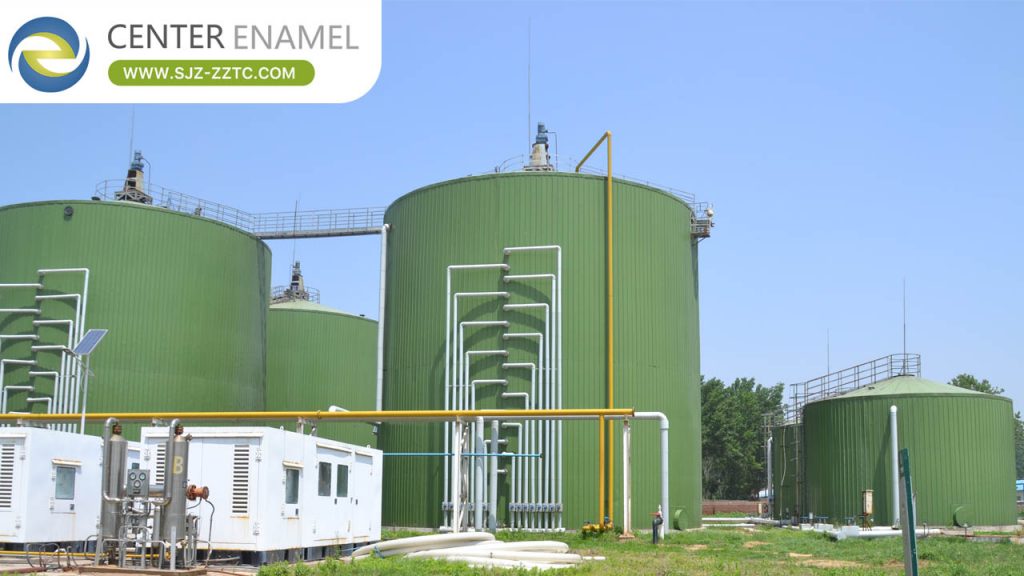
Zhaqi Biogas Project in Inner Mongolia. A mesophilic anaerobic fermentation plant processing 900 m³/day of farm animal manure and agricultural waste including grass straw, equipped with 4 CSTR reactors (Ø25.98 × 8.4 m) and producing 20,000 m³ of biogas daily. It is a documented agricultural-residue-and-manure co-digestion project in a cold-climate region.
| Project | Zhaqi Biogas Project in Inner Mongolia |
| Location | Xing'an, Inner Mongolia, China |
| Industry | Agriculture / Farm Biogas |
| Application | Manure + agricultural residue co-digestion |
| Product | 4 CSTR anaerobic reactors |
| Capacity | 900 m³/D feedstock |
| Quantity | 4 sets (Ø25.98 × 8.4 m) |
| Material | Glass-Fused-to-Steel (GFS) |
| Output | 20,000 m³ biogas/day |
| Status | Delivered 2017 |
About Center Enamel
Center Enamel applies its industry application experience in agricultural and farm biogas, supplying bolted Glass-Fused-to-Steel (GFS) tanks for manure-and-crop-residue plants on three continents. The company manufactures GFS tankage engineered for continuous wet, corrosive digester duty — glass fused at 820–930°C gives an inert, impermeable barrier — with documented agricultural biogas projects such as the Inner Mongolia CSTR installation above.
Advantages and Limitations
Residue co-digestion diverts field waste from burning, cuts manure odors, and lifts biogas yield. Limits: fibrous feed needs sizing and reliable mixing; cold climates need insulation and heat recovery; and residue supply is seasonal, so storage buffers matter. Modular GFS tanks reduce civil works and speed deployment.
Comparison: Residue Alone vs Co-Digestion
| Factor | Residue alone | Residue + manure |
| C:N | 60–90:1 (stalls) | 20–30:1 (stable) |
| Buffer | poor | strong |
| HRT | very long | 25–30 days |
| Biogas | low | steady 55–65% CH₄ |
Agricultural residue is digestible and a strong biogas feedstock, but it performs best when co-digested with manure at 35–38°C to reach C:N 20–30:1. Scope the project by residue tonnage and co-feed ratio, size a wet CSTR for 15–30-day HRT, and specify corrosion-resistant GFS tankage.
Frequently Asked Questions (FAQ)
Q1: Can agricultural residue be digested?
A: Yes — straw, stover, husks, and energy grass digest anaerobically, ideally co-digested with manure for stable C:N and higher methane.
Q2: Which residues suit AD?
A: Wheat/rice/corn straw, bagasse, husks, and napier grass are common; high-lignin wood waste is less suitable without pretreatment.
Q3: Why co-digest with manure?
A: Manure supplies nitrogen, alkalinity, and active microbes, balancing residue C:N to 20–30:1 and preventing stalls.
Q4: What C:N ratio is needed?
A: Target 20–30:1 total; residues alone sit at 60–90:1 and starve the biomass.
Q5: What tank capacity is available?
A: Center Enamel supplies GFS digester tanks from 200 m³ to 60,000 m³, modular for farm and agricultural plants.
Q6: What project experience exists?
A: Delivered manure-and-residue CSTR biogas projects in Inner Mongolia and food-waste co-digestion plants in Pakistan.
Send your residue tonnage, moisture, and available manure volume. We will set the co-feed ratio for C:N 20–30:1, size a mesophilic CSTR, and quote GFS tankage for your agricultural biogas project.