
One-Stop CBG Plant EPC Solutions Integrating High-Performance GFS Tanks for Anaerobic Digestion
Global industrial wastewater treatment policies are escalating from "compliance discharge" to mandatory "resource recovery" and "zero liquid discharge." The EU, through its Circular Economy Action Plan, requires member states to increase industrial wastewater reuse rates and extends carbon footprint accounting to the full life cycle of wastewater treatment. China continuously updates and tightens industrial water pollutant discharge standards, with increasingly stringent limits on total nitrogen, total phosphorus, and characteristic pollutants for industries such as chemicals, pharmaceuticals, and printing and dyeing. Some water-scarce regions and highly polluting industries are mandated to adopt zero or near-zero liquid discharge technologies. Germany has established a differentiated pretreatment technical standard system by industry, requiring industrial wastewater to meet specific quality requirements before discharge into municipal wastewater treatment plants, implementing strict source control.
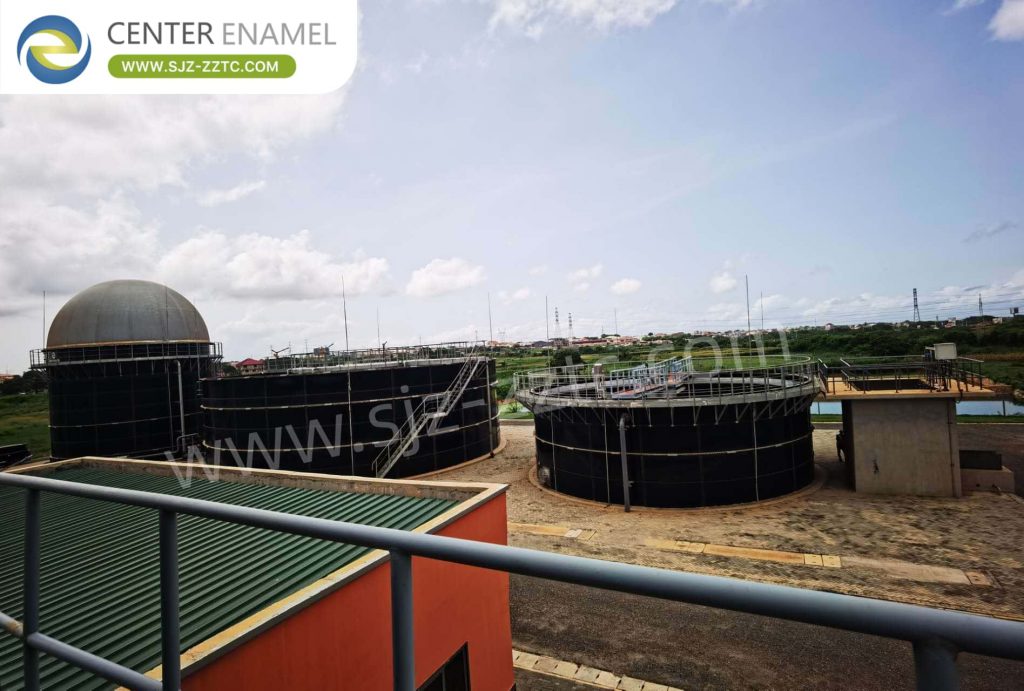
This regulatory shift toward resource recovery creates significant opportunities for CBG Plant EPC Solutions that convert organic pollutants into renewable energy. As a leader in this field, Center Enamel integrates durable GFS Tanks with advanced anaerobic processes to help clients achieve both environmental compliance and energy independence, turning wastewater treatment into a profit center through biogas production.
Essential UASB Supporting Equipment for Reliable Anaerobic Treatment
Core equipment includes the GFS anaerobic reactor tank, with the internal three-phase separator being the key component for gas-liquid-solid separation and sludge retention. The bottom high-precision distribution system (distribution pipes, distributors, pressure regulators) ensures uniform influent distribution, preventing short-circuiting and sludge accumulation. Supporting equipment includes influent lift pumps, equalization tanks, and flow meters to stabilize influent conditions. The top biogas collection system includes gas collection hoods, gas piping, desulfurization/dehydration equipment, and gas storage. Online temperature, pH, and COD monitoring instruments are integrated. Bottom sludge discharge pipes and pumps periodically remove excess sludge. The complete equipment package is compact, with no rotating wear parts, low equipment loss, and high operational stability.
For any CBG Plant EPC Solutions provider, the quality and integration of this supporting equipment directly impacts long-term plant performance. Center Enamel's GFS Tanks serve as the robust foundation for these systems, with the enamel coating providing exceptional resistance to the corrosive environment created by volatile fatty acids and hydrogen sulfide. The modular design of GFS tanks also simplifies the installation of internal components like the three-phase separator and distribution system.
Standardized Brewery Wastewater Treatment Solutions with GFS Tanks
Mature "solid-liquid separation + anaerobic digestion + aerobic polishing" process train, perfectly suited for high-concentration, easily biodegradable organic wastewater. Pretreatment uses screens, sedimentation tanks, and microfiltration to remove spent grain residues and colloidal suspended solids, preventing equipment clogging and reducing biochemical load. The main stage uses UASB/EGSB high-efficiency anaerobic processes for rapid high-concentration organic degradation with simultaneous biogas energy recovery-suitable for high pollution loads. Subsequent A/O or contact oxidation aerobic processes deeply degrade residual pollutants, with final sedimentation and disinfection ensuring stable effluent compliance. Anaerobic digesters use Center Enamel GFS tanks, resistant to organic acid corrosion with long service life. The entire process has strong shock load resistance, simple process flow, convenient O&M, and is suitable for brewery industry's intermittent and seasonal discharge patterns.
This standardized approach, delivered through comprehensive CBG Plant EPC Solutions, has proven its effectiveness across numerous brewery projects. The integration of GFS Tanks as anaerobic digesters is particularly advantageous, as the glass-fused-to-steel surface prevents the organic acid corrosion that commonly plagues concrete or carbon steel tanks in brewery applications. The resulting biogas can be upgraded to CBG (Compressed Biogas) for vehicle fuel or injection into natural gas networks, maximizing the project's economic and environmental returns.
Indonesia Palm Oil Biogas Upgrade Project
Commissioned in 2013 as the core anaerobic digestion reactor for the POME treatment station, with 3 GFS tanks in two sizes: 17.58 m dia. × 8.4 m height / 16.82 m dia. × 7.2 m height. The tanks serve as the core anaerobic reaction equipment specifically for high-organic palm oil production wastewater-anaerobic digestion degrades pollutants and recovers biogas. Tanks are adapted to local palm industry wastewater needs. GFS tank assembly is convenient with corrosion resistance for Southeast Asia's hot humid high-corrosion environment-a mature biomass energy environmental benchmark project.
This landmark project exemplifies the turnkey capability of Center Enamel's CBG Plant EPC Solutions. By supplying not only the GFS Tanks but also the complete engineering, procurement, and construction services, the company delivered a fully operational biogas facility that has performed reliably for over a decade. The project's success in one of the world's most challenging industrial wastewater sectors underscores the durability of GFS tanks and the expertise of Center Enamel as an EPC partner.
Center Enamel's Full-Category Complete Product Matrix
Center Enamel has built a complete product matrix of "core storage tanks + supporting covers + specialty pressure vessels + complete environmental engineering services"-the only company globally to achieve integrated enamel frit R&D, self-manufacturing, and GFS tank application.
① Core: Proprietary GFS Tanks-Using proprietary double-sided hot-rolled double-layer enamel anti-corrosion technology-resistant to strong acids/alkalis, high salinity, and microbial corrosion-modular quick assembly-suitable for all strong-corrosion conditions in wastewater, biogas, and chemical applications.
② Supporting: Fusion Bonded Epoxy Tanks-Produced on China's first intelligent standardized production line-primarily for drinking water, fire water, and neutral medium storage.
③ Sealing: Aluminum Dome Covers-Proprietary high-strength aluminum alloy self-supporting structure-meeting international waterproof and load-bearing standards-suitable for tank sealing and biogas collection.
④ Other Tanks: Carbon Steel Tanks, Stainless Steel Tanks, Composting Tanks, Various Non-Standard Pressure Vessels.
⑤ Engineering Services: Environmental EPC General Contracting, Anaerobic Process Section Subcontracting-one-stop coverage across food waste, leachate, municipal wastewater, livestock biogas, petrochemical/metallurgical, and seawater desalination industries-customizable tank volume, corrosion protection grade, and complete process solutions with integrated equipment manufacturing and engineering construction.
This comprehensive product matrix enables Center Enamel to deliver truly integrated CBG Plant EPC Solutions. Clients benefit from single-source responsibility for all tank-related components, ensuring compatibility and reducing procurement complexity. Whether the project requires gas-tight GFS tanks for anaerobic digestion or cost-effective storage for treated effluent, the company provides optimally engineered solutions for each application.
Comprehensive International Authoritative Certifications
Center Enamel holds CE, NSF, WRAS, ISO9001, BSCI, ASME, and other global certifications-fully clearing EU, North American, Southeast Asian, and African project tendering barriers-providing critical hard credential advantages for large overseas project bidding.
These certifications are essential for any CBG Plant EPC Solutions provider operating in international markets. They demonstrate compliance with the strictest quality, safety, and environmental standards, giving clients confidence in the durability and performance of GFS Tanks and associated equipment. The certifications also streamline the permitting and approval process for biogas projects in regulated jurisdictions, reducing project timeline risks.
Aluminum Alloy Trough Deck Roof for Cost-Effective Storage
Aluminum Alloy Trough Deck Roof is a cost-effective economical tank cover solution for clean water and wastewater storage scenarios, primarily designed for drinking water, production wastewater, and firewater reserve tanks, balancing practicality and cost advantages. The main body is integrally formed from anti-corrosion aluminum alloy plates, paired with aluminum support trusses. Its lightweight design imposes less load on the tank foundation, reducing civil construction investment. A naturally formed dense oxide protective layer on the surface resists rain and mild wastewater corrosion, withstands outdoor sun and rain exposure, and effectively blocks wind, rain, insects, fallen leaves, and odor volatilization, protecting water quality by preventing dust and debris from falling in and causing secondary contamination.
The flat roof structure is neat and orderly, allowing installation of maintenance walkways, guardrails, vents, and level monitoring ports on top, facilitating daily inspection and equipment maintenance. The simple sealing structure enables straightforward installation with short construction timelines, and virtually eliminates the need for anti-corrosion painting maintenance, resulting in extremely low operational costs. It is suitable for various small, medium, and large atmospheric pressure water storage tanks, and has been widely implemented in waterworks clear water tanks, industrial circulating water tanks, park firewater tanks, and domestic wastewater temporary storage facilities. It is highly compatible with water storage applications that do not require biogas collection or high-pressure sealing.
While CBG Plant EPC Solutions focus primarily on anaerobic digesters and biogas upgrading, the Aluminum Alloy Trough Deck Roof offers a complementary solution for auxiliary storage needs. For example, treated effluent storage tanks, firewater reserve tanks, and process water tanks within a biogas plant can all benefit from this cost-effective roof design. By offering both gas-tight covers for digesters and economical covers for water storage, Center Enamel provides a complete roofing solution for all tanks within a CBG plant, ensuring consistency in quality and corrosion protection across the facility.
Frequently Asked Questions (FAQ)
Q1: What are CBG Plant EPC Solutions and how do GFS Tanks fit into them?
A: CBG (Compressed Biogas) Plant EPC Solutions encompass the full engineering, procurement, and construction of facilities that convert organic waste into renewable natural gas. Center Enamel's GFS Tanks serve as the primary anaerobic digesters, providing a corrosion-resistant, gas-tight environment for the UASB process that generates biogas from high-strength industrial wastewater or agricultural residues.
Q2: Which industries are best suited for Center Enamel's CBG Plant EPC Solutions with GFS Tanks?
A: Industries generating high-COD organic wastewater-including palm oil mills (POME), breweries, food processing, sugar refineries, paper mills, and livestock operations-are ideal candidates. The combination of durable GFS Tanks and efficient anaerobic treatment enables these facilities to treat wastewater, recover biogas for energy, and meet stringent discharge standards, often achieving payback periods under 3–5 years.
Q3: What certifications ensure the quality and reliability of Center Enamel's GFS Tanks for CBG plants?
A: Center Enamel's GFS Tanks and CBG Plant EPC Solutions hold CE, NSF, WRAS, ISO9001, BSCI, and ASME certifications. These international accreditations confirm compliance with European, North American, and global quality and safety standards, ensuring that the tanks and systems deliver reliable performance over their 30+ year design life.