
Center Enamel: A Leading Supplier of Biogas Project Solutions for the Livestock Industry
Driven by global population growth and consumption upgrades, the livestock industry is undergoing a profound transformation from traditional free-range farming to large-scale, intensive operations. While this transition significantly improves the efficiency of livestock product supply, it also brings environmental challenges due to the concentrated and explosive growth of livestock manure. Facing the pressure of processing billions of tons of manure and the urgent global carbon reduction targets, simple pollution control can no longer meet the industry's sustainable development needs. Transforming waste into renewable resources has become an inevitable choice.
Center Enamel, deeply rooted in the environmental protection equipment manufacturing field, leverages a powerful product matrix centered on Glass-Fused-to-Steel (GFS) tanks and one-stop engineering delivery capabilities. The company is committed to providing global livestock clients with full-chain solutions, from manure treatment to high-value utilization of biogas, helping farms achieve compliant operations while fully tapping into the multi-dimensional economic benefits of energy, fertilizer, and carbon reduction.
Overview of Global Livestock Industry Development
With global population growth and rising household income levels, the demand for livestock products such as meat, eggs, and milk continues to climb, driving the livestock industry to rapidly transform toward large-scale, intensive, and standardized operations. Traditional decentralized farming models are being replaced by large-scale farms and industrial parks, with significantly increased stocking density per farm and continuous improvements in mechanized and automated farming management. The scale of the livestock industry in developed countries is relatively mature, while developing countries (especially China) are accelerating the process of large-scale farming, with the proportion of large-scale farming increasing year by year, becoming the mainstream trend of global livestock development.
As the scale of farming continues to increase, the generation of livestock manure is growing explosively, with billions of tons produced globally every year. If not handled properly, manure can easily cause water eutrophication, soil pollution, foul odors, and massive emissions of greenhouse gases (such as methane and ammonia), aggravating environmental burdens and climate change pressure. At the same time, due to the concentrated generation of manure in large-scale farms and limited local consumption capacity, traditional ways of returning manure to fields are difficult to meet processing needs. Resource-based and harmless treatment of manure has become a key challenge for the sustainable development of the global livestock industry.
How Does Animal Manure Increase Profitability?
Energy Revenue from Biogas Power Generation/Heating
Biogas produced by anaerobic fermentation of animal manure can be directly used for power generation, fed into the grid, or used locally to provide electricity and heat for farms and surrounding communities, replacing part of fossil energy consumption. Globally, biogas power generation projects generally enjoy feed-in tariff subsidies or green electricity premiums. In some regions, biogas is further purified into biomethane, injected into natural gas pipelines, or sold as vehicle fuel, further broadening revenue channels. For farms, biogas utilization not only reduces their own energy costs but also creates stable additional cash flow by selling surplus electricity and gas, thereby improving overall operating efficiency.
Agricultural Value of Biogas Residue and Slurry as Organic Fertilizer
The biogas residue and slurry produced by anaerobic digestion are rich in nitrogen, phosphorus, potassium, various trace elements, and organic matter, making them high-quality organic fertilizer resources. After solid-liquid separation, composting, or deep processing, biogas residue can be made into commercial organic fertilizer or seedling substrate for sale. Biogas slurry can be directly returned to the field or processed into liquid fertilizer to replace some chemical fertilizers, improve soil structure, and increase soil fertility. Bringing these to the market or connecting with surrounding farms can reduce planting-side fertilizer procurement costs and open up new revenue sources for farms, achieving bidirectional value-added in the planting-breeding cycle.
Policy Dividends from Carbon Reduction Trading
Open stacking or direct discharge of livestock manure emits large amounts of potent greenhouse gases such as methane. Standardized treatment through anaerobic digestion can significantly reduce greenhouse gas emissions. Once this portion of emission reduction meets relevant methodology accounting standards, it can be developed into carbon credits and sold in voluntary carbon markets or mandatory carbon trading systems, bringing additional carbon asset revenue to farms. With the continuous improvement of the global carbon pricing mechanism and the continuous growth of corporate carbon neutrality needs, the carbon reduction value of livestock manure treatment projects is increasingly receiving attention and support from capital and policy.
Core Process of Converting Animal Manure into Biogas
3.1 Raw Material Pretreatment System
After manure collection, it first passes through a screen to remove coarse debris (such as straw, plastic, sand, and gravel) to prevent clogging and wear of subsequent equipment. It then enters a grit chamber for sedimentation to separate inorganic impurities such as heavy mud and stones, reducing the load on the anaerobic system. The material after impurity removal and sedimentation enters a mixing tank, where it is diluted with water and homogenized through stirring to adjust the manure concentration to a solid content suitable for anaerobic fermentation (generally 8%~12%). At the same time, the pH value can be adjusted to create stable and uniform feeding conditions for subsequent anaerobic digestion.
3.2 Anaerobic Digestion System
The mixed material enters the anaerobic fermentation tank (commonly a CSTR - Continuous Stirred-Tank Reactor). In a sealed, hypoxic environment, it relies on the synergistic action of various microorganisms such as hydrolytic bacteria, acidogenic bacteria, and methanogenic bacteria. Through the four stages of hydrolysis, acidification, acetogenesis, and methanogenesis, organic matter is gradually decomposed and converted into biogas composed mainly of methane (CH₄ 55%~65%) and carbon dioxide. The system needs to control temperature (mesophilic around 35°C or thermophilic around 53°C), pH value (6.8~7.5), stirring frequency, and hydraulic retention time (20~30 days) to ensure gas production efficiency and stable system operation.
3.3 Biogas Purification, Storage, and Utilization
The produced biogas is purified through desulfurization, dehydration, and other processes to remove impurities such as hydrogen sulfide and water vapor, and then enters a gas holder for temporary storage. It can be used for power generation, heating, cooking fuel, or purified to natural gas quality for injection into the pipeline network. The fermented biogas residue and slurry are rich in nitrogen, phosphorus, potassium, and organic matter. Biogas residue can be made into organic fertilizer after solid-liquid separation and composting; biogas slurry can be directly returned to the field for irrigation or processed into liquid fertilizer, realizing the full resource utilization of "three biogases" (biogas, residue, and slurry) and forming an ecological cycle loop combining planting and breeding.
Core Technology and Equipment: CSTR + GFS Tank + Double Membrane Roof
4.1 CSTR (Continuous Stirred-Tank Reactor)
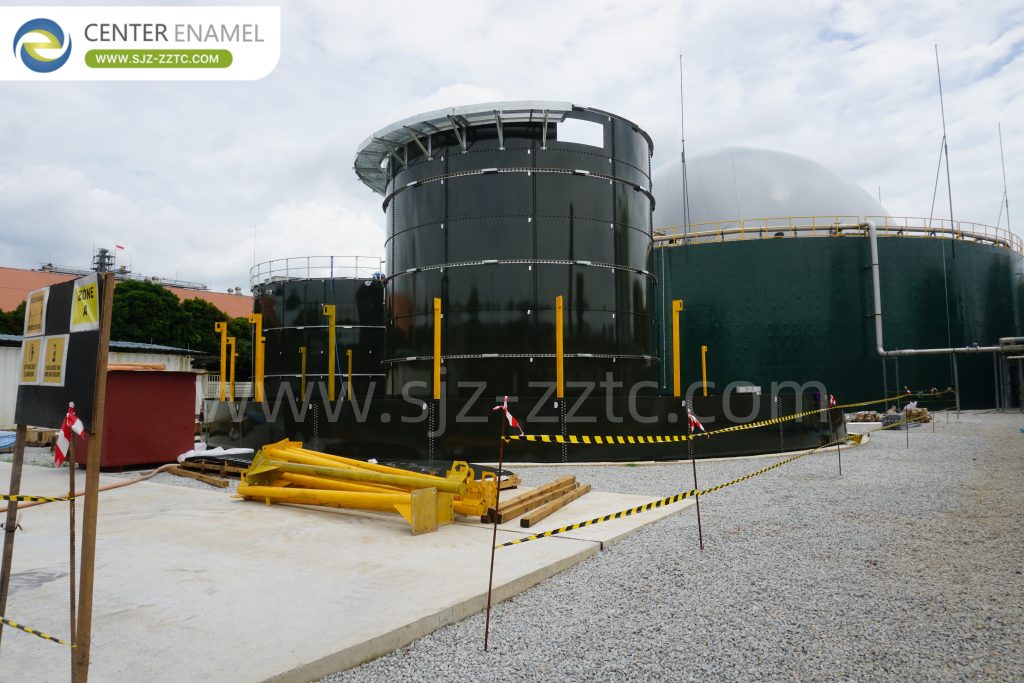
The CSTR (Continuous Stirred-Tank Reactor) is the core processing unit of a biogas project. It converts organic waste into biogas by relying on the action of anaerobic microorganisms, achieving waste reduction and stabilization while producing renewable energy. This reactor is equipped with a mechanical stirring device and uses a continuous or semi-continuous feeding method to fully mix high-suspended-solid, high-concentration organic wastewater with anaerobic microorganisms at a constant temperature, forming a relatively complete mixed fermentation state, thereby effectively degrading organic matter in the wastewater. The reaction tank is equipped with a positive and negative pressure protector, biogas pipeline, crust breaking device, paddle stirrer, stirring shaft, feed inlet, mud outlet, etc., making it suitable for large-scale anaerobic treatment of high-concentration organic waste such as livestock manure and kitchen waste.
4.2 GFS (Glass-Fused-to-Steel) Tank
The GFS (Glass-Fused-to-Steel) tank is manufactured by firing steel plates at high temperatures of 820°C~930°C, causing the molten glass to react with the surface of the steel plate to form an inert inorganic bonding layer, combining the strength and toughness of steel with the excellent corrosion resistance of glass. Compared with traditional epoxy coating or welded storage tanks, GFS tanks have better anti-corrosion performance and longer service life. Its double-layer coating structure (2C2F, two coats and two firings) includes a surface coating, a base coating, and a steel plate substrate, with dual protection on both inside and outside surfaces. In addition, GFS tanks use an assembly-type installation method, which is convenient for construction and has a short cycle. It is widely used in fields such as biomass energy, drinking water storage, municipal sewage, landfill leachate, and industrial wastewater treatment.
4.3 Double Membrane Roof Gas Storage System
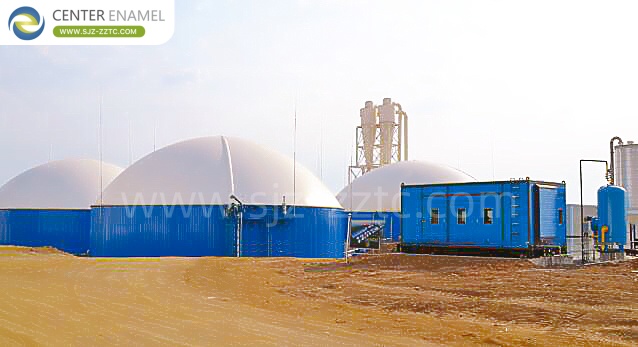
The double membrane roof is the preferred solution for biogas storage systems, offering significant advantages over traditional structures under normal operating conditions. In terms of cost, the double membrane roof can directly reduce the construction cost of the tank top. In terms of space utilization, it significantly reduces the footprint compared to traditional structures and saves the foundation construction costs required for ground-type gas holders. The double membrane structure is usually composed of an inner membrane (gas storage membrane) and an outer membrane (protective membrane), which maintains the air pressure between the membranes through a blower to achieve stable and controllable biogas pressure. It has good sealing and safety, ensuring the efficient and stable operation of the biogas storage and gas supply system.
How to Choose a Supplier of Biogas Project Solutions?
5.1 Maturity and Stability of Core Processes and Equipment
Biogas projects have long investment cycles and high operational requirements. Whether the equipment supplier has mastered core anaerobic fermentation processes like CSTR, and whether it has mature manufacturing capabilities for key equipment such as mechanical stirring, feeding/discharging, and crust breaking, directly determines the gas production efficiency and operational stability after the project is put into production. At the same time, the corrosion resistance, sealing, and service life of the tank material (e.g., GFS tanks can last over 20 years) are also key factors in ensuring long-term stable project operation and reducing maintenance costs.
5.2 Full-Set, One-Stop Engineering Delivery Capability
From raw material pretreatment and anaerobic digestion to biogas purification, storage, and utilization, biogas projects involve the connection of multi-link processes. If a supplier can only provide a single piece of equipment but lacks overall engineering capabilities, it can easily lead to issues such as inconsistent standards across links and undefined responsibilities. Suppliers with complete solution capabilities of "equipment manufacturing - process segment undertaking - EPC (Engineering, Procurement, and Construction)" can better guarantee the overall quality and progress of the project from design and construction to commissioning.
5.3 International Certification and Quality Assurance System
Biogas projects often involve cross-border cooperation and local standard requirements. Whether the supplier has international authoritative certifications such as CE, WRAS, NSF, and ISO 9001, and whether it has established a multi-layer quality control system covering raw materials, production, and inspection, is an important basis for judging whether its products can meet the regulations and safety standards of different countries/regions.
5.4 Global Project Experience and Localized Service Capability
The long-term stable operation of a biogas project after completion is inseparable from timely after-sales response and technical support. Suppliers with rich overseas project implementation experience, an extensive localized service network, and mature troubleshooting and on-site repair processes can provide cross-border clients with more reliable full-life-cycle guarantees, effectively reducing project operational risks.
Center Enamel: One-Stop Biogas Project Solution Supplier
6.1 Company Strength
Center Enamel is a global leader in the prefabricated storage industry. It has built two high-end R&D and production bases, deploying over 150,000 square meters of large-scale R&D positions, realizing "self-developed, self-produced, and independently controlled," with the second phase of the base under planning and construction. The company independently built a core R&D center equipped with cutting-edge high-precision equipment and established joint laboratories and graduate internship bases with universities such as Hebei University of Science and Technology and Donghua University. Industry-university-research cooperation projects cover topics such as enameling and sewage treatment processes, hot-rolled steel plate processing technology, etc.
Regarding the quality management system, products have passed international authoritative certifications such as CE, WRAS, NSF, BSCI, and ISO 9001:2015, and are accompanied by multiple external inspections such as steel plate raw material quality certificates and inspection reports to fully guarantee product quality. As the first manufacturer in China to independently develop and produce GFS tanks, Center Enamel developed the first domestic hot-rolled double-sided enameled plate, filling a domestic technology gap, and possesses nearly 200 enamel formulas and patents. It is the world's only GFS tank enterprise possessing both enameling and enamel glaze technologies.
6.2 Comprehensive Product Matrix
Center Enamel started by focusing on the R&D and production of GFS tanks and gradually extended to fields such as storage tanks, covers, pressure vessels, and engineering equipment, forming a multi-category, comprehensive equipment manufacturing system. Products include GFS tanks (the first manufacturer in China), Fusion Bonded Epoxy tanks (first batch of production lines in China), stainless steel tanks, Galvanized Steel tanks, Aluminum Geodesic Dome Roof.
Roof solutions cover Glass-Fused-to-Steel Roof (suitable for scenarios with high airtightness requirements such as CSTR anaerobic tanks), Aluminum Alloy Trough Deck Roof, stainless steel covers, Single and Double Membrane Roof (integrated into anaerobic fermentation tanks for biogas collection and odor control), FRP Roof (dome or flat), and other diversified choices. In addition, the company also developed a full set of modular sewage treatment equipment units, supporting various reactors such as CSTR, UASB, IC, USR, UBF, EGSB, as well as engineering equipment such as storage tanks, double membrane gas holders, three-phase separators, mixers, desulfurization tanks, and solid-liquid separators, building a complete solution system covering "equipment manufacturing - process segment undertaking - EPC".
6.3 Project Experience in Over 100 Countries
Center Enamel's products are sold to over 100 countries around the world, creating milestones in its development history: In 2008, it became the designated GFS tank supplier for the Beijing Olympic Games sewage treatment project; in 2009, it expanded into the overseas market for the first time, applying GFS tanks to a drinking water project in Niger, Africa; in 2015, it became the first GFS tank manufacturer in Asia to receive the US NSF61 certification and reached a strategic cooperation with a professional US storage tank company.
In the same year, it successfully sold its products back to the United States, the birthplace of GFS tanks, breaking the zero record for Chinese GFS tank exports to the US; in 2018, it created the record for the tallest GFS tank in Asia (34.8 meters) in a fire water tank project in Indonesia. The company has built a sales center network covering all regions of China and key overseas markets, and through local agent systems, supports project cases operating for more than 20 years with 24-hour efficient response, on-site service, and perfect customer guarantee processes, fully demonstrating its global project delivery and after-sales service capabilities.
Typical Cases of Center Enamel
Case 1: Pakistan Biogas Project
Recently, the Center Enamel Pakistan Biogas Project was successfully completed. The project uses kitchen waste and elephant grass as raw materials and mainly adopts the CSTR anaerobic reactor process. Through mechanical stirring, the raw materials are fully contacted with anaerobic microorganisms to achieve a daily biogas production of 100 cubic meters. As a model project, Center Enamel, with its self-developed GFS tank as the core, supports full-chain equipment such as raw material pretreatment, biogas purification, and intelligent control, providing a one-stop solution from processing to gas production, purification, and storage. Follow-up will promote the construction of larger-scale biogas projects, fully demonstrating the company's technical strength and engineering delivery capabilities in the overseas environmental protection field.
Case 2: Indonesia Palm Oil Wastewater Treatment Project
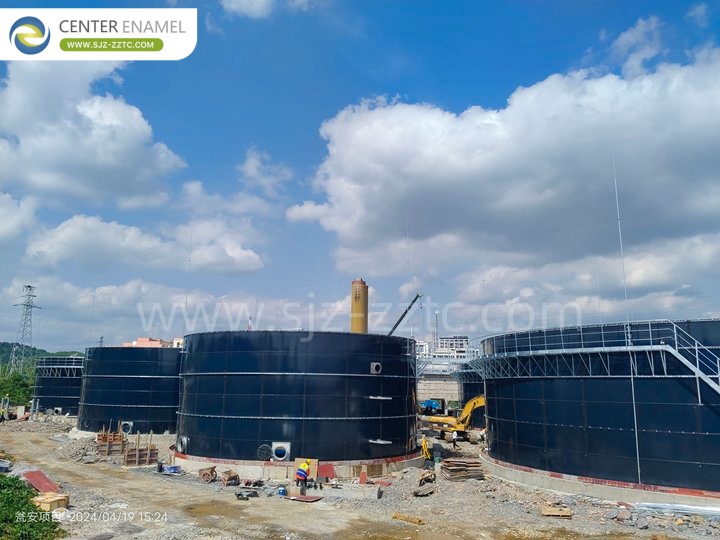
In 2013, Center Enamel undertook the anaerobic reactor project for a palm oil wastewater treatment plant in Indonesia. The project installed 3 GFS tanks with specifications of Ø17.58m×8.4m and Ø16.82m×7.2m, applied to the anaerobic treatment link of palm oil mill wastewater. This project is a typical case of Center Enamel in the biomass energy field in Southeast Asia, reflecting the reliability and applicability of the company's GFS tank products in palm oil wastewater treatment scenarios, providing mature technical references for similar agricultural waste resource treatment projects in the region.
Conclusion
The resource utilization of livestock manure is not only a key path to breaking environmental constraints but also an important opportunity for livestock enterprises to reduce costs, increase efficiency, and open up new growth points. Relying on self-developed CSTR anaerobic reactor technology, GFS tanks with excellent corrosion resistance and a service life of over 20 years, and core equipment such as efficient and reliable double membrane roof gas storage systems, Center Enamel has built a full-process solution covering "pretreatment - anaerobic digestion - biogas purification and storage - terminal utilization".
The company has rich project experience radiating to more than 100 countries around the world, a complete international authoritative certification system, and strong manufacturing guarantees of "self-developed, self-produced, and independently controlled," which can provide customized, stable, and efficient one-stop services for livestock industry clients of different scales. Choosing Center Enamel means choosing to escort your biogas project with advanced technology and mature experience, and moving together toward a green, circular, and sustainable energy future.
FAQ
Q1: What are the requirements for livestock farm size for biogas projects?
A: Small and medium-sized farms are also suitable. Center Enamel provides modular and scalable solutions that can flexibly configure tank volume and process units according to daily manure output, which can be implemented from dozens of cubic meters to tens of thousands of cubic meters of biogas production per day, balancing economy and practicality.
Q2: What are the advantages of GFS tanks compared to traditional concrete tanks?
A: GFS tanks have extremely strong corrosion resistance and a service life of over 20 years. They are standardized in factory production, assembled on-site, have a short construction cycle, controllable quality, and are convenient for later maintenance. Their comprehensive cost-effectiveness is significantly better than traditional tanks.
Q3: What after-sales guarantees does Center Enamel provide after the project is completed?
A: Relying on a global sales service network and local agent system, the company provides 24-hour response, on-site troubleshooting, spare parts supply, and regular inspections to ensure the stable operation of the project throughout its life cycle.