
Center Enamel: A Professional One-Stop Solution Provider for Global Waste to Energy Projects
The global biogas industry competitive landscape shows divergence. Leading companies dominate major project market shares through the "EPC + Operation" integrated model, while small and medium-sized enterprises focus on county-level distributed projects and specialized equipment segments. China's biogas equipment exports continue to expand, with generator sets primarily flowing to emerging markets. Business model innovation is accelerating, with carbon asset development becoming a standard feature of large projects, converting methane emission reductions into tradable carbon credits.
Some countries have piloted digestate fertilizer carbon credit trading, encouraging the integration of digestate application to farmland with carbon accounting. The "biogas operation outsourcing" service model is emerging, improving operational efficiency of county-level projects through professional management. From a technology and equipment perspective, anaerobic digestion is the core process of biogas engineering.
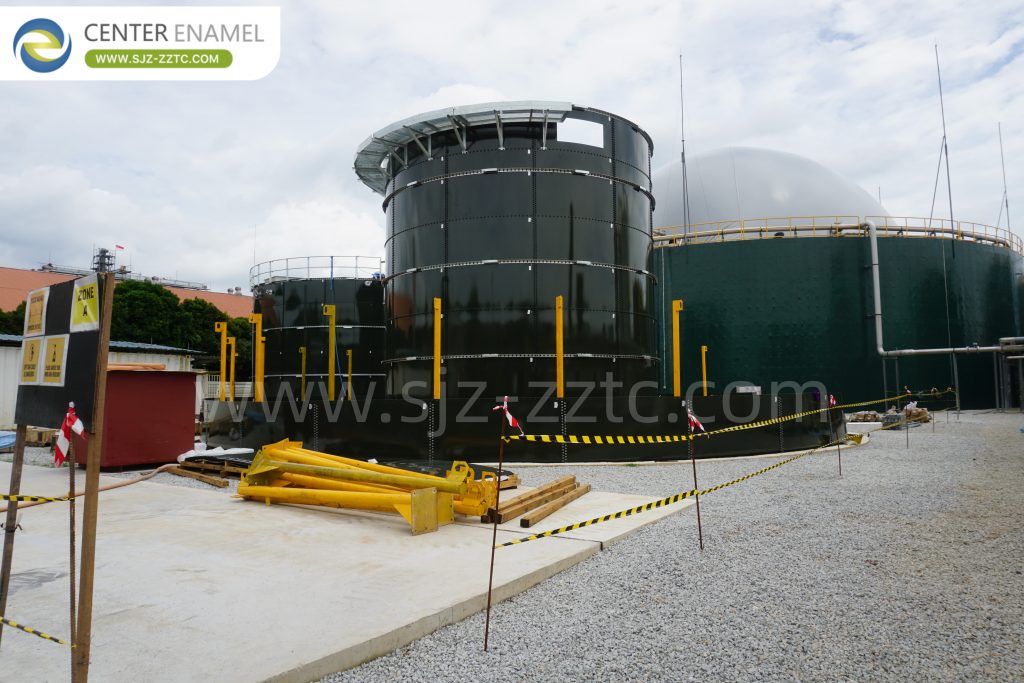
Glass-fused-to-steel (GFS) tanks, with their excellent sealing, corrosion resistance, and construction convenience, have become the mainstream choice for large anaerobic digestion tanks. Their modular design can be combined with membrane gas holders to form an integrated "fermentation + gas storage" solution, with penetration rates continuing to rise in new projects in biogas industry clusters.
Climate GFS Tanks-Custom Wind and Seismic Engineering
GFS tanks can undergo customized wind and seismic design based on project site climate and geological conditions, with environmental adaptability far superior to concrete tanks. Concrete tanks are cast-in-place monolithic structures, with seismic and wind resistance entirely dependent on on-site construction quality. In remote areas, typhoon-prone zones, and earthquake belts, construction quality is difficult to control. Under strong earthquakes or typhoons, concrete tanks are prone to cracking and base settlement damage, with subsequent reinforcement costs equivalent to rebuilding.
GFS tanks undergo collection of local seismic intensity, maximum wind pressure, and foundation bearing capacity data before construction, with customized thickened steel panels, stiffening ribs, and anchored base components—all factory-prefabricated to standardized specifications. The bolted panel structure has excellent stress distribution capability, making it less prone to overall fracture under seismic and typhoon impacts, and minor foundation settlement will not cause through-cracking. Structural parameters can be flexibly adjusted for mountainous, coastal typhoon-zone, and high-seismic-zone projects, providing long-term protection against extreme natural climate damage.
CSTR-The Classic Suspended-Growth Anaerobic Process
CSTR, or Continuously Stirred Tank Reactor, is a suspended-growth continuous-flow anaerobic digestion process suitable for high-solids, high-concentration organic pollutant treatment, and is the most widely used classic anaerobic treatment technology. The process relies on a mechanical stirring system to solve the technical challenges of material stratification, sludge sedimentation, and surface crusting in traditional anaerobic reactors, achieving homogeneous mixing of wastewater, anaerobic sludge, functional microorganisms, and organic substrates throughout the reactor, ensuring full contact between microorganisms and pollutants. Unlike attached-growth anaerobic processes, CSTR requires no media carriers, relying on suspended sludge bacterial communities for degradation reactions. It withstands high-suspended-solids and high-viscosity wastewater shocks, making it the mainstream process for food waste, livestock manure, and municipal sludge anaerobic digestion. The process architecture is simple, operation logic straightforward, and it is adaptable to various high-pollution organic solid-liquid mixed systems.
Analysis of Biogas Feedstock Sources
Biogas plants use organic waste as feedstock to produce biogas through anaerobic digestion—the core technological pathway for biomass energy utilization. Biogas sources cover five major organic feedstock categories:
- Livestock manure (pig, cattle, poultry manure from large-scale farms)—rich in easily degradable organics with high gas production efficiency, the most mainstream biogas feedstock; (2) Crop straw and agricultural residues (corn stover, wheat straw, rice straw, vegetable waste)—high cellulose/hemicellulose content requiring pretreatment to improve gas yield;
- Food waste and kitchen residues—rich in oils, starches, proteins, with high organic loading and large gas production;
- Municipal sludge (primary and waste activated sludge from WWTPs)—high solids content, suitable for high-solids anaerobic digestion;
- Industrial organic waste residues and liquids (distillers' grains, sugar factory waste, fruit pomace, papermaking black liquor, etc.)—high-concentration organic liquids with excellent gas production efficiency.
Various feedstocks can be digested alone or in co-digestion, with mixed feedstocks providing more balanced nutrition and stable gas production. Core anaerobic processes use CSTR/USR with Center Enamel GFS tanks as digesters—corrosion-resistant, excellent sealing, ensuring stable anaerobic conditions and efficient biogas production.
Company Development History of Center Enamel
Center Enamel has been deeply engaged in the environmental bolted storage equipment field for over 30 years. Starting with proprietary enamel anti-corrosion material technology, the company has gradually completed the full-industry-chain upgrade from a single tank manufacturer to a comprehensive environmental EPC service provider. Throughout its 30+ year history, the company has been recognized as a National High-Tech Enterprise, National Specialized and Sophisticated "Little Giant," Manufacturing Single Champion, and Provincial Green Factory. It has successfully delivered over 30,000 environmental projects globally, establishing itself as a leading enterprise in the global GFS tank storage industry. The company has fully integrated the entire chain from enamel frit R&D, intelligent environmental equipment manufacturing, to EPC project contracting—every business breakthrough has been achieved through proprietary core anti-corrosion technology.
Center Enamel’s R&D Team
Center Enamel has built a full-chain professional team covering R&D, design, marketing, installation, and after-sales. The R&D team is led by national-level materials technology experts, specializing in enamel frit and tank anti-corrosion core technologies. External senior environmental engineering and mechanical structure engineers are retained to strengthen R&D capabilities, focusing on anti-corrosion coating formulations, specialty corrosion-resistant tanks, and anaerobic supporting integrated equipment—continuously breaking through industry technological barriers.
The team operates through proprietary laboratories with external university research collaboration—conducting year-round new material and new process durability pilot testing and long-term corrosion simulation testing. Specialized enamel formulations are iteratively developed for extreme conditions such as high-salinity wastewater, strong acid/alkali POME, and high-organic livestock manure—providing core technical support for the company's annual new invention and utility patents—building a proprietary material technology barrier.
Gas Holder for Biogas Projects
Center Enamel's Gas Holder (independent double-membrane biogas holder) is a ground-mounted biogas storage device installed independently from the fermentation tank. It adopts a double-layer high-strength membrane structure, with the inner membrane forming the gas storage cavity and the outer membrane forming the protective shell. Continuous aeration between the inner and outer membranes maintains constant positive pressure, ensuring stable sealing of the gas storage cavity. The Gas Holder is installed separately from the fermentation tank and connected via biogas transmission pipelines. Biogas produced from the fermentation tank is sent to the holder for storage after desulfurization and dehydration, then pressure-regulated and stably delivered to end-use equipment, enabling separated management of biogas production, storage, and utilization.
The gasholder volume can be customized from tens to thousands of cubic meters to meet storage and peak-shaving requirements for different production rates and consumption cycles. The Gas Holder is equipped with a comprehensive safety control system, including biogas leak detection, inner membrane overpressure protection, emergency flare stack, and lightning protection grounding, ensuring full operational safety. The membrane material uses high-strength PVDF outer membrane and biogas-corrosion-resistant inner membrane, with a service life of over 15 years. Maintenance is simple, requiring only periodic checks of membrane integrity and aeration system operation, with significantly lower lifecycle maintenance costs than steel gasholders.