
Center Enamel EPC Services: Innovative Anaerobic Digestion of Landfill Leachate Solutions
The management of municipal solid waste represents one of the most significant environmental challenges for urban infrastructure. Central to this challenge is the generation of Landfill Leachate—a highly concentrated, toxic liquid formed when water percolates through waste cells, leaching out organic and inorganic pollutants. Due to its high strength, complex chemical composition, and extreme variability, it is widely considered one of the most difficult wastewaters to treat in the industrial sector. However, with the global push toward resource recovery and carbon neutrality, the Anaerobic Digestion of Landfill Leachate has emerged as a premier technology, allowing municipalities to transform this environmental hazard into a source of renewable biogas.
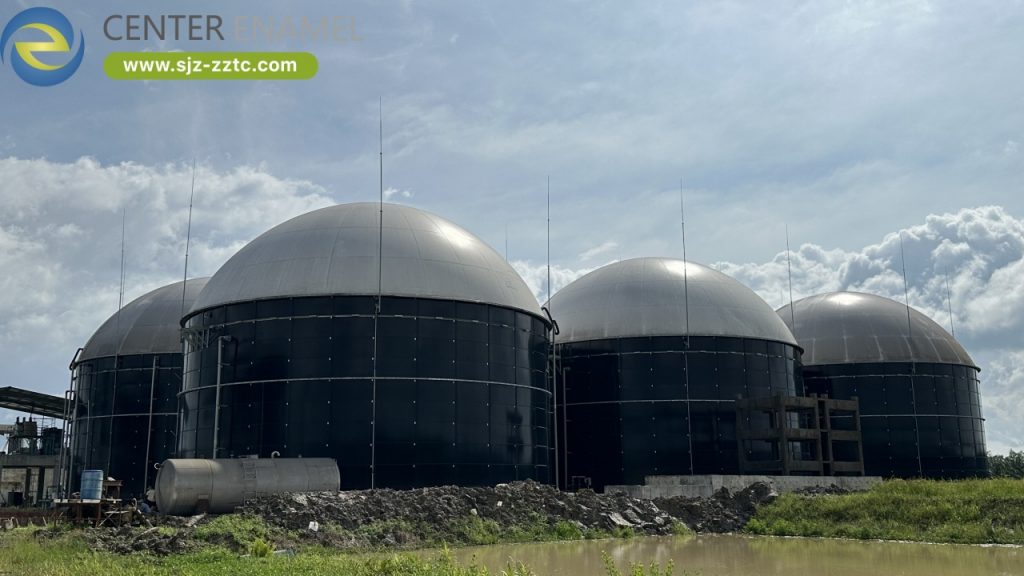
Shijiazhuang Zhengzhong Technology Co., Ltd, operating under the industry-leading brand Center Enamel, provides world-class Engineering, Procurement, and Construction (EPC) services specifically designed to address the complexities of leachate management. With over thirty years of experience and a project footprint in more than one hundred countries, we combine advanced process design with our flagship Glass-Fused-to-Steel (GFS) technology and specialized Aluminum Dome Roofs to deliver turnkey solutions that are durable, efficient, and sustainable.
Understanding the Aggressive Nature of Landfill Leachate
To design an effective EPC solution for the Anaerobic Digestion of Landfill Leachate, one must first understand the aggressive and volatile nature of the feedstock throughout its lifecycle.
1. Chemical Profile and Lifecycle Evolution
The composition of Landfill Leachate is not static; it evolves significantly as the landfill site matures.
Young Leachate: Characterized by high levels of Volatile Fatty Acids (VFAs) and a high ratio of Biochemical Oxygen Demand (BOD) to Chemical Oxygen Demand (COD). This makes it an ideal candidate for Anaerobic Digestion, as the organic matter is highly biodegradable.
Mature Leachate: As the landfill ages, the concentration of humic and fulvic acids increases, while the biodegradability decreases. This requires specialized anaerobic configurations and potential pre-treatment stages to ensure the microbes remain active.
2. High Ammonia Nitrogen Challenges
A primary hurdle in the Anaerobic Digestion of Landfill Leachate is the extreme concentration of ammonia nitrogen. If not managed through precise EPC process design, ammonia can lead to microbial inhibition, causing the reactor to fail. Center Enamel’s solutions utilize advanced nitrogen stripping or dilution strategies integrated into the anaerobic stage to maintain a stable biological environment.
Technical Foundations of Advanced Anaerobic Digestion
The success of a leachate-to-energy project depends on the stability of the biological environment and the hydraulic efficiency of the reactor.
1. The Biological Sequence of Treatment
Hydrolysis: The initial breakdown of complex polymers into soluble monomers. In leachate treatment, this is crucial for dealing with suspended organic particles.
Acidogenesis and Acetogenesis: The conversion of monomers into volatile acids and eventually into acetic acid, hydrogen, and carbon dioxide.
Methanogenesis: The final, sensitive stage where specialized microorganisms convert precursors into methane. Our EPC designs prioritize pH stability and temperature control to protect these sensitive microbes from the toxic shocks often found in Landfill Leachate.
2. Advanced Reactor Configurations: UASB and EGSB
Center Enamel’s EPC services leverage high-rate anaerobic systems such as the Upflow Anaerobic Sludge Blanket (UASB) and Expanded Granular Sludge Bed (EGSB). These reactors are specifically chosen for Landfill Leachate because they allow for a high biomass concentration and high hydraulic loading rates, ensuring maximum COD removal and stable biogas generation in a relatively small footprint.
Center Enamel EPC Services: Beyond Tank Manufacturing
Our EPC approach provides a seamless transition from conceptual design to operational reality, ensuring that every component of the Anaerobic Digestion of Landfill Leachate system is optimized for performance.
1. Engineering and Process Design
We begin with a comprehensive analysis of the local leachate profile. Our engineers design a customized treatment train that accounts for seasonal variations in precipitation and the specific age of the landfill cells. This phase includes hydraulic modeling and mass balance calculations to ensure the reactor size is perfectly matched to the load.
2. Procurement and Quality Control
Leveraging our global supply chain, we procure the highest-grade components, from mechanical mixers to sophisticated monitoring sensors. Every component is vetted against international standards to ensure it can withstand the corrosive environment of a leachate treatment plant.
3. Construction and Commissioning
Our modular construction methods allow for rapid deployment. Once the GFS tanks and Aluminum Dome Roofs are assembled, our team conducts rigorous testing, including hydrostatic testing and biological seeding, to ensure the plant reaches its target treatment efficiency as quickly as possible.
Core Infrastructure: GFS Tanks and Aluminum Dome Roofs
The physical containment of Landfill Leachate is the most critical hardware challenge. Standard materials often fail within years due to the aggressive chemical cocktail.
1. Glass-Fused-to-Steel (GFS) Technology: The Industrial Standard
Our GFS tanks provide the ultimate defense against leachate-induced corrosion.
Inert Barrier: The glass enamel coating is fused to the steel at over 800 degrees, creating a surface that is impervious to organic acids, ammonia, and heavy metals.
Durability and Flex: Unlike concrete, which can crack and leak leachate into the soil, our bolted steel design offers a degree of flexibility that withstands seismic movements and ground settling.
International Compliance: Our tanks meet AWWA D103-09 and ISO 28765 standards, ensuring they are accepted by global environmental regulators and municipal authorities.
2. Aluminum Dome Roofs: Geodesic Excellence for Leachate Storage
For the storage of raw Landfill Leachate and treated effluent, our Aluminum Dome Roofs are the premier choice.
Superior Corrosion Resistance: Aluminum is naturally resistant to the humid, ammonia-rich gases that evaporate from leachate. Unlike painted steel, it will not rust or degrade over time.
Maintenance-Free Service: These geodesic structures are self-supporting and require no internal columns. This eliminates the risk of structural failure from internal support corrosion and provides a maintenance-free service life of over thirty years.
Odor and Emission Containment: The precision engineering of our domes ensures a tight seal, which is critical for complying with local air quality regulations and maintaining positive relations with neighboring communities.
Sustainability, Economics, and ROI Analysis
Implementing Anaerobic Digestion of Landfill Leachate through Center Enamel’s EPC services is a strategic economic decision.
Renewable Energy Generation: The biogas produced can be used to power the treatment facility’s pumps and blowers, significantly reducing operational energy costs.
Reduction in Secondary Treatment Costs: By removing the bulk of the organic load anaerobically, the energy required for downstream aerobic treatment (such as MBR systems) is drastically reduced.
Carbon Credits and ESG Compliance: Capturing methane prevents powerful greenhouse gas emissions, allowing municipalities to generate carbon credits and meet their corporate and national sustainability targets.
Global Project Excellence: Proving the EPC Model
Our EPC expertise is demonstrated through successful installations in diverse environments. These non-fictitious projects highlight our capacity to deliver infrastructure for high-efficiency energy recovery:
Shandong Heze Biogas Project This major regional initiative utilized 3 units of our high-performance GFS tanks. The project successfully handles complex organic residues, transforming them into a stable energy stream and showcasing our reliability in industrial-scale recovery.
Inner Mongolia Hinggan League Bio-Natural Gas Project In a region with extreme temperature fluctuations, this installation integrated 4 units of our bolted steel tanks. These vessels provide the stable environment necessary for the high-efficiency production of bio-natural gas from complex organic waste streams.
Jiangsu Xuzhou Biogas Project This project involved the deployment of 4 units of our advanced GFS containment technology. It serves as a model for how Center Enamel’s EPC services can be used to rapidly build essential infrastructure for modern Landfill Leachate and anaerobic digestion needs.
A Total Solution for Urban Waste Challenges
The transition to advanced Anaerobic Digestion of Landfill Leachate is essential for the future of sustainable urban development. By converting a toxic waste stream into a renewable energy asset, municipalities can protect their groundwater while securing their energy future.
At Shijiazhuang Zhengzhong Technology Co., Ltd (Center Enamel), we are dedicated to providing the innovation and EPC excellence that make these projects possible. From our premier GFS tanks to our specialized Double Membrane Roofs and Aluminum Dome Roofs, we offer a total solution designed for the future of the planet.