
Center Enamel EPC Services: Technology for Efficient Anaerobic Digestion of Chicken Manure
The global poultry industry has reached a scale where traditional waste management practices are no longer sufficient to meet environmental and economic demands. Among all livestock residues, Chicken Manure is uniquely positioned as a high-potency energy resource, yet it is simultaneously one of the most complex feedstocks to process. Characterized by high nitrogen levels and significant solids content, it requires a sophisticated engineering approach to unlock its bioenergy potential. Through the implementation of Anaerobic Digestion of Chicken Manure, poultry operations can transition from waste disposal to energy generation.
Shijiazhuang Zhengzhong Technology Co., Ltd, operating under the world-renowned brand Center Enamel, stands as a global pioneer in providing the specialized EPC services necessary for this transition. With over thirty years of innovation and a project footprint extending to more than one hundred countries, we provide the turnkey containment and processing solutions that make high-efficiency biological recovery a reality. Our Glass-Fused-to-Steel (GFS) technology and integrated roofing systems are specifically engineered to handle the unique chemical profile of Chicken Manure, ensuring long-term operational success and high returns on investment.
The Strategic Value and Biological Profile of Chicken Manure
To optimize the Anaerobic Digestion of Chicken Manure, it is essential to understand the material's chemical characteristics. Unlike cattle or swine waste, chicken residue is highly concentrated.
1. High Energy Density and Biogas Yield
Chicken Manure has one of the highest methane-producing potentials among animal wastes due to its high organic load. When managed in a controlled anaerobic environment, it produces a rich biogas that can be utilized for heating poultry houses, generating electricity for the farm, or being upgraded into renewable natural gas (RNG) for the grid.
2. The Challenge of Ammonia Inhibition
A primary hurdle in processing Chicken Manure is its high uric acid and protein content, which breaks down into ammonia during digestion. High levels of ammonia can be toxic to methanogenic bacteria. Center Enamel’s EPC services incorporate advanced process controls, such as ammonia stripping or co-digestion strategies, to ensure that the Anaerobic Digestion of Chicken Manure remains stable and productive.
Technical Foundations of Advanced Anaerobic Digestion
Transforming poultry waste into power requires a sophisticated biological sequence. The reactor must provide a stable environment to protect sensitive microorganisms from the aggressive nature of the waste.
1. The Four Biological Stages of Treatment
Hydrolysis: Breaking down complex organic polymers (proteins and fats) into simple monomers.
Acidogenesis: Converting those monomers into volatile fatty acids.
Acetogenesis: Refining the intermediates into acetic acid and hydrogen.
Methanogenesis: The final, most sensitive stage where specialized microorganisms convert precursors into methane.
2. CSTR Technology: Optimizing Mixing Dynamics
Because Chicken Manure often contains high solids and feathers, effective mixing is critical. Center Enamel’s Continuous Stirred-Tank Reactor (CSTR) configurations utilize high-torque mechanical mixers. These systems prevent the formation of floating crusts and ensure uniform temperature distribution, maximizing the contact between bacteria and organic matter.
Center Enamel: Engineering Excellence in Containment
The containment of Chicken Manure requires materials that can withstand extreme ammonia concentrations and organic acids.
1. Glass-Fused-to-Steel (GFS) Technology
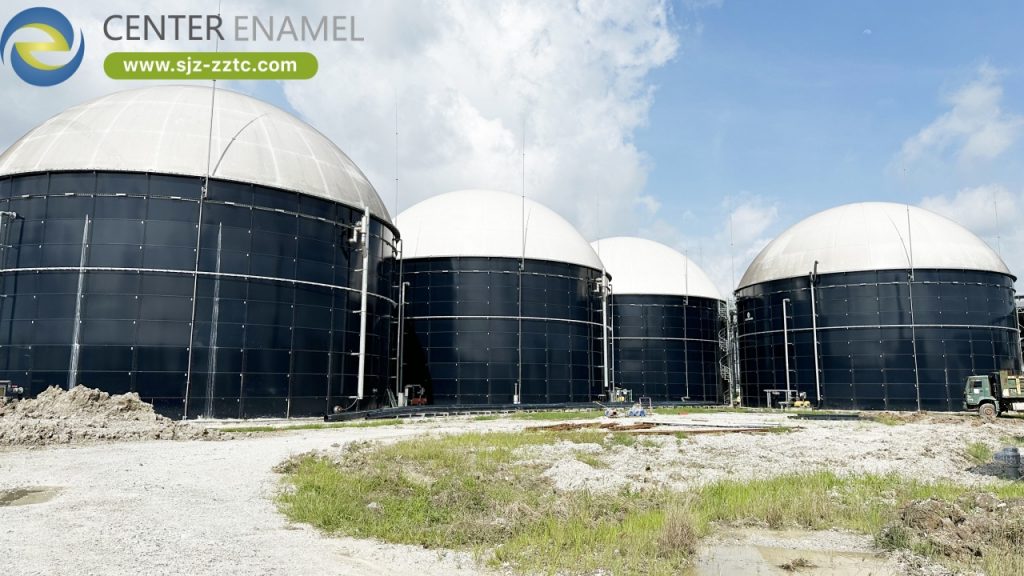
Our GFS tanks are the premier choice for poultry biogas reactors. By fusing a high-tech glass enamel coating to specialized steel at temperatures exceeding 800 degrees, we create a material with:
Superior Corrosion Resistance: The glass surface is inert and resistant to the aggressive hydrogen sulfide and ammonia produced during the Anaerobic Digestion of Chicken Manure.
Hardness and Durability: Our GFS coating scores a 6.0 on the Mohs scale, ensuring the tank walls remain undamaged by abrasive materials over decades of service.
Global Compliance: Our tanks meet international standards, including AWWA D103-09 and ISO 28765, ensuring project bankability and safety.
2. Integrated Gas Management with Double Membrane Roofs
Efficient energy utilization requires total gas capture. Our Double Membrane Roofs function as an integrated, variable-volume gas holder. The flexible inner membrane expands to store biogas, while the air-pressurized outer membrane provides a protective structural shell against the elements.
3. Aluminum Dome Roofs: Maintenance-Free Longevity
For the storage of treated digestate—the nutrient-rich organic fertilizer produced—Center Enamel provides specialized Aluminum Dome Roofs .
Geodesic Engineering: These self-supporting domes require no internal columns, which is essential because internal supports would corrode rapidly in a poultry waste environment.
Zero Maintenance: Constructed from high-strength aluminum alloy, these domes are naturally resistant to the humid, corrosive gases associated with Chicken Manure.
Odour Containment: The precision seal of our domes ensures that odors are contained, improving relations with neighboring communities.
Sustainability and Economic ROI for Poultry Producers
Implementing Anaerobic Digestion of Chicken Manure through Center Enamel’s EPC services is a strategic economic decision.
Energy Autonomy: Poultry houses require significant energy for climate control. By generating power on-site, producers can hedge against fluctuating energy prices.
Nutrient Valorization: The digestate remaining after the process is a stabilized, pathogen-free organic fertilizer that is superior to raw Chicken Manure, providing a high-value byproduct for field application or sale.
Environmental Compliance: Capturing methane allows producers to qualify for international carbon credits and meet increasingly strict environmental regulations.
Global Project Excellence: Center Enamel in Action
Our EPC expertise is proven through successful installations in diverse climates. These non-fictitious projects highlight our capacity to deliver infrastructure for high-efficiency energy recovery:
Shandong Heze Biogas Project This major regional initiative utilized 3 units of our high-performance GFS tanks. The project successfully transforms agricultural and livestock residues into a stable energy stream, demonstrating the reliability of our tanks in large-scale recovery operations.
Inner Mongolia Hinggan League Bio-Natural Gas Project In a region with extreme temperature fluctuations, this installation integrated 4 units of our bolted steel tanks. These vessels provide the stable environment necessary for the high-efficiency production of bio-natural gas from agricultural waste.
Jiangsu Xuzhou Biogas Project This project involved the deployment of 4 units of our advanced GFS containment technology. It serves as a model for how Center Enamel’s EPC services can be used to rapidly build essential infrastructure for modern waste management and anaerobic digestion needs.
Leading the Future of Poultry Energy
The transition to advanced Anaerobic Digestion of Chicken Manure is essential for a sustainable and profitable poultry industry. By converting a waste byproduct into a renewable energy asset, producers can protect the environment while securing their energy future.
At Shijiazhuang Zhengzhong Technology Co., Ltd (Center Enamel), we are dedicated to providing the innovation and EPC excellence that make these projects possible. From our premier GFS tanks to our specialized Double Membrane Roofs and Aluminum Dome Roofs, we offer a total solution designed for the future of the planet.