
Center Enamel GFS Tanks: Biogas & Wastewater Anti-Corrosion Solutions
The global biogas industry competitive landscape shows divergence. Leading companies dominate major project market shares through the "EPC + Operation" integrated model, while small and medium-sized enterprises focus on county-level distributed projects and specialized equipment segments. China's biogas equipment exports continue to expand, with generator sets primarily flowing to emerging markets. Business model innovation is accelerating, with carbon asset development becoming a standard feature of large projects, converting methane emission reductions into tradable carbon credits. Some countries have piloted digestate fertilizer carbon credit trading, encouraging the integration of digestate application to farmland with carbon accounting.
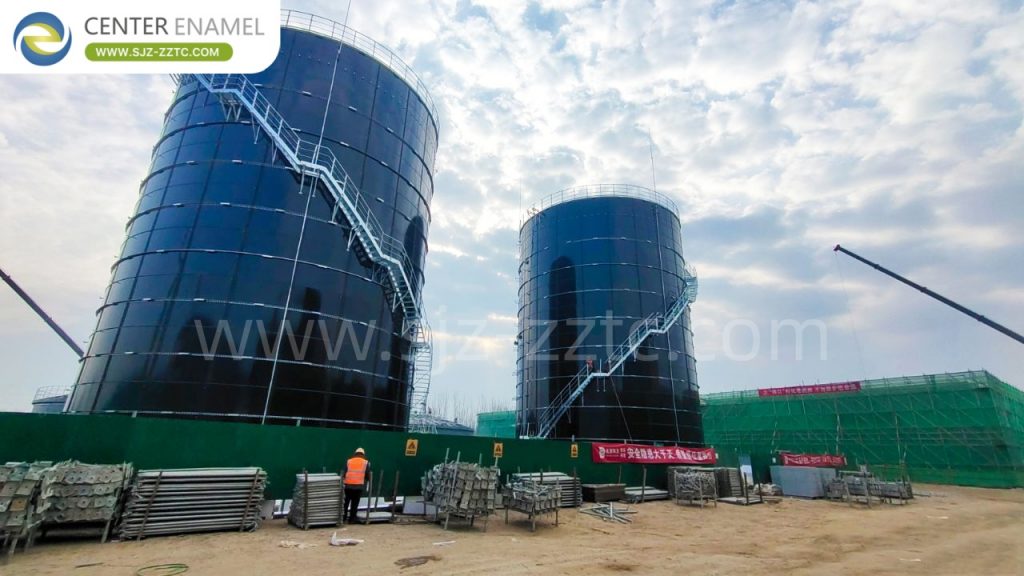
The "biogas operation outsourcing" service model is emerging, improving operational efficiency of county-level projects through professional management. From a technology and equipment perspective, anaerobic digestion is the core process of biogas engineering. Glass-fused-to-steel (GFS) tanks, with their excellent sealing, corrosion resistance, and construction convenience, have become the mainstream choice for large anaerobic digestion tanks. Their modular design can be combined with membrane gas holders to form an integrated "fermentation + gas storage" solution, with penetration rates continuing to rise in new projects in biogas industry clusters.
GFS Tanks - Superior Corrosion Resistance for Diverse Operating Conditions
Center Enamel has independently developed over 200 specialized enamel frit formulations and supporting patents, capable of customizing anti-corrosion enamel based on customer storage media, with adaptability comprehensively superior to concrete tanks. Concrete tanks use a single material, only suitable for neutral clean water storage. When storing corrosive materials such as livestock manure, palm oil mill effluent, chemical wastewater, food waste digestate, high-salinity wastewater, etc., additional anti-corrosion linings must be applied. These linings are prone to failure, preventing long-term stable operation and cannot adapt to alternating high/low concentration storage conditions.
GFS tanks can be specifically formulated with specialized enamels resistant to strong acids, strong alkalis, high organic content, and high salinity. A single tank can switch between multiple wastewater and fermentation feedstock storage requirements. They are universally applicable across biogas anaerobic digestion, municipal wastewater, livestock farming, food processing, and industrial water treatment scenarios, eliminating the need to rebuild tanks for media changes, perfectly meeting the needs of diversified, multi-condition environmental protection projects.
Core & Supporting Equipment for Anaerobic Digestion Systems
The core equipment is a vertical sealed anaerobic reactor tank, with Center Enamel GFS tanks as the mainstream choice for high-corrosion, high-viscosity wastewater conditions. The key operating equipment is a low-speed mechanical stirrer, comprising motor, gearbox, and impeller blades, achieving uniform mixing throughout the reactor and preventing sedimentation and crusting. Supporting equipment includes corrosion-resistant feed pumps, flow control valves, and inlet piping for precise feed flow control; biogas collection systems (piping, water seals, dual-membrane gas holders, desulfurization units) for biogas collection, purification, and storage. Online monitoring equipment for temperature, pH, and liquid level is integrated for real-time reaction parameter monitoring. Sludge discharge pumps, return piping, and emergency drain systems complete the equipment package, with convenient operation and maintenance, low failure rates, and support for long-term continuous stable operation.
Standardized Digestate Treatment: Nitrogen, Phosphorus & Salinity Removal
Treatment focuses on nitrogen and phosphorus removal, desalination, and polishing—suitable for the unique water quality of low organics, high nutrients. The mainstream "pretreatment + biological nitrogen removal + advanced polishing" system. Pretreatment is minimal, only simple filtration to remove trace suspended solids—no complex solid-liquid separation or organic degradation steps required. The main stage uses AO or A²O multistage biological nitrogen removal processes to target high ammonia nitrogen, total nitrogen, and total phosphorus—addressing the core eutrophication issue. For high-salinity digestate, coagulation/sedimentation and membrane treatment for desalination ensure effluent compliance. The entire process requires no high-intensity organic degradation units, with simplified flow, stable operation, strong shock load resistance, convenient O&M, and suitability for the stable single-component digestate.
Case Study: Malaysia Palm Oil Biogas Project with GFS Tanks
The project uses Center Enamel GFS tanks as the core anaerobic digestion facility with 5 tanks, each with effective volume of 5,400 m³, total effective volume 27,000 m³. Influent COD ≥ 60,000 mg/L, BOD ≤ 25,000 mg/L. After anaerobic digestion, effluent COD drops to below 12,000 mg/L, BOD ≤ 5,000 mg/L—overall organic removal efficiency approximately 80%. Single tank daily biogas production 4,400 m³, total project daily biogas 22,000 m³—stable biogas yield of 0.45 m³ per kg COD removed—efficient biogas energy recovery while solving palm oil processing wastewater pollution.
Complete Product Matrix: Tanks, Covers, Pressure Vessels & EPC Services
Center Enamel has built a complete product matrix of "core storage tanks + supporting covers + specialty pressure vessels + complete environmental engineering services"—the only company globally to achieve integrated enamel frit R&D, self-manufacturing, and GFS tank application.
① Core: Proprietary GFS Tanks
Using proprietary double-sided hot-rolled double-layer enamel anti-corrosion technology—resistant to strong acids/alkalis, high salinity, and microbial corrosion—modular quick assembly—suitable for all strong-corrosion conditions in wastewater, biogas, and chemical applications.
② Supporting: Fusion Bonded Epoxy Tanks
Produced on China's first intelligent standardized production line—primarily for drinking water, fire water, and neutral medium storage.
③ Sealing: Aluminum Dome Covers
Proprietary high-strength aluminum alloy self-supporting structure—meeting international waterproof and load-bearing standards—suitable for tank sealing and biogas collection.
④ Other Tanks: Carbon Steel Tanks, Stainless Steel Tanks, Composting Tanks, Various Non-Standard Pressure Vessels.
⑤ Engineering Services: Environmental EPC General Contracting, Anaerobic Process Section Subcontracting—one-stop coverage across food waste, leachate, municipal wastewater, livestock biogas, petrochemical/metallurgical, and seawater desalination industries—customizable tank volume, corrosion protection grade, and complete process solutions with integrated equipment manufacturing and engineering construction.
Global Standardized Service System for Seamless Project Delivery
Leveraging regional sales centers in China and overseas local agent networks, Center Enamel has established a complete after-sales service loop covering all markets. The system provides four core service pillars: 24/7 rapid response mechanism, on-site domestic/overseas installation services, full-project-cycle after-sales support, and long-term warranty protection—forming a complete service chain from preliminary site survey, mid-term construction management, to long-term inspection and maintenance. The entire system is uniformly adapted to both domestic and international project service standards, coordinating personnel scheduling, material support, and on-site coordination for simultaneous projects across multiple regions—significantly reducing customer multi-party coordination costs and ensuring efficient domestic and overseas project delivery.