
Center Enamel: Leading EPC Contractor for Cambodia Biogas Projects
Cambodia’s economy is dominated by agriculture and livestock breeding, with large rural areas, scattered family farms and agricultural processing facilities across Phnom Penh, Siem Reap and Battambang. The booming cattle farming, poultry rearing, rice milling and food processing generate massive quantities of livestock manure, rural domestic sewage and agricultural organic waste every day.
Due to inadequate environmental infrastructure and lack of standardized disposal methods, most organic wastewater and manure are discharged randomly into rivers, farmland and open land. This causes serious odor pollution, groundwater contamination, river eutrophication and rising greenhouse gas emissions, severely affecting rural living environment and ecological balance.
Turning Cambodia’s organic sewage and livestock waste into biogas brings outstanding ecological, economic and social advantages. Biogas projects realize harmless treatment, waste reduction and resource recycling in one integrated system. Clean biogas can replace firewood and traditional fossil fuels for cooking, heating and small-scale power generation, effectively protecting local forest resources and lowering living energy costs. The digested residues can be processed into high-quality organic fertilizer to improve farmland soil and support green planting. The main raw materials for biogas production in Cambodia include cattle and poultry manure, crop straw, rice mill wastewater, food processing waste and rural domestic organic sewage. As Cambodia gradually strengthens environmental regulations and promotes rural renewable energy development, biogas projects have become an important direction for sustainable livestock farming and rural circular economy.
As a global environmental engineering leader, Center Enamel stands as the professional Biogas Project EPC Contractor, applying mature Anaerobic Technologies and high-performance GFS Tanks to provide full turnkey biogas solutions for Cambodian rural farms and agricultural enterprises.
Analysis of Biogas Generation Principles
Biogas production mainly depends on anaerobic digestion, a natural and efficient biological process that decomposes organic matter in an oxygen-free environment to produce methane-rich biogas. Livestock manure, agricultural residues and food processing wastewater in Cambodia are rich in cellulose, organic carbon and nitrogen, which are ideal substrates for anaerobic microorganisms.
The entire biogas generation process is divided into four stable stages. The first is hydrolysis, where complex organic substances are decomposed into small molecules such as sugar and amino acids. The second is acidification, in which acidogenic bacteria convert small molecular organics into volatile fatty acids, hydrogen and carbon dioxide. The third stage is acetogenesis, transforming intermediate products into acetic acid, the direct precursor of methane formation. The last stage is methanogenesis, where methanogenic microorganisms produce biogas containing 55%–70% methane and 30%–45% carbon dioxide.
After anaerobic treatment, pathogens and odor in organic waste are greatly reduced. The produced biogas can be used for farm power generation, daily heating and cooking, while digested sludge residue is made into premium organic fertilizer. Cambodia’s tropical monsoon climate maintains stable temperature and humidity all year round, providing favorable conditions for continuous and stable anaerobic reaction, making local biogas projects high-efficiency and economically viable.
Four Anaerobic Technologies Suitable for Cambodia Biogas Project
As a professional Biogas Project EPC Contractor, Center Enamel provides four mature Anaerobic Technologies tailored to Cambodia’s tropical climate, scattered farm characteristics, waste properties and different project scales.
CSTR (Completely Stirred Tank Reactor): CSTR is widely applied for large-scale intensive livestock farms with high-solid manure in Cambodia. Equipped with mechanical stirring devices, it ensures full mixing of raw materials and effectively prevents crusting and sedimentation inside the tank. It supports continuous feeding and stable biogas output, perfectly suitable for large commercial cattle and poultry breeding bases around urban areas.
USR (Upflow Solids Reactor): USR is designed for high-suspended-solid livestock waste. Without mechanical stirring, it relies on upward water flow to retain sludge and organic particles. Featuring simple structure, low energy consumption and easy maintenance, USR is highly suitable for medium-sized scattered farms and remote rural areas across Cambodia.
UASB (Upflow Anaerobic Sludge Blanket): UASB is a globally proven cost-effective anaerobic technology for liquid manure and organic wastewater treatment. Wastewater flows upward through a dense sludge blanket to achieve efficient degradation of organic pollutants. It has high loading capacity, low operating cost and strong stability, widely used in Cambodia’s rice mill wastewater and food processing wastewater biogas projects.
IC (Internal Circulation): IC is an advanced high-rate anaerobic technology driven by internal biogas circulation. Its processing load capacity is 3–5 times that of traditional reactors, with compact floor space and excellent COD removal efficiency. It is the preferred choice for large-scale integrated biogas projects in Cambodia that pursue maximum energy recovery and land saving.
Equipment Supplied by Center Enamel for Cambodia Biogas Project
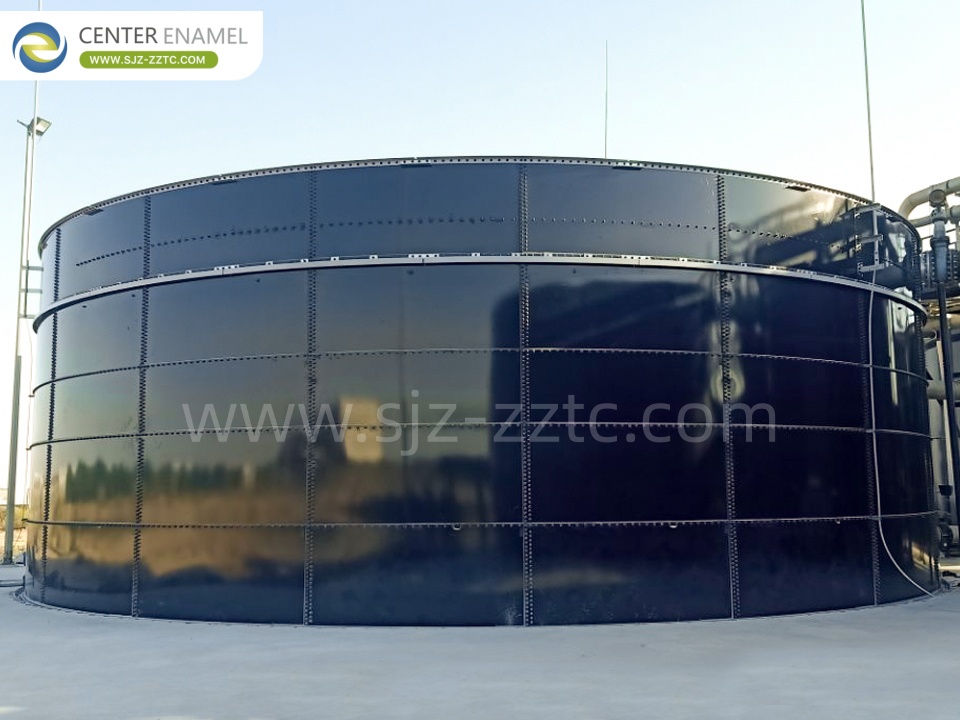
Center Enamel provides complete and durable supporting equipment specially customized for Cambodia biogas projects, among which GFS Tanks (Glass-Fused-to-Steel Tanks) are the core facilities of the anaerobic digestion system.
GFS Tanks are sintered at a high temperature over 820°C, featuring full pH resistance ranging from pH 1 to 14, capable of resisting strong corrosion from manure and digestive slurry. With outstanding seismic performance and UV stability, GFS Tanks adapt perfectly to Cambodia’s high temperature, high humidity and rainy tropical environment. Bolted assembly enables fast on-site installation and later capacity expansion, with a service life of more than 30 years and extremely low maintenance cost.
Besides GFS Tanks, Center Enamel also supplies double membrane gas holders for safe biogas storage, with automatic pressure control and explosion-proof function to ensure stable gas supply for power generation and daily use. FBE tanks are applied for wastewater equalization and pretreatment with cost-effective anti-corrosion performance.
Various tank roof systems including air membrane roof, enamel roof, sun panel roof, aluminum flat roof, FRP roof and aluminum dome roof are available to adapt to Cambodia’s rainy, windy tropical weather. Complete supporting systems such as agitation, feeding, pumping and discharge equipment guarantee stable and efficient operation of the entire biogas plant.
Overall Advantages of Center Enamel in Cambodia Biogas Project
Center Enamel owns comprehensive competitive strengths in delivering biogas projects adapting to Cambodia’s diverse climate, rural geography and farm operation demands. The team provides customized engineering design through on-site investigation, matching anaerobic processes, GFS Tanks specifications and system layout according to local waste output, solid content, land resources and energy demand. Core equipment adopts super anti-corrosion materials to adapt to Cambodia’s high temperature, high humidity and complex rural environment.
As a full-lifecycle Biogas Project EPC Contractor, Center Enamel covers design, manufacturing, installation, commissioning and after-sales support, greatly reducing clients’ project coordination difficulty and investment risks. Optimized Anaerobic Technologies maximize biogas yield and organic fertilizer output, helping Cambodian farms realize energy self-sufficiency, cost reduction and additional income.
Center Enamel’s Efficient Installation Process
All equipment components are factory prefabricated and strictly inspected to ensure stable quality. The hydraulic jacking installation method adopts top-down construction, eliminating the need for high-altitude scaffolding and reducing crane dependence. Bolted assembly completely replaces on-site welding, avoiding welding failure caused by Cambodia’s high humidity and dusty weather, and ensuring overall structural safety. Compared with concrete tanks, the commissioning cycle is greatly shortened, enabling early biogas production and faster return on investment.
Two Successful Project Cases of Center Enamel
Case 1: Canada Biogas Project
Tank Dimensions: φ8.4*7.2 m (H) 2 units
Total Volume: 798 m³
Completion Date: 2024
Case 2: France Biogas Project
Anaerobic Process: CSTR
Tank Dimensions: φ18.33*8.4 m (H) 1 unit
Total Volume: 2215 m³ 1 unit
Completion Date: 2021
Cambodia’s livestock and agricultural industries are steadily moving toward intensification, greening and circular development, making biogas projects indispensable for rural environmental governance, energy conservation and sustainable growth. As a professional Biogas Project EPC Contractor, Center Enamel integrates mature Anaerobic Technologies, high-quality GFS Tanks and full turnkey EPC services that perfectly fit Cambodia’s tropical climate and scattered rural farm features. It helps local farms and rural communities convert organic waste into clean biogas and organic fertilizer, ease environmental pollution, reduce reliance on fossil energy and firewood, and create long-term ecological and economic benefits for Cambodian biogas investors and farmers.