
Center Enamel: One-Stop Biogas Solutions with GFS Tanks & Membrane Roofs
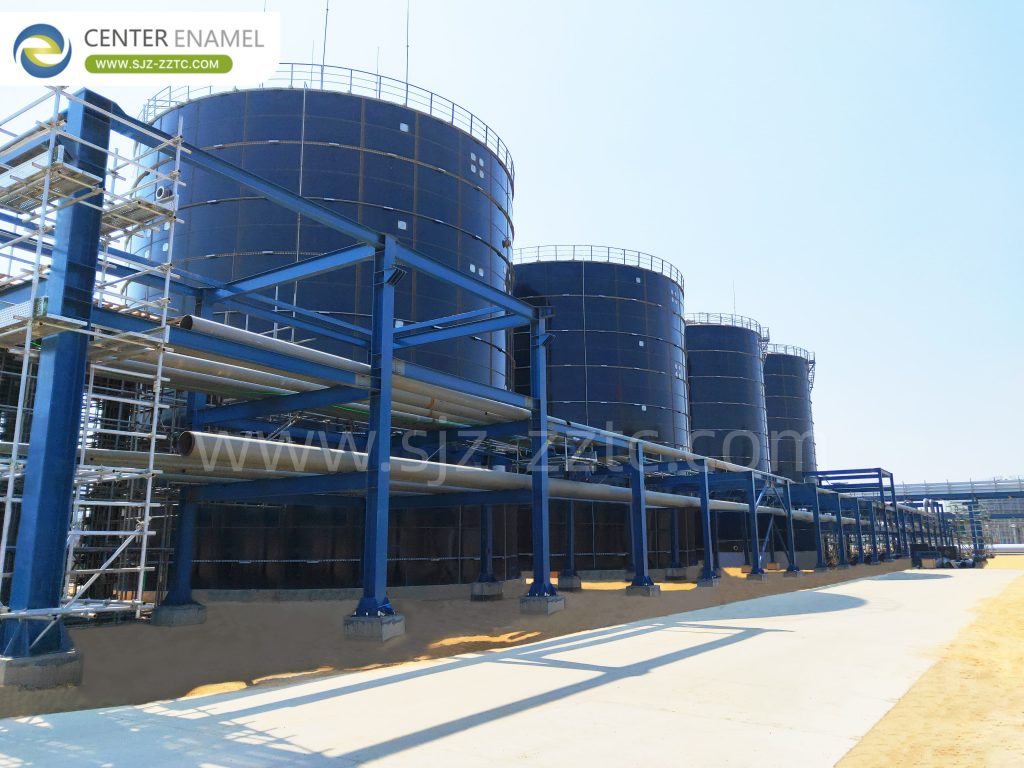
The global biogas industry is in a phase of large-scale expansion, with China contributing the major share of new capacity, becoming the fastest-growing single market. Europe's mainstream model focuses on combined heat and power (CHP) and biomethane grid injection, with active biomethane certificate trading and application scenarios covering power generation, heating, and transportation fuel. China, in contrast, emphasizes vehicle fuel and industrial heating while actively promoting the fertilizer utilization of digestate, showing significant differentiation in application scenarios.
Southeast Asian emerging markets show rapidly growing food waste treatment demand, becoming key areas for global companies; while African and Latin American markets remain in the early stages, primarily relying on low-cost direct application models. Countries show differentiated development paths in biogas resource utilization: Europe focuses on energy output, China emphasizes comprehensive utilization, and emerging markets prioritize pollution control.
Superior Corrosion Resistance of GFS Tanks vs. Concrete
Center Enamel's independently developed double-sided double-layer enameling technology is the industry's leading coating anti-corrosion technology, with corrosion resistance completely surpassing concrete tanks. Concrete tank interiors are riddled with pores, allowing wastewater and acid/alkaline media to easily penetrate and corrode the structural layer. Long-term use leads to irreversible problems such as internal wall spalling, water seepage, and rebar corrosion, which are difficult to repair and cannot be fundamentally resolved.
GFS tanks feature high-temperature enameling on both the interior and exterior surfaces of steel panels, with a dense, non-porous enamel finish that completely blocks corrosive liquids and biogas permeation. The enamel layer has extremely strong chemical stability, resisting acids, alkalis, salts, and microbial corrosion. Concrete tanks will develop extensive corrosion and leakage after 5-8 years of use, while GFS tank anti-corrosion service life can exceed 30 years, with no need for frequent internal lining repairs throughout the service life, significantly reducing long-term anti-corrosion maintenance investment and fundamentally eliminating environmental risks of medium leakage contaminating sites and groundwater. Compared to traditional concrete and FRP tanks, GFS tank coatings have no risk of peeling or blistering, and are adaptable to highly corrosive conditions such as palm oil mill effluent, livestock manure, and chemical high-salinity wastewater, with outstanding long-term comprehensive cost advantages.
Applicable Scenarios for CSTR Anaerobic Digestion
Primarily for high-solids organic pollutant treatment, widely used in food waste leachate, large-scale livestock manure, slaughterhouse wastewater, and food processing high-strength wastewater. Also suitable for municipal sludge and industrial organic sludge anaerobic digestion. In the agricultural and environmental sector, it is used for large-scale farm manure resource recovery, achieving wastewater reduction, harmless treatment, and energy recovery. In the food and brewing industry, it is suitable for high-oil, high-protein, high-suspended-solids wastewater. It is also suitable for small to medium-sized wastewater treatment projects, township decentralized wastewater treatment, and as a pretreatment process for high-strength organic wastewater in large industrial parks to reduce downstream load. It is particularly suitable for difficult-to-treat organic wastewater with complex composition, high solids content, and easy crusting.
Cost-Effective Operation and Maintenance
O&M costs are low and controllable, with outstanding resource recovery benefits—excellent overall cost-effectiveness. Treatment processes are simple and mature, with no complex pretreatment or high-end degradation equipment—conventional equipment with low failure rates and simple maintenance. Stable water quality with no drastic fluctuations—no frequent parameter adjustments, low labor requirements and costs. No large quantities of specialty chemicals required, with controlled chemical and energy costs. Key advantage is high resource recovery value—compliant digestate and treated effluent can be used as ecological fertilizer for agricultural application, reducing chemical fertilizer use. Digestate can be concentrated into commercial liquid fertilizer, with resource recovery revenues generally covering routine O&M costs—industry-leading economics.
Global Installation Coverage and Delivery Capability
Center Enamel is the pioneer of Chinese GFS equipment exports, with installation service coverage across over 100 countries and regions—possessing full delivery capability across climates, regulations, and geographies.
Overseas coverage includes Southeast Asia (Vietnam, Thailand, Malaysia, Indonesia, Cambodia, Bangladesh, Nepal, etc.), Africa (Ghana, South Africa, Mali, Guinea, Zambia, Kenya, Pakistan, etc.), Europe/Americas (Sweden, USA, Russia, etc.), the Middle East, and Latin America—adaptable to tropical rainy high-salt spray, high-altitude mountainous, Nordic severe cold, and high-standard European/American facility conditions.
The company uses a dual-service model of "own cross-border construction teams + overseas local agent coordination"—whether clients are in developed countries or remote developing regions—providing one-stop services including on-site survey, on-site installation, process commissioning, and operator training. Complete coverage covers biogas engineering, municipal wastewater, industrial wastewater, livestock manure, drinking water storage, and other global mainstream environmental engineering projects—possessing the full delivery capability to undertake large-scale tank farm projects in any country worldwide.
Flexible and Efficient Service Delivery System
Center Enamel's own cross-border construction teams + global localized agent network—modular GFS tank assembly with short construction periods and dismantlable/reusable capability—suitable for overseas short-term projects, phased expansions, and relocation needs—full-lifecycle after-sales O&M support ensuring long-term stable client operations.
Single and Double Membrane Roofs for Biogas Storage
Single and Double Membrane Roofs are proprietary airtight tank cover systems for anaerobic digestion and biogas storage projects, specifically developed for biogas collection and odor containment, representing a benchmark lightweight sealing solution for fermentation tanks. The single-layer membrane roof features a simple structure with economical cost, meeting basic biogas containment needs.
The double membrane roof consists of inner and outer corrosion-resistant membrane materials, with pressurized air in the interlayer forming rigid support, providing outstanding thermal insulation that reduces biogas condensate formation inside the tank, with enhanced wind and snow load resistance suitable for high-altitude and windy outdoor sites. The membrane material is specialized aging-resistant and biogas-slurry-corrosion-resistant PVDF membrane, which will not leak or degrade from long-term contact with biogas or hydrogen sulfide. The flexible structure accommodates tank settlement and slight deformation without cracking or gas leakage.
The lightweight design eliminates heavy steel support trusses, significantly reducing the load on the tank and foundation, saving construction costs. The roof integrates biogas outlets, safety pressure relief valves, and access channels, fully enabling closed gas collection for anaerobic fermentation tanks, recovering biogas for power generation and heating while blocking odor diffusion to meet environmental odor control requirements. It is widely used in large-scale livestock biogas projects, municipal sludge anaerobic digestion, and food waste fermentation projects, compatible with large-volume glass-fused-to-steel anaerobic tanks, with fast construction and simple maintenance requiring only periodic membrane seal integrity checks, offering significant overall engineering advantages.