
Center Enamel: Professional EPC Contractor for Laos Chicken Farm Biogas Projects
Laos is a typical agricultural country in Southeast Asia, with the livestock industry serving as a core pillar of rural economic income and meat supply. Chicken farming is widely developed across Vientiane, Luang Prabang, Savannakhet and Champasak provinces, including large-scale intensive poultry bases, medium-sized breeding farms, and countless scattered rural chicken households. With the continuous expansion of breeding scale, massive chicken manure, urine and breeding wastewater are produced every day across rural and suburban areas.
Most chicken farms in Laos lack standardized waste disposal infrastructure and environmental management awareness. Untreated chicken manure is randomly piled up or directly discharged into rivers, farmland and rural watercourses. This causes serious odor pollution, river eutrophication, groundwater contamination, pathogen breeding and the spread of livestock diseases. It also releases large amounts of greenhouse gases and damages local ecological balance. Nevertheless, chicken manure is rich in organic carbon, nitrogen, cellulose and degradable nutrients, making it high-quality raw material for Biogas Project.
Under Laos’ national renewable energy strategy and 2030 carbon neutrality goals, promoting mature Biogas Technology and stable CSTR Reactor has become an essential way to solve breeding pollution and realize clean energy utilization.
As a global leading EPC contractor specializing in biogas and environmental engineering, Center Enamel has rich project experience in Southeast Asia, providing customized anaerobic processes, high-performance GFS equipment and one-stop turnkey solutions tailored to Laos’ tropical climate and livestock waste characteristics.
Biogas Generation Principle from Chicken Manure
Chicken manure generates biogas through natural sealed anaerobic digestion without oxygen involvement. The whole biological reaction is divided into four stable stages:
Hydrolysis: Complex organic substances such as protein and cellulose in chicken manure are decomposed into simple soluble small molecules.
Acidification: Acidogenic bacteria convert small molecular organics into volatile fatty acids, hydrogen and carbon dioxide.
Acetogenesis: Intermediate substances are further transformed into acetic acid, the direct precursor of methane production.
Methanogenesis: Methanogenic archaea consume acetic acid to produce methane and carbon dioxide, forming methane-rich biogas.
The purified biogas can be used for farm power generation, boiler heating and rural daily cooking. Digested biogas residues and slurry are processed into high-quality organic fertilizer, realizing a closed-loop circular economy of “waste-energy-fertilizer”. Laos’ year-round warm tropical climate maintains stable microbial activity, ensuring continuous and efficient biogas output all year round.
Advantages of Chicken Farm Biogas Project for Laos Energy Development
Developing chicken farm Biogas Project brings remarkable economic, environmental and social benefits to Laos’ energy and rural development.
First, it thoroughly solves chicken manure odor and water pollution, helping farms meet national environmental regulations and protecting rural water and ecological resources.
Second, biogas eases Laos’ seasonal power shortage and unstable grid supply, reducing reliance on imported fossil fuels and improving rural energy self-sufficiency.
Third, biogas replaces firewood and biomass burning for cooking, effectively reducing deforestation and protecting Laos’ forest and ecological environment.
Fourth, biogas digestate reduces chemical fertilizer dependence, improves soil fertility and increases crop yields, promoting circular agricultural development.
In addition, biogas project construction and operation create local jobs, supporting Laos’ renewable energy promotion and green low-carbon development roadmap.
Four Main Anaerobic Technologies
Center Enamel provides four mature anaerobic technologies perfectly customized for Laos’ tropical climate, chicken manure characteristics and different farm scales.
CSTR (Completely Stirred Tank Reactor)
As the core recommended CSTR Reactor for Laos chicken farms, it is specially designed for high-solid chicken manure. High-torque mechanical stirring ensures full mixing of sludge and raw materials, preventing crusting and sedimentation. It features stable operation, strong anti-impact load capacity and continuous biogas output, ideal for large intensive chicken farms.
UASB (Upflow Anaerobic Sludge Blanket)
Classic cost-effective anaerobic technology for chicken farm wastewater. Wastewater flows upward through dense granular sludge to efficiently degrade organic pollutants. It has simple structure, low operation cost and easy maintenance, suitable for medium-sized chicken farm sewage treatment.
USR (Upflow Solids Reactor)
Optimized for high-suspended-solid chicken manure. It has a simple layout, low investment and strong raw material adaptability, perfectly matching scattered small rural chicken farms in Laos.
IC (Internal Circulation)
Advanced high-rate anaerobic technology driven by internal biogas circulation. Its volumetric loading capacity is 3–5 times higher than traditional reactors, saving land occupation and delivering excellent COD removal efficiency, the best choice for super-large integrated chicken farm biogas projects.
Core Equipment for Laos Chicken Farm Biogas Project
Center Enamel supplies reliable, durable, and high-performance equipment for Laos chicken farm Biogas Project.
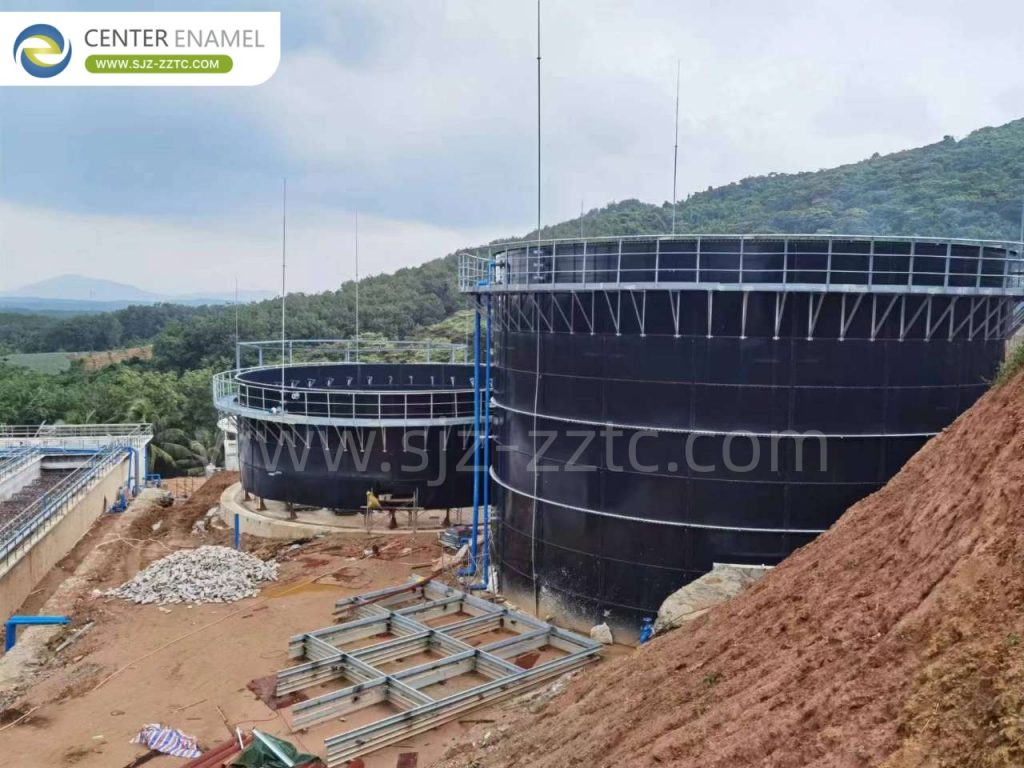
Glass-Fused-to-Steel (GFS) TanksGFS tanks are the core of anaerobic digestion systems. Fused at over 820°C, they offer:
- Full pH resistance (1–14) to withstand corrosive chicken manure and digestate
- Strong weather resistance, UV stability, and long service life
- Bolted assembly for fast installation and flexible expansion
- Service life exceeding 30 years with minimal maintenance
Double Membrane Gas Holders
These provide safe biogas storage with automatic pressure control, stable gas supply, and explosion protection for power generation systems.
Fusion Bonded Epoxy (FBE) Tanks
Used for equalization, pre-treatment, and water storage, FBE tanks offer cost-effective corrosion resistance for auxiliary processes.
Tank Roof Systems
- Air Membrane Roof: Flexible, lightweight, and gas-tight with automatic pressure adjustment.
- Enamel Roof: Highly corrosion-resistant GFS roof for harsh chemical environments.
- Sun Panel Roof: Light-transmitting, weather-resistant, and durable.
- Aluminum Flat Roof: Cost-effective, salt-spray resistant, and easy to install.
- FRP Roof: Lightweight, high-strength, and chemically stable.
- Aluminum Dome Roof: Arched, wind-resistant, rainproof, ideal for Laos’ tropical monsoon climate.
Agitation, Feeding, and Discharging Systems
Supporting equipment ensures stable material flow, efficient reaction, and reliable operation of the entire biogas system.
Why Center Enamel Is the Preferred EPC Contractor
- Owns Asia’s largest GFS Tank manufacturing base, ensuring stable production and timely delivery to remote rural areas of Laos.
- Possesses over 200 patented enamel formulas, adapting to Laos’ high temperature, high humidity and rainy tropical environment.
- Complies with NSF, WRAS, ISO 28765 and other international standards; every steel plate passes 1500V spark testing for zero defects.
- Provides customized engineering design according to local manure output, farm layout and energy demand.
- Offers full lifecycle EPC services including design, manufacturing, installation, commissioning and after-sales support.
- Rich Southeast Asian project experience, familiar with Laos’ rural construction conditions, climate and environmental policies.
Professional Installation Process of Center Enamel
Factory Prefabrication: All tank components are prefabricated and strictly inspected in the factory to ensure stable quality.
Hydraulic Jacking System: Adopts top-down hydraulic jacking installation without high-altitude scaffolding, suitable for Laos’ narrow rural farm sites.
Bolted Assembly, No On-Site Welding: All structures are assembled by high-strength bolts, avoiding welding failure caused by high humidity and heavy rainfall.
Fast Commissioning: Bolted structure eliminates long concrete curing time, enabling fast project operation and faster investment return.
Classic Successful Biogas Project Cases
Case1: France Biogas Project
Process Stage: CSTR
Tank Dimensions: φ18.33 × 8.4 m (H) — 1 Unit
Total Volume: 2,215 m³ — 1 Unit
Completion Year: 2021
Case2: Indonesia Biogas Project
Tank Application: Palm Oil Wastewater Treatment Plant
Tank Model: Ø19.86 × 8.4 m
Number of Tanks: 3 GFS Tanks
Installation: 7 personnel, 40 days
Installation Date: November 2009
Laos’ chicken breeding industry produces abundant manure resources with huge Biogas Project potential. Mature Biogas Technology and professional CSTR Reactor effectively solve breeding pollution and boost clean energy supply. Center Enamel provides diversified anaerobic processes, complete GFS supporting equipment and one-stop EPC services, helping Laos realize chicken manure recycling, rural energy independence and sustainable circular agricultural development.