
Center Enamel:
Professional Turnkey Contractor for Vietnam Pulp Mill Wastewater Treatment Project
In 2026, Vietnam has solidified its position as a global powerhouse in the pulp and paper industry, fueled by surging e-commerce packaging demand and a strategic pivot toward sustainable recycled-fiber production. Major mill clusters in Binh Duong, Bac Ninh, and Long An provinces drive national economic growth. Yet this progress has reached a critical environmental tipping point.
The Ministry of Natural Resources and Environment (MONRE) has enforced the Vietnam National Green Growth Strategy, mandating significantly improved effluent quality and encouraging closed-loop water systems. Pulp mill wastewater-a complex mixture of lignin, organic acids, chlorinated bleaching compounds, and high suspended solids-presents extreme COD levels, persistent color, and toxic potential. Meeting these 2026 standards demands more than off-the-shelf equipment; it requires a specialized turnkey contractor with deep process engineering expertise and field-proven corrosion-resistant infrastructure.
Why Pulp Mill Wastewater Treatment Demands a Specialized Turnkey Contractor
Vietnamese mill owners operate under unique pressures: tight construction timelines, soft soil conditions in the Mekong Delta and coastal zones, saline air corrosion near the sea, and uncompromising regulatory oversight. A turnkey contractor provides integrated engineering, procurement, and construction (EPC) services, ensuring every component-from primary clarification to biogas capture-works in harmony. Center Enamel (Shijiazhuang Zhengzhong Technology Co., Ltd) stands at the forefront, combining global material science with localized execution capability.
Material Science Foundations – Containment Built for Chemical Aggression
The corrosiveness of pulp mill effluent-driven by extreme pH swings, residual bleaching chemicals, and high chloride content-requires superior material selection. Center Enamel deploys a multi-technology portfolio to ensure long-term structural integrity and minimal lifecycle costs.
Glass-Fused-to-Steel (GFS) Tanks – The Core Reactor for Biological Treatment
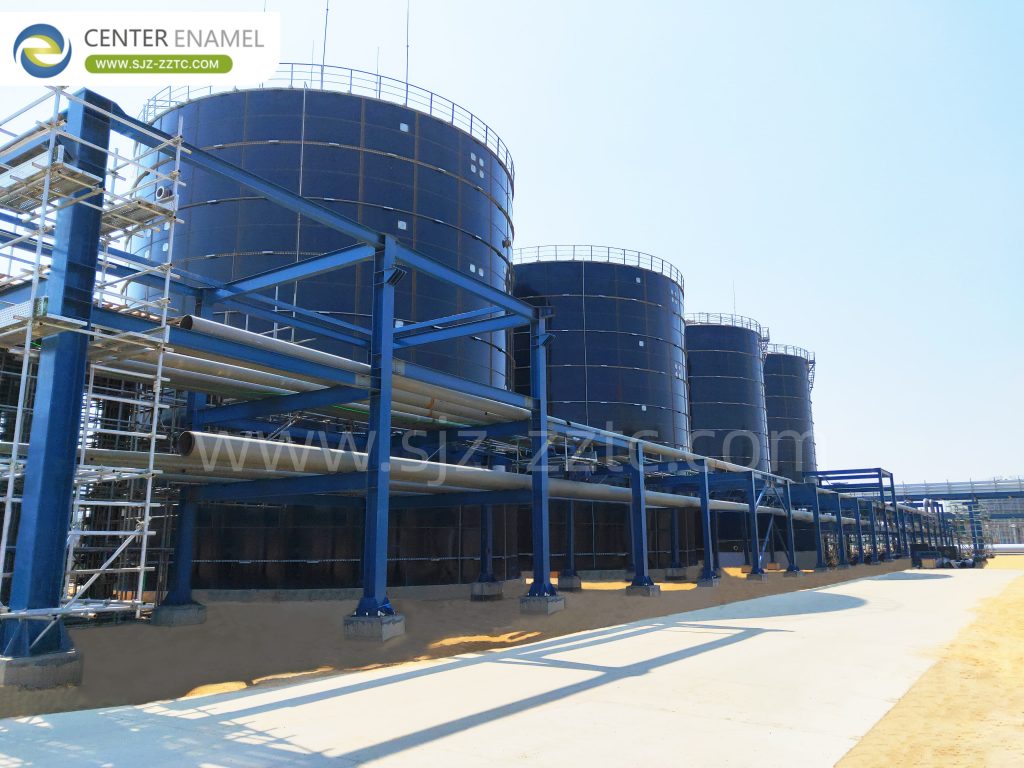
Our GFS tanks are the global standard for anaerobic and aerobic reactors in the paper industry. The glass coating, fused to specialty steel at over 800°C, creates a chemically inert surface that resists lignin-rich black liquor and aggressive pulping chemicals. The bolted, modular design enables rapid assembly in congested industrial zones and challenging soil conditions-a critical advantage for Vietnam's industrial parks.
Epoxy Coated Tanks – Reliable Support for Auxiliary and Polishing Stages
For equalization basins, treated water storage, and secondary process stages, Center Enamel provides high-specification electrostatic powder-coated epoxy tanks. These offer excellent resistance to industrial detergents and pre-treated effluent, delivering a cost-effective yet highly durable alternative for non-primary treatment applications.
Double Membrane Roof Systems – Biogas Capture for Energy Self-Sufficiency
Installed on anaerobic digesters treating high-strength organic loads, our gas-tight double membrane roofs capture methane-rich biogas generated during the breakdown of pulping waste. This recovered energy can power mill boilers, significantly lowering operational costs and reducing the carbon footprint-a key 2026 priority for Vietnamese manufacturers.
Aluminum Dome Roofs – Odor Containment and Climate Protection
For large-scale clarifiers and sedimentation basins, Center Enamel provides geodesic aluminum dome roofs. Constructed from high-strength aluminum alloy, these naturally resist the humid, corrosive mill atmosphere. The clear-span design effectively contains odors and shields treatment processes from Vietnam's heavy monsoon rainfall.
The Complete Treatment Process Train – End-to-End EPC Engineering
As a full-scope turnkey contractor, Center Enamel designs and integrates each stage of the treatment train to match the specific chemical and organic profile of pulp mill effluent.
Advanced Primary Treatment – Fiber Recovery and Grit Removal
Our turnkey solutions incorporate mechanical screening and primary clarifiers to recover valuable fibers, remove bark and grit, and reduce the hydraulic and organic load on downstream biological units.
High-Rate Anaerobic Digestion (IC/UASB) – COD Reduction with Energy Recovery
For the high-COD streams typical of chemical and mechanical pulping, anaerobic digestion is the core technology. Using our GFS reactors and double membrane roof systems, we break down complex organics, achieving substantial COD reduction while maximizing biogas yield for on-site energy use.
Aerobic Polishing and Color Removal – Meeting MONRE 2026 Standards
To meet Vietnam's stringent color and COD limits, we implement advanced aerobic processes such as activated sludge or Moving Bed Biofilm Reactors (MBBR), followed by chemical coagulation and tertiary polishing. These stages, often housed in our epoxy coated tanks, ensure final effluent is safe for discharge or further treatment for factory utility reuse.
Addressing Vietnam-Specific Operational Realities
Working as a turnkey contractor in Vietnam demands deep awareness of local challenges:
Salinity and humidity – Coastal mills face accelerated corrosion from saline air. Our glass-fused steel provides a permanent, impermeable barrier against atmospheric attack.
Soft soil conditions – Many industrial parks in the Mekong Delta and coastal regions sit on soft ground. Our modular bolted tanks are significantly lighter than concrete alternatives, reducing foundation complexity and cost.
Strict discharge standards – Vietnam's 2026 environmental regulations are non-negotiable. Our systems integrate real-time monitoring and automated chemical dosing to ensure continuous compliance.
Rapid deployment – In Vietnam's fast-paced economy, production delays are expensive. Our prefabricated modular tanks commission much faster than traditional cast-in-place concrete basins, keeping treatment capacity aligned with mill expansion schedules.
Project Reference – Cangzhou Industrial Wastewater Treatment Project
The following table presents a representative project that demonstrates Center Enamel's capability to deliver large-scale, multi-tank industrial wastewater treatment solutions as a turnkey contractor. All data are sourced from actual project records.
| Project Parameter | Specification |
| Application Field | Industrial Wastewater |
| Project Location | Cangzhou, China |
| Completion Date | 2021 |
| Total Storage Volume | 32,061 m³ |
| Number of Tanks | 13 units |
Tank Configuration Details
| Tank Diameter | Tank Height | Quantity |
| φ22.17 m | 12.0 m | 4 |
| φ14.52 m | 14.4 m | 2 |
| φ12.23 m | 10.2 m | 2 |
| φ15.29 m | 8.4 m | 1 |
| φ18.34 m | 8.4 m | 2 |
| φ8.41 m | 4.8 m | 1 |
| φ6.11 m | 4.8 m | 1 |
| Total | 13 units |
Key Technologies Applied
Glass-Fused-to-Steel (GFS) tanks for biological reactors
Epoxy coated tanks for auxiliary and polishing stages
Integrated system design for complex organic and industrial waste streams
Project Outcomes
Successfully managed complex industrial wastewater with high organic loads
Met stringent regional discharge standards
Achieved low maintenance costs through durable, corrosion-resistant tank systems
Demonstrated large-scale, integrated turnkey delivery capability
Integrated Solution Advantages – Lower Costs, Longer Life, Local Support
Reduced Lifecycle Operating Costs
The self-cleaning, non-porous glass surface of our GFS tanks prevents scale and lignin residue buildup, ensuring consistent hydraulic performance and reducing maintenance shutdown frequency.
Extended Asset Longevity
Double-sided enamel protection ensures an extended service life even in highly corrosive chemical environments, representing a superior long-term capital investment.
Professional Training for Vietnamese Teams
Center Enamel provides comprehensive operational training for local Vietnamese engineering teams, ensuring each Pulp Mill Wastewater Treatment system operates at peak efficiency throughout its service life.
Company Core Competencies – Manufacturing Excellence and Quality Assurance
Shijiazhuang Zhengzhong Technology Co., Ltd operates automated production lines that ensure every component meets the world's most rigorous quality standards.
Research & Development – We hold numerous patents for enamel formulations, allowing us to customize tank coatings for the specific chemical profile of pulp mill waste.
International Certifications – Our products are certified to meet or exceed AWWA D103-09, ISO 28765, and NSF 61, providing absolute confidence to international paper groups and local Vietnamese mill owners.
Integrated EPC Delivery – By managing design, manufacturing, and on-site installation, we provide a single point of responsibility from project inception to commissioning.
Frequently Asked Questions (FAQ)
1. Why is pulp mill wastewater considered significantly more challenging to treat than municipal sewage?
Pulp mill effluent contains complex organic compounds such as lignin, chlorinated organics, and high COD loads, along with extreme pH fluctuations. These characteristics require specialized anaerobic-aerobic treatment trains and chemically resistant containment-far beyond conventional municipal treatment.
2. What specific advantages do Glass-Fused-to-Steel (GFS) tanks offer for Vietnam's pulp mills?
GFS tanks are chemically inert, resisting both acidic and alkaline streams as well as saline coastal air. Their modular bolted design enables rapid installation in soft soil conditions and tight industrial park spaces, and they require less heavy foundation engineering than concrete alternatives.
3. How does biogas recovery from double membrane roofs benefit mill operations?
Biogas captured from anaerobic digesters-rich in methane-can be used in mill boilers to replace purchased fuels. This reduces operational energy costs, lowers the facility's carbon footprint, and supports Vietnam's National Green Growth Strategy for industrial sustainability.
4. What are the key MONRE requirements that Vietnamese pulp mills must meet in 2026?
MONRE enforces stricter limits on COD, color, suspended solids, and toxic compounds. The regulations also encourage closed-loop water reuse and require real-time monitoring. Our turnkey systems include automated dosing and compliance instrumentation to meet these non-negotiable standards.
5. Why is a turnkey contractor preferred over procuring tanks and process equipment separately?
A turnkey contractor provides integrated design, single-point quality control, coordinated logistics, faster commissioning, and unified after-sales support. This reduces interface risks, accelerates project delivery, and ensures all components function together seamlessly-critical for meeting Vietnam's aggressive mill expansion schedules.