
Why Does Chemical Wastewater Demand a Specialist EPC Contractor and Superior GFS Tanks?
Industrial wastewater treatment today is defined by the "three highs"-high difficulty, high cost, and high energy consumption. Wastewater from new energy, chemical, and pharmaceutical industries is complex in composition with numerous characteristic pollutants, and traditional treatment processes struggle to remove them effectively.
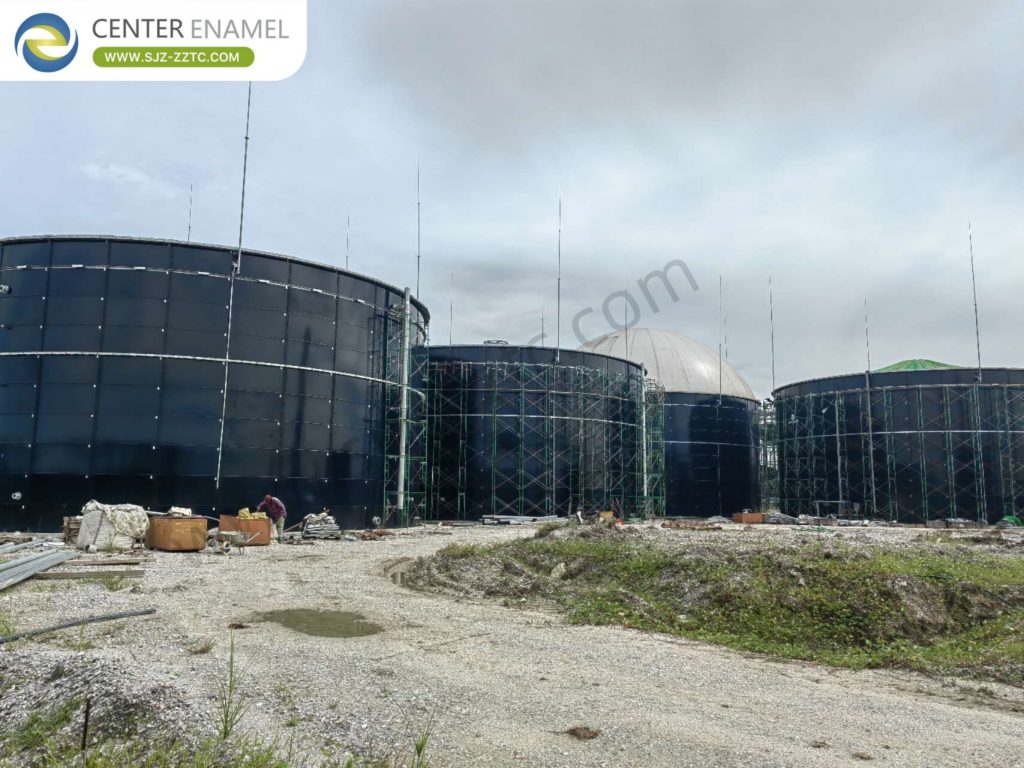
Chinese companies hold significant price advantages in the mid- to low-end equipment segment, yet the industry also faces continuous technological upgrade pressure from increasingly stringent emission standards, along with new requirements for digitalization and low-carbon transformation on operational refinement management capabilities. Nowhere do these pressures converge more sharply than in chemical wastewater, where toxicity, salinity, and load volatility combine. Meeting this challenge requires more than equipment supply: it demands a Chemical Wastewater Treatment EPC Contractor who controls process design, corrosion-proof tank manufacturing, and construction quality under one contract-and whose GFS Tanks can survive decades of aggressive service.
Why Corrosion Resistance Decides the Whole Project Economics
Before process selection, the tank shell determines lifecycle cost. Center Enamel's independently developed double-sided double-layer enameling technology is the industry's leading coating anti-corrosion technology, with corrosion resistance completely surpassing concrete tanks. Concrete tank interiors are riddled with pores, allowing wastewater and acid/alkaline media to easily penetrate and corrode the structural layer. Long-term use leads to irreversible problems such as internal wall spalling, water seepage, and rebar corrosion, which are difficult to repair and cannot be fundamentally resolved.
GFS Tanks feature high-temperature enameling on both the interior and exterior surfaces of steel panels, with a dense, non-porous enamel finish that completely blocks corrosive liquids and biogas permeation. The enamel layer has extremely strong chemical stability, resisting acids, alkalis, salts, and microbial corrosion. Concrete tanks will develop extensive corrosion and leakage after 5–8 years of use, while GFS tank anti-corrosion service life can exceed 30 years, with no need for frequent internal lining repairs throughout the service life, significantly reducing long-term anti-corrosion maintenance investment and fundamentally eliminating environmental risks of medium leakage contaminating sites and groundwater. Compared to traditional concrete and FRP tanks, GFS tank coatings have no risk of peeling or blistering, and are adaptable to highly corrosive conditions such as palm oil mill effluent, livestock manure, and chemical high-salinity wastewater, with outstanding long-term comprehensive cost advantages.
Where IC Anaerobic Technology Fits-and Where It Does Not
A capable Chemical Wastewater Treatment EPC Contractor must know when to deploy which process. The IC reactor is primarily designed for high-concentration, high-flow soluble industrial organic wastewater, covering brewery, beverage, starch, pharmaceutical, chemical, and papermaking high-strength wastewater. It suits land-constrained projects with high treatment efficiency requirements in large industrial wastewater treatment facilities, and can serve as the primary process for high-strength wastewater requiring rapid COD and BOD removal. It is also well matched to centralized industrial park WWTPs and large enterprise proprietary treatment systems, particularly for wastewater with significant quality fluctuations and extremely high pollutant concentrations. However, it is not suitable for high-solids, high-viscosity wastewater. Where conditions fit, it is the preferred anaerobic process for modern high-efficiency industrial wastewater treatment-and specifying it correctly is exactly the value a specialist EPC contractor brings.
The Real Cost Drivers of Chemical Wastewater O&M
Understanding operating economics shapes better design decisions. Chemical wastewater O&M costs rank among the highest of all wastewater types with poor overall economic viability, second only to pharmaceutical wastewater. Strong toxicity and high salinity require extensive segregated pretreatment equipment-high capital investment and complex operation. Advanced oxidation requires continuous addition of expensive chemicals such as hydrogen peroxide, ozone, and catalysts, driving very high chemical costs. High-salinity wastewater evaporation crystallization and reverse osmosis membrane treatment consume enormous energy, making electricity and steam costs significant. Salt-bearing and toxic sludge is hazardous waste with high compliance disposal costs, and disposal can account for over 30% of total costs. Equipment in high-salt, highly corrosive, strong oxidizing environments suffers frequent corrosion damage with high repair and replacement costs, requiring premium corrosion protection-one reason GFS Tanks outperform lower-grade alternatives on total cost. Frequent water quality fluctuations require dedicated 24/7 monitoring and adjustment, raising labor costs. Resource recovery benefits are minimal, with overall investment far exceeding returns, making chemical wastewater one of the highest economic burdens in industrial wastewater treatment.
| Cost Driver | Impact on Chemical Wastewater O&M |
| Segregated pretreatment | High capital investment; complex operation |
| Advanced oxidation chemicals | Very high recurring chemical cost (H₂O₂, ozone, catalysts) |
| Evaporation crystallization & RO | Enormous electricity and steam consumption |
| Hazardous sludge disposal | Can exceed 30% of total operating cost |
| Equipment corrosion repair | Frequent damage in high-salt, oxidizing environments |
| 24/7 monitoring labor | High staffing cost due to water quality fluctuation |
| Resource recovery return | Minimal; investment far exceeds returns |
South Africa Brewery Project: Proving the Integrated Model
The South Africa Brewery High-Strength Wastewater Treatment Project focuses on high-concentration organic wastewater treatment in the brewing industry, featuring both Center Enamel GFS Tanks and stainless steel tanks as core equipment. GFS tanks serve as the primary anaerobic digestion system, suited to brewery wastewater's high-COD, high-sugar, readily decomposable characteristics for efficient organic pollutant degradation. Stainless steel tanks are used for wastewater transfer and chemical storage supporting processes. The complete equipment package has excellent corrosion resistance and flexible assembly, providing long-term stable treatment of brewery production and cleaning wastewater and solving local brewing industry pollution challenges. This is a mature brewery wastewater treatment case in Africa, and it demonstrates how a single Chemical Wastewater Treatment EPC Contractor can coordinate multiple tank technologies within one delivery scope.
| Project Parameter | Specification |
| Project | South Africa Brewery High-Strength Wastewater Treatment |
| Core equipment | GFS tanks + stainless steel tanks |
| GFS tank role | Primary anaerobic digestion system |
| Stainless steel tank role | Wastewater transfer and chemical storage |
| Wastewater characteristics | High COD, high sugar, readily decomposable |
| Delivery model | Integrated equipment package |
| Key advantages | Corrosion resistance, flexible assembly, stable long-term treatment |
| Reference value | Mature brewery wastewater case in Africa |
After-Sales Support That Protects a 30-Year Asset
Corrosion-proof tanks and anaerobic systems only deliver their promised life when supported properly. The after-sales team adheres to the service principles of rapid response, professional efficiency, and full-cycle support, providing 24/7 full-lifecycle O&M support to global clients. Standard remote services include fault diagnosis, process parameter adjustment, and tank anti-corrosion maintenance guidance. For domestic and long-distance overseas clients, overseas technical service personnel can be dispatched for on-site inspection, annual inspection, and equipment refurbishment as needed. The team also maintains long-term client feedback tracking mechanisms, regularly collecting tank and anaerobic equipment operational data to continuously optimize product structure and support processes. Supporting external technical expert teams provide specialized support for anaerobic process commissioning, biogas upgrading O&M, and wastewater upgrade and retrofit projects, ensuring long-term stable operation of domestic and overseas projects while continuously improving global client satisfaction and repurchase rates.
Flexible Delivery for Cross-Border and Phased Projects
Delivery flexibility matters as much as technical performance. Center Enamel combines its own cross-border construction teams with a global localized agent network. Modular GFS Tanks assembly offers short construction periods and dismantlable, reusable capability, making the system suitable for overseas short-term projects, phased expansions, and relocation needs. Full-lifecycle after-sales O&M support ensures long-term stable client operations, whether the plant is a permanent industrial facility or a temporary treatment installation supporting a construction or mining campaign.
Frequently Asked Questions
What does a Chemical Wastewater Treatment EPC Contractor handle?
A specialist EPC contractor manages design, equipment manufacturing, construction, commissioning, and O&M under one contract, ensuring corrosion-proof tanks and anaerobic processes work together to meet discharge limits.
Are GFS Tanks suitable for high-salinity chemical wastewater?
Yes. The dense, non-porous enamel layer resists acids, alkalis, salts, and microbial corrosion, delivering 30+ years of service where concrete tanks fail within 5–8 years.
When is an IC reactor the right anaerobic choice?
IC reactors suit high-concentration, high-flow soluble organic wastewater with rapid COD/BOD removal needs, but are not recommended for high-solids or high-viscosity streams.
Looking for a reliable partner to own your chemical effluent project from process design through commissioning? Contact with Center Enamel's engineering team and we will prepare a tailored EPC proposal for your review. You are also welcome to request our global project portfolio to explore how GFS Tanks and anaerobic systems have performed in over 100 countries.