
How a China Brewing Wastewater Treatment Project EPC Contractor Treat Brewery Effluent?
When overseas breweries evaluate a treatment plant, they increasingly look east-not only for equipment value, but for an accountable delivery partner. As an experienced China Brewing Wastewater Treatment Project EPC Contractor, Center Enamel (Shijiazhuang Zhengzhong Technology Co., Ltd) combines Chinese manufacturing scale with international engineering standards, and the foundation of every plant we deliver is a fleet of GFS Tanks engineered for the corrosive reality of brewery effluent.
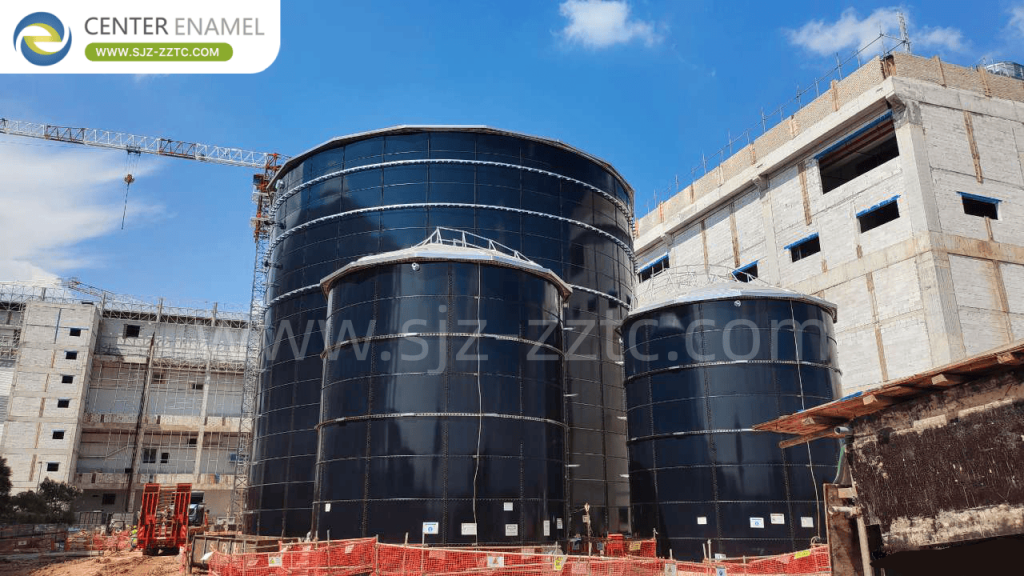
Why Buyers Are Turning to Chinese EPC Partners
The competitive landscape is diverging. Leading companies are building integrated service capability through technical integration and capital operations, while industry concentration gradually rises. Chinese manufacturers continue to consolidate their advantage in mid-tier equipment exports, international giants focus on high-end customers and the most complex industrial wastewater markets, and local players hold the mid-to-low-end and industrial-park centralized treatment segments through responsiveness and cost.
Within the anaerobic process segment, UASB, EGSB and IC reactors-favored for high loading rates, small footprints and stable operation-are widely used for high-concentration organic pre-treatment in food processing, pharmaceutical fermentation, alcohol brewing and chemical plants. Because these reactors rely on steel tank shells, their corrosion resistance and gas-tightness directly determine long-term operational stability, which is exactly why GFS Tanks have become the vessel of choice. For breweries, that market maturity means the treatment process itself is no longer experimental-it is standardized.
A Standardized Treatment Train for Brewery Effluent
The mature brewery wastewater treatment solution is a "solid-liquid separation + anaerobic digestion + aerobic polishing" train, perfectly suited to high-concentration, easily biodegradable organic effluent. Pre-treatment uses screens, sedimentation tanks and microfiltration to remove spent-grain residues and colloidal suspended solids, preventing equipment clogging and reducing downstream biochemical load. The main stage uses high-efficiency UASB or EGSB anaerobic reactors for rapid degradation of concentrated organic matter with simultaneous biogas energy recovery, precisely where pollution loads are highest.
Subsequent A/O or contact-oxidation aerobic processes deeply remove residual pollutants, while final sedimentation and disinfection ensure stable effluent compliance. The anaerobic digesters are built in Center Enamel GFS Tanks that resist organic-acid corrosion over a long service life. The whole train is shock-load tolerant, has a simple flow sheet and convenient operation, and matches the brewery industry's intermittent, seasonal discharge pattern. Among all the components in that train, the vessel itself often decides whether the plant lasts a decade or falls apart in five years-which is why GFS Tanks deserve a closer look.
Why GFS Tanks Outlast Concrete by Decades
Center Enamel's independently developed double-sided, double-layer enameling technology is an industry-leading anti-corrosion coating whose performance completely surpasses concrete. Concrete tank interiors are riddled with pores, so wastewater and acid or alkaline media easily penetrate and corrode the structural layer; over time this causes irreversible wall spalling, water seepage and rebar corrosion that are difficult to repair and cannot be fundamentally fixed. GFS Tanks, by contrast, use high-temperature enameling on both the interior and exterior of each steel panel, producing a dense, non-porous enamel finish that completely blocks corrosive liquids and biogas permeation.
The enamel layer has exceptional chemical stability against acids, alkalis, salts and microbial corrosion. Concrete tanks develop widespread corrosion and leakage after 5-8 years of service, while the anti-corrosion service life of GFS Tanks can exceed 30 years, with no need for frequent internal lining repairs-cutting long-term anti-corrosion maintenance investment and eliminating the environmental risk of media leaking into the site or groundwater. Compared with concrete and FRP tanks, GFS coatings never peel or blister, making them ideal for highly corrosive conditions such as palm-oil mill effluent, livestock manure and chemical high-salinity wastewater, and delivering outstanding long-term whole-life cost.
| Aspect | Concrete Tanks | Center Enamel GFS Tanks |
| Surface structure | Porous interior; media penetrates through | Dense, non-porous double-layer enamel |
| Corrosion behavior | Acid/alkali ingress; spalling, seepage, rebar rust | Resists acids, alkalis, salts and microbes |
| Typical service life | Noticeable corrosion and leakage within 5-8 years | Anti-corrosion life exceeds 30 years |
| Maintenance burden | Hard to repair; repeated lining work | No frequent internal lining repairs |
| Failure modes | Leaching into site soil and groundwater | No peeling or blistering |
| Best fit | Neutral, mild media | Brewery effluent, POME, livestock manure, chemical high-salinity |
When that corrosion resistance is combined with high-rate anaerobic process equipment, the result is a reactor that performs as well as it endures.
The IC Reactor Built Inside a GFS Tank
The core of the high-rate anaerobic section is a GFS Tank fitted with a built-in gas-lift internal circulation system and upper and lower three-phase separators-the key components that enable autonomous circulation and reliable sludge-water separation. A bottom precision distribution system and pressure-regulating feed device ensure uniform, stable influent across the reactor floor, supported by influent lift pumps, equalization tanks and flow meters for precise influent control. At the top, high-efficiency biogas collection is integrated with desulfurization, dehydration and storage, so recovered gas leaves the plant usable rather than vented. High-precision online monitoring tracks temperature, pH, COD and liquid level in real time, and dedicated bottom and mid-section sludge-discharge pipes with recirculation control remove excess sludge without any external return pumps. The complete system is highly integrated, free of redundant equipment, compact and highly automated. A reactor this tightly integrated is only possible because Center Enamel controls the product line end to end.
A Full Product Matrix Behind Every Plant
Center Enamel has built a complete matrix of "core storage tanks + supporting covers + specialty pressure vessels + complete environmental engineering services," and it is the only company worldwide to combine integrated enamel frit R&D, self-manufacturing and GFS tank application. At the core are proprietary GFS Tanks using double-sided hot-rolled double-layer enamel anti-corrosion technology, resistant to strong acids and alkalis, high salinity and microbial corrosion, and assembled modularly and quickly for the most corrosive wastewater, biogas and chemical conditions.
Supporting the tanks are fusion-bonded epoxy (FBE) tanks produced on China's first intelligent standardized production line, mainly for drinking water, fire water and neutral-media storage. For sealing and gas containment, proprietary high-strength aluminum dome covers use a self-supporting aluminum-alloy structure meeting international waterproof and load-bearing standards, suitable for both tank sealing and biogas collection. The range also includes carbon steel tanks, stainless steel tanks, composting tanks and various non-standard pressure vessels, backed by environmental EPC general contracting and anaerobic process-section subcontracting-a one-stop offering across food waste, leachate, municipal wastewater, livestock biogas, petrochemical and metallurgical effluent, and seawater desalination. Hardware is only half the promise; the other half is keeping the plant running wherever it is built.
Global Service That Outlasts the Warranty Period
Leveraging regional sales centers in China and overseas local agent networks, Center Enamel has built a complete after-sales service loop covering every market. The system rests on four pillars: a 24/7 rapid-response mechanism, on-site domestic and overseas installation services, full-project-cycle after-sales support and long-term warranty protection. Together they form a complete service chain from preliminary site survey, through mid-term construction management, to long-term inspection and maintenance. The whole system is uniformly adapted to domestic and international project service standards, coordinating personnel scheduling, material support and on-site coordination across simultaneous projects in multiple regions-significantly reducing customers' multi-party coordination costs and ensuring efficient delivery both at home and abroad. All of this capability is ultimately validated on real operating sites, and our reference portfolio stretches across continents.
Proven in the Field-the Pakistan Biogas Demonstration
In the Food Waste + Napier Grass Biogas Demonstration Project in Pakistan, Center Enamel acted as EPC and general contractor. The plant uses a CSTR (Continuous Stirred-Tank Reactor) as its core anaerobic process, co-digesting food waste with Napier grass. A mechanical mixing system keeps the feedstock and anaerobic microorganisms in thorough contact, degrades organic matter efficiently and sustains a stable biogas output of about 100 m³ per day. Because this is the local official demonstration project, its purpose is to validate gas-production efficiency and long-term continuous operating stability; after successful pilot operation, several large-scale Napier grass biogas projects are planned in the region. The same high-loading, corrosion-resilient, gas-recovery principles scale directly to brewery anaerobic digesters built in GFS Tanks.
| Parameter | Project Details |
| Project | Food Waste + Napier Grass Biogas Demonstration |
| Location | Pakistan |
| Center Enamel role | EPC / general contractor |
| Core anaerobic process | CSTR (Continuous Stirred-Tank Reactor) |
| Feedstock | Food waste co-digested with Napier grass |
| Mixing system | Mechanical agitation |
| Stable biogas output | Approximately 100 m³/day |
| Significance | Official local demonstration; larger follow-up projects planned |
From a greenfield brewery in Southeast Asia to a retrofitted plant in Europe, our engineers can model your effluent profile and deliver a fixed-scope EPC package anchored on GFS Tanks and high-rate anaerobic digestion. Contact Center Enamel today for a preliminary process scheme, tank sizing and budget tailored to your brewery.
Frequently Asked Questions
What makes Center Enamel a strong China Brewing Wastewater Treatment Project EPC Contractor?
Center Enamel integrates enamel frit R&D, GFS tank manufacturing, IC/UASB anaerobic process design, biogas roofs and EPC construction under one contract, with 10,000+ projects worldwide and CE, NSF, WRAS, ISO 9001 and ASME credentials for overseas tendering.
Why choose GFS Tanks over concrete for brewery anaerobic digesters?
Concrete develops pores, acid penetration, wall spalling and rebar corrosion within 5-8 years, while Center Enamel GFS Tanks use double-sided double-layer enameling that resists organic acids, sulfides and biogas for 30+ years-with no peeling, blistering or frequent lining repairs.
How does the IC reactor inside a GFS tank improve performance?
The GFS tank houses a built-in gas-lift internal circulation system and three-phase separators that recirculate sludge without external pumps, paired with precision influent distribution, integrated biogas cleanup and real-time monitoring of temperature, pH, COD and level.