
Why Is a China Industrial Wastewater Treatment Project EPC Contractor the Right Partner for Wastewater Treatment?
When a brewery, pharmaceutical plant, chemical works or industrial park needs a new wastewater treatment plant, the choice of partner is now as global as the supply chain itself. Increasingly, owners look to China not only for equipment value but for an EPC contractor who can deliver the process, the vessels and the long-term service as one accountable package. As a leading China Industrial Wastewater Treatment Project EPC Contractor, Center Enamel (Shijiazhuang Zhengzhong Technology Co., Ltd) has built that package around the IC Process-the high-rate anaerobic technology that anchors modern industrial effluent plants.
The Global Market Is Turning East
The Asia-Pacific region, and China in particular, has become the world's largest industrial wastewater treatment market, and the operation and maintenance segment's contribution keeps rising-a clear shift from one-time project construction to long-term operational management. North America focuses on upgrading aging facilities, while Europe emphasizes high-value-added resource recovery. Wastewater from the new-energy value chain-lithium batteries, photovoltaics and hydrogen-is the most notable emerging growth area, because its complex composition and high treatment difficulty generate real demand for customized solutions. Third-party treatment models in industrial parks continue to mature, driving consolidation in professional operations. In the Middle East, water scarcity pushes advanced treatment and reuse, while manufacturing transfer in Southeast Asia fuels local facility construction. That market shift is not just about geography-it is about which process best handles the hardest emerging effluents.
Where the IC Process Delivers Its Best Results
The IC Process is designed primarily for high-concentration, high-flow soluble industrial organic wastewater, spanning brewery, beverage, starch, pharmaceutical, chemical and papermaking effluents. It is the natural choice for land-constrained projects where treatment efficiency in large facilities is non-negotiable, and it serves as the primary high-rate process for high-strength wastewater requiring rapid COD and BOD removal. It fits centralized industrial-park wastewater treatment plants and large enterprise-owned systems alike-especially where quality fluctuates and pollutant concentrations are extreme. It is not suitable for high-solids, high-viscosity waste, and within its correct envelope it has become the preferred anaerobic process for modern high-efficiency industrial treatment.
| Scenario | Why the IC Process Is a Fit |
| Brewery, beverage, starch effluent | High soluble COD/BOD, readily biodegradable |
| Pharmaceutical fermentation, chemical, papermaking | Concentrated organic load at high flow |
| Land-constrained industrial sites | Footprint roughly one-third of traditional anaerobic systems |
| Industrial-park WWTPs and large enterprise plants | Handles quality swings and extreme concentrations |
| Not recommended | High-solids, high-viscosity waste |
The efficiency of the IC Process is only as reliable as the vessel that contains it, and that is where GFS Tanks come in.
The Vessel Behind the Process-GFS Tanks
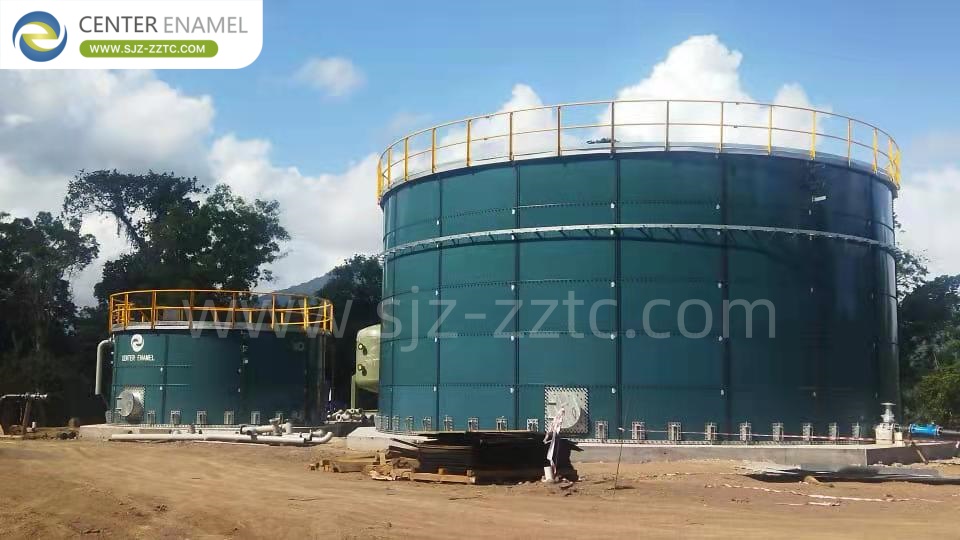
Center Enamel's independently developed double-sided, double-layer enameling is an industry-leading anti-corrosion technology whose performance completely surpasses concrete. Concrete tank interiors are riddled with pores, so wastewater and acid or alkaline media easily penetrate and corrode the structural layer, causing irreversible wall spalling, water seepage and rebar corrosion that are difficult to repair and cannot be fundamentally fixed.
GFS Tanks use high-temperature enameling on both the interior and exterior of each steel panel, producing a dense, non-porous enamel finish that completely blocks corrosive liquids and biogas permeation. The enamel layer has exceptional chemical stability against acids, alkalis, salts and microbial corrosion.
Concrete tanks develop widespread corrosion and leakage within 5–8 years, while the anti-corrosion service life of GFS Tanks can exceed 30 years-with no frequent internal lining repairs, lower long-term maintenance investment and no risk of media leaking into site soil or groundwater. Compared with concrete and FRP tanks, GFS coatings never peel or blister, making them ideal for aggressive conditions such as palm-oil mill effluent, livestock manure and chemical high-salinity wastewater. Once the process and vessel are settled, owners quickly ask what the plant will cost to run-and here the IC Process pays back again.
Economics That Improve Year After Year
Operating and maintenance costs for a well-designed brewery or industrial treatment plant are moderate to low, because the process is stable and controllable and resource-recovery credits offset ongoing expenses. The equipment itself is simple and durable, with no high-end precision wear parts, which means low failure rates and low maintenance demand. Excellent wastewater biodegradability means no large doses of oxidants or detoxification agents are required-only small amounts of flocculants and pH adjusters, keeping chemical costs low. The stable biogas produced by anaerobic digestion can be used directly for plant heating and equipment insulation, significantly reducing energy bills. Process parameters only need adjustment during peak-season load swings, so labor requirements stay minimal. And spent grain, digestate solids and liquid fertilizer can be sold off, further improving the plant's economics. A low-running-cost plant also needs the right cover on every tank, and Center Enamel's roof portfolio is engineered to match.
The Right Roof for Every Duty-the Aluminum Geodesic Dome
Center Enamel's independently developed aluminum geodesic dome is stamped from high-strength aluminum alloy plates into a triangular-grid, spherical, self-supporting structure that spans wide tank diameters without internal support columns. Aluminum delivers excellent weather and corrosion resistance, standing up to acid rain, salt spray and UV radiation across extreme outdoor climates. The design complies with international AWWA D108 standards, with plate thickness, rib cross-sections and joint connections all verified by finite-element stress analysis so wind and snow loads meet building codes in different regions.
At only one-third to one-half the weight of a steel roof of the same span, it sharply reduces load on the tank top and can be installed directly without tank-wall reinforcement. Double sealing-specialized sealant strips plus mechanical interlocking-delivers superior airtight performance for biogas storage, enclosed odor control and drinking-water contamination prevention, while the column-free design never interferes with internal mixers or water distributors. Because aluminum does not support microbial growth, the roof needs no anti-corrosion maintenance over decades, keeping total life-cycle costs low. Hardware of this quality needs a delivery and service network to match, and Center Enamel's footprint now spans the globe.
A Worldwide Presence, Localized Delivery
Center Enamel's global business covers more than 100 countries and regions, with 30,000+ successful overseas projects. Products are exported to Europe, the Americas, the Middle East, Africa, Southeast Asia and Latin America, supported by a well-established localized service network. Domestically, the company is organized into North, South, Central, East and Southwest marketing regions covering environmental, water-utility, livestock and petrochemical customers. Internationally, it follows a "standardized products + localized adaptation" model, adjusting tank corrosion protection, sealing and pressure standards to each country's water quality and environmental regulations. Reference landmarks include large-volume GFS tanks in Italy, 20-meter tower water-supply tanks in Colombia, coastal seawater-treatment tanks in Costa Rica and large municipal wastewater aluminum-dome projects in Saudi Arabia, alongside long-term strategic partnerships with many Fortune 500 companies.
| Country / Region | Landmark Reference |
| Italy | Large-volume GFS tank installations |
| Colombia | 20 m tower water-supply tanks |
| Costa Rica | Coastal seawater-treatment tanks |
| Saudi Arabia | Large municipal wastewater aluminum-dome projects |
| Global | Exports to 100+ countries; Fortune 500 partnerships |
Even the best-built plant benefits from a support team that stays close for decades.
After-Sales That Keeps Plants Running for Decades
Center Enamel's after-sales team is built on the principles of rapid response, professional efficiency and full-cycle support, providing 24/7 full-lifecycle O&M support to global clients. Standard remote services cover fault diagnosis, process parameter adjustment and tank anti-corrosion maintenance guidance. For domestic and long-distance overseas clients, technicians can be dispatched for on-site inspection, annual inspection and equipment refurbishment as needed. The team also maintains long-term client feedback tracking, regularly collecting operational data from tanks and anaerobic equipment to refine product structure and support processes. Dedicated external expert teams provide specialized support for anaerobic process commissioning, biogas upgrading O&M and wastewater upgrade or retrofit projects-ensuring long-term stable operation and continuously improving global client satisfaction and repurchase rates.
From a single high-strength effluent stream to an entire industrial-park WWTP, our engineers can benchmark your load against the IC Process and deliver a fixed-scope EPC proposal. Contact Center Enamel today for a preliminary process scheme, GFS tank layout and budget tailored to your industrial wastewater project.
Frequently Asked Questions
What makes Center Enamel a credible China Industrial Wastewater Treatment Project EPC Contractor?
Center Enamel integrates enamel frit R&D, GFS tank manufacturing, IC/UASB process design, roof supply and EPC construction under one contract, with 30,000+ projects in 100+ countries, Fortune 500 partnerships, and CE, NSF, WRAS, ISO 9001 and ASME credentials for overseas tendering.
Which effluents is the IC Process best suited for?
The IC Process targets high-concentration, high-flow soluble industrial organic wastewater-brewery, beverage, starch, pharmaceutical, chemical and papermaking-in land-constrained sites and industrial-park WWTPs. It is not designed for high-solids, high-viscosity waste.
How do GFS Tanks and the aluminum geodesic dome reduce long-term cost?
GFS Tanks resist corrosive effluent and biogas for 30+ years with no relining, while the aluminum geodesic dome weighs only one-third to one-half of a steel roof, needs no anti-corrosion maintenance, and provides airtight biogas containment and odor control.