
China Livestock Wastewater Treatment Project EPC Contractor with CSTR Process Solutions-Center Enamel
The core challenges of industrial wastewater treatment center on the "three highs"-high difficulty, high cost, and high energy consumption. Wastewater from new energy, chemical, and pharmaceutical industries is complex in composition with numerous characteristic pollutants, and traditional treatment processes are difficult to remove effectively. Chinese companies have significant price advantages in the mid-to-low-end equipment segment. The industry also faces continuous technological upgrade pressure from increasingly stringent emission standards, as well as new requirements for digitalization and low-carbon transformation on operational refinement management capabilities.
CSTR Process Application Scenarios
Primarily designed for high-solids organic pollutant treatment, the CSTR Process is widely used in food waste leachate, large-scale livestock manure, slaughterhouse wastewater, and food processing high-strength wastewater. It is also suitable for municipal sludge and industrial organic sludge anaerobic digestion. In the agricultural and environmental sector, it is utilized for large-scale farm manure resource recovery, achieving wastewater reduction, harmless treatment, and energy recovery. In the food and brewing industry, it is suitable for high-oil, high-protein, high-suspended-solids wastewater. It is also suitable for small to medium-sized wastewater treatment projects, township decentralized wastewater treatment, and as a pretreatment process for high-strength organic wastewater in large industrial parks to reduce downstream load. It is particularly suitable for difficult-to-treat organic wastewater with complex composition, high solids content, and easy crusting.
Palm Oil Mill Effluent O&M Costs
Building upon effective pretreatment methods, operational and maintenance costs remain moderate to low while biogas recovery benefits are exceptionally high, delivering outstanding overall economics and one of the best input-output ratios in industrial wastewater treatment. POME has excellent biodegradability (BOD/COD 0.5-0.6) with very high anaerobic digestion efficiency, requiring no expensive advanced oxidants or detoxification agents-only small amounts of lime/NaOH for pH adjustment and flocculants for low chemical costs.
CSTR/USR anaerobic equipment is simple and durable, utilizing GFS tanks with 30+ year corrosion resistance and no precision wear parts, resulting in extremely low failure rates and minimal repair or replacement requirements. Biogas recovery serves as the core economic benefit, producing exceptional biogas yields of 8-15 m³ per m³ POME. Combined heat and power (CHP) systems can meet 30-50% of mill electricity demand, while waste heat can be redirected for digester heating and FFB sterilization preheating to ensure high energy self-sufficiency.
Recovered palm oil from pretreatment oil separation can be sold as biodiesel feedstock or oleochemical raw material for substantial economic returns. Furthermore, anaerobic effluent rich in nitrogen, phosphorus, and potassium can be utilized for palm plantation irrigation and fertilization after advanced treatment, achieving dual resource recovery of water and fertilizer. Palm oil mills in Southeast Asia commonly benefit from renewable energy subsidies and carbon reduction credits (CDM/carbon trading), allowing biogas power projects to apply for carbon asset development and further improve project economics. Overall, the POME treatment system capital payback period is typically 5-8 years, with biogas power generation revenues fully covering O&M costs to generate net profit.
Malaysia Palm Oil Biogas Project
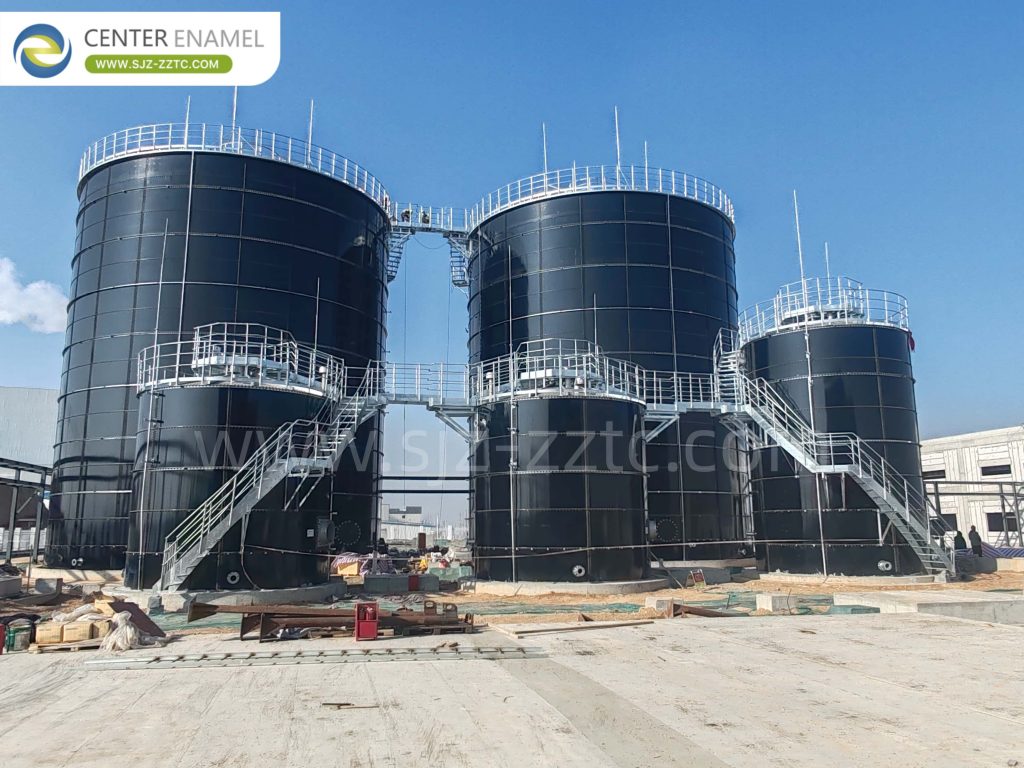
Demonstrating real-world execution excellence, this project utilizes Center Enamel GFS tanks as the core anaerobic digestion facility comprising 5 tanks, each with an effective volume of 5,400 m³ (total effective volume of 27,000 m³). Influent COD is maintained at ≥ 60,000 mg/L and BOD at ≤ 25,000 mg/L. Following anaerobic digestion, effluent COD drops below 12,000 mg/L and BOD drops to ≤ 5,000 mg/L, achieving an overall organic removal efficiency of approximately 80%. Single-tank daily biogas production reaches 4,400 m³, bringing total project daily biogas output to 22,000 m³ with a stable biogas yield of 0.45 m³ per kg COD removed. This ensures efficient biogas energy recovery while completely resolving palm oil processing wastewater pollution, showcasing top-tier competence as a trusted China Livestock Wastewater Treatment Project EPC Contractor.
Center Enamel Global Market Presence
Connecting large-scale industrial execution to worldwide reach, Center Enamel's global business covers over 100 countries and regions with 30,000+ successful overseas projects. Products are exported to all major regions including Europe, the Americas, the Middle East, Africa, Southeast Asia, and Latin America, backed by a well-established global localized service network. Domestically, the company is structured into North, South, Central, East, and Southwest marketing regions, comprehensively serving environmental, water utility, livestock, and petrochemical customers nationwide. Internationally, the company adopts a "standardized products + localized adaptation" model-adjusting tank corrosion protection, sealing, and pressure standards to fit diverse national water quality regulations-with landmark global projects including large-volume GFS tanks in Italy, 20 m tower water supply tanks in Colombia, coastal seawater treatment tanks in Costa Rica, and large municipal wastewater aluminum dome projects in Saudi Arabia.
Flexible Service Delivery System
To support diverse international client requirements, Center Enamel operates an integrated model combining dedicated cross-border construction teams with a global localized agent network. Modular GFS tank assembly allows for short construction periods and dismantlable, reusable capabilities, making it ideal for overseas short-term projects, phased expansions, and relocation needs. Full-lifecycle after-sales O&M support guarantees long-term stable client operations across all industrial sectors, including specialized deployments managed by any leading China Livestock Wastewater Treatment Project EPC Contractor.
Aluminum Alloy Trough Deck Roof
Complementing enclosed anaerobic and storage systems, the Aluminum Alloy Trough Deck Roof provides a cost-effective, economical tank cover solution for clean water and wastewater storage scenarios. Primarily designed for drinking water, production wastewater, and firewater reserve tanks, it perfectly balances practicality and financial efficiency. The main body is integrally formed from anti-corrosion aluminum alloy plates paired with robust aluminum support trusses. Its lightweight structure imposes minimal load on tank foundations, reducing civil construction investments.
A naturally formed dense oxide protective layer on the surface resists rain and mild wastewater corrosion, withstands outdoor sun exposure, and effectively blocks wind, rain, insects, fallen leaves, and odor volatilization. This protects water quality by preventing dust and debris from causing secondary contamination. The flat roof structure is neat and orderly, allowing the installation of maintenance walkways, guardrails, vents, and level monitoring ports on top to facilitate daily inspections and equipment maintenance. The simple sealing structure ensures straightforward installation with short timelines and virtually eliminates anti-corrosion painting maintenance, resulting in extremely low operating costs across waterworks clear water tanks, industrial circulating water tanks, park firewater tanks, and domestic wastewater temporary storage facilities.