
Center Enamel-China Palm Oil Wastewater Treatment Project EPC Contractor & GFS Tanks Engineering
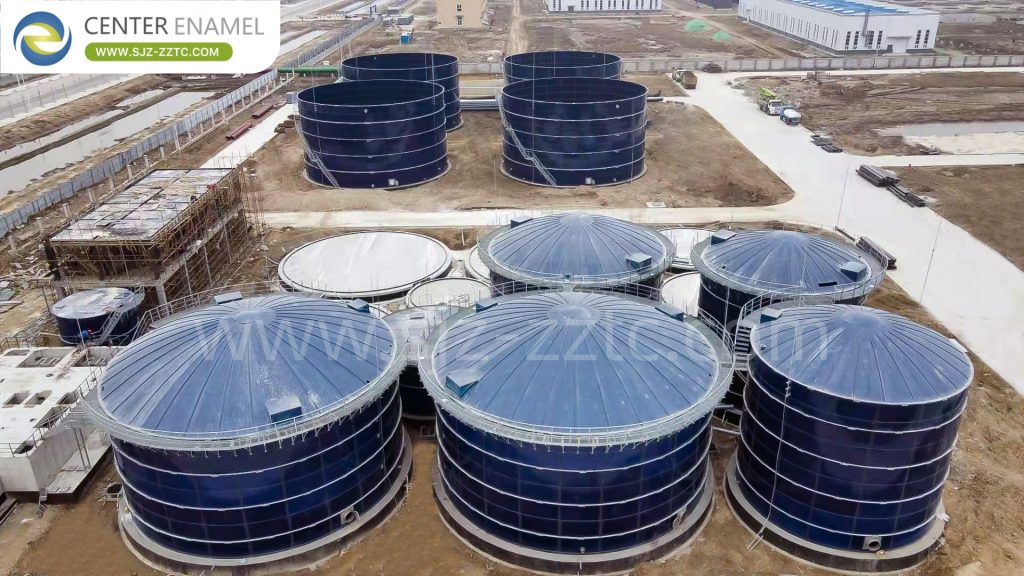
The core challenges of industrial wastewater treatment center on the "three highs"-high difficulty, high cost, and high energy consumption. Wastewater from new energy, chemical, and pharmaceutical industries is complex in composition with numerous characteristic pollutants, and traditional treatment processes are difficult to remove effectively. Chinese companies have significant price advantages in the mid-to-low-end equipment segment. The industry also faces continuous technological upgrade pressure from increasingly stringent emission standards, as well as new requirements for digitalization and low-carbon transformation on operational refinement management capabilities. To address these complex demands, Center Enamel provides expert engineering as a leading China Palm Oil Wastewater Treatment Project EPC Contractor.
GFS Tanks Adaptable to Complex Conditions
Center Enamel has independently developed over 200 specialized enamel frit formulations and supporting patents, capable of customizing anti-corrosion enamel based on customer storage media, with adaptability comprehensively superior to concrete tanks. Concrete tanks use a single material, only suitable for neutral clean water storage. When storing corrosive materials such as livestock manure, palm oil mill effluent, chemical wastewater, food waste digestate, high-salinity wastewater, etc., additional anti-corrosion linings must be applied. These linings are prone to failure, preventing long-term stable operation and cannot adapt to alternating high/low concentration storage conditions.
GFS Tanks can be specifically formulated with specialized enamels resistant to strong acids, strong alkalis, high organic content, and high salinity. A single tank can switch between multiple wastewater and fermentation feedstock storage requirements. They are universally applicable across biogas anaerobic digestion, municipal wastewater, livestock farming, food processing, and industrial water treatment scenarios, eliminating the need to rebuild tanks for media changes, perfectly meeting the needs of diversified, multi-condition environmental protection projects managed by Center Enamel as a trusted China Palm Oil Wastewater Treatment Project EPC Contractor.
What is CSTR Process
CSTR, or Continuously Stirred Tank Reactor, is a suspended-growth continuous-flow anaerobic digestion process suitable for high-solids, high-concentration organic pollutant treatment, and is the most widely used classic anaerobic treatment technology. The process relies on a mechanical stirring system to solve the technical challenges of material stratification, sludge sedimentation, and surface crusting in traditional anaerobic reactors, achieving homogeneous mixing of wastewater, anaerobic sludge, functional microorganisms, and organic substrates throughout the reactor, ensuring full contact between microorganisms and pollutants.
Unlike attached-growth anaerobic processes, CSTR requires no media carriers, relying on suspended sludge bacterial communities for degradation reactions. It withstands high-suspended-solids and high-viscosity wastewater shocks, making it the mainstream process for food waste, livestock manure, and municipal sludge anaerobic digestion. The process architecture is simple, operation logic straightforward, and it is adaptable to various high-pollution organic solid-liquid mixed systems implemented within every China Palm Oil Wastewater Treatment Project EPC Contractor delivery.
Palm Oil Mill Effluent Sources
Palm oil mill effluent (POME) originates from the entire processing chain of fresh fruit bunches (FFB) in palm oil milling-the highest pollution load and largest volume high-concentration organic industrial wastewater in tropical agricultural processing. Palm oil mills typically process 30-120 tons of FFB daily, generating approximately 0.5-1.0 m³ of wastewater per ton of FFB processed-single mills discharging hundreds to thousands of cubic meters daily, representing a core environmental challenge for the palm oil industry.
Wastewater comes from three main sources:
- Sterilization: FFB enter sterilization vessels for high-temperature steaming to deactivate lipase and prevent free fatty acid increase-producing sterilization condensate, the largest volume source at 80-90°C, rich in soluble sugars, amino acids, organic acids, COD 15,000-30,000 mg/L;
- Clarification: Pressed crude oil undergoes centrifugal separation and gravity settling to remove water and impurities-producing large volumes of oily wastewater with extremely high oil content and suspended solids, COD 50,000-80,000 mg/L, the highest organic load source;
- Kernel recovery: Palm kernels are separated by hydrocyclones and washed for recovery-producing sandy wash water with high suspended solids but relatively lower organic concentration. Auxiliary discharges include CIP cleaning, floor wash, boiler blowdown, and cooling tower water.
POME is acidic (pH 4.0-5.0), high-temperature (60-80°C), brown colloidal, rich in oils, suspended solids, colloidal proteins, and soluble sugars-a typical high-concentration, high-oil, high-suspended-solids organic industrial wastewater treated via advanced GFS Tanks.
Center Enamel Development History
Center Enamel has been deeply engaged in the environmental bolted storage equipment field for over 30 years. Starting with proprietary enamel anti-corrosion material technology, the company has gradually completed the full-industry-chain upgrade from a single tank manufacturer to a comprehensive environmental EPC service provider. Throughout its 30+ year history, the company has been recognized as a National High-Tech Enterprise, National Specialized and Sophisticated "Little Giant," Manufacturing Single Champion, and Provincial Green Factory. It has successfully delivered over 30,000 environmental projects globally, establishing itself as a leading enterprise in the global GFS tank storage industry. The company has fully integrated the entire chain from enamel frit R&D, intelligent environmental equipment manufacturing, to EPC project contracting-every business breakthrough has been achieved through proprietary core anti-corrosion technology as an elite China Palm Oil Wastewater Treatment Project EPC Contractor.
Center Enamel R&D Team
Center Enamel has built a full-chain professional team covering R&D, design, marketing, installation, and after-sales. The R&D team is led by national-level materials technology experts, specializing in enamel frit and tank anti-corrosion core technologies. External senior environmental engineering and mechanical structure engineers are retained to strengthen R&D capabilities, focusing on anti-corrosion coating formulations, specialty corrosion-resistant tanks, and anaerobic supporting integrated equipment-continuously breaking through industry technological barriers.
The team operates through proprietary laboratories with external university research collaboration-conducting year-round new material and new process durability pilot testing and long-term corrosion simulation testing. Specialized enamel formulations are iteratively developed for extreme conditions such as high-salinity wastewater, strong acid/alkali POME, and high-organic livestock manure-providing core technical support for the company's annual new invention and utility patents-building a proprietary material technology barrier supporting robust GFS Tanks.
Glass-Fused-to-Steel Roof Solutions
Glass-Fused-to-Steel Roof is a specialized tank cover solution designed for high air-tightness applications, primarily suited for CSTR anaerobic fermentation tanks and other biogas reactor tanks, serving as a core supporting component in organic waste anaerobic treatment projects. The roof is manufactured with the same material system as glass-fused-to-steel assembled tanks, with steel substrate and high-temperature fused glass coating integrated into one unit. The roof panel joints are equipped with specialized sealant strips and fasteners, achieving high-level overall air-tightness that completely seals biogas generated from anaerobic reactions inside the tank, preventing methane and odorous gas leakage while enabling biogas recovery and on-site odor control.
The product resists long-term corrosion from fermentation liquid and acid/alkaline biogas slurry, and will not be corroded or delaminate due to microorganisms or sulfides in the anaerobic environment. Its service life is synchronized with the glass-fused-to-steel tank, significantly reducing maintenance frequency. The structure employs steel truss supports for the glass-coated panels, providing stable load-bearing capacity. It can accommodate various process openings for mixers, biogas collection, monitoring, and manways, offering high integration.
Modular components enable rapid on-site assembly, suitable for large-volume anaerobic fermentation tanks. It is widely used in livestock manure treatment, food waste anaerobic digestion, straw biogas, and municipal sludge disposal projects, and is the mainstream reliable roof selection for anaerobic fermentation tanks integrated into systems designed by Center Enamel.