
Reliable Solutions by China slaughterhouse Wastewater Treatment Project EPC Contractor Using GFS Tanks
The competitive landscape shows divergence, with leading companies building integrated service capabilities through technical integration and capital operations, and industry concentration gradually increasing. Chinese companies continue to consolidate their advantages in mid-tier equipment exports. International giants target high-end customers and complex industrial wastewater markets, while local players occupy the mid-to-low-end and industrial park centralized treatment markets with service responsiveness and cost advantages.
In the anaerobic process segment, UASB, EGSB, and IC anaerobic reactors, with advantages of high loading rates, small footprints, and stable operation, are widely used in high-concentration organic wastewater pretreatment in food processing, pharmaceutical fermentation, alcohol brewing, chemical, and other industries. These reactors use steel tank shells, and their corrosion resistance and gas-tightness directly determine long-term operational stability. The application value of glass-fused-to-steel tanks in such scenarios is increasingly prominent.
GFS Tanks Layout Adaptations
GFS tanks offer flexible customization of size and appearance, with higher land utilization rates, ideally suited for modern compact plant layouts, with significant advantages over fixed poured concrete tanks. Concrete tanks cannot alter volume or shape after pouring, with heavy bases occupying large areas, making placement difficult on narrow or irregular plots. Their rough, uniform appearance cannot match modern facility aesthetic requirements.
GFS tanks volume can be precisely customized as needed, with capacities ranging from dozens of cubic meters to 50,000 cubic meters freely selectable. Tank height and diameter can be flexibly combined to fit narrow or irregularly shaped plots, effectively saving plant land occupation. Enamel color customization is also supported, achieving visual harmony with plant buildings and environmental facilities. During later plant expansion, GFS tanks can be directly adjusted in layout and expanded; concrete tanks, being monolithic structures, must be demolished and rebuilt, offering less flexibility in land resource utilization. This aligns well with the intensive construction and aesthetic operation and maintenance needs of industrial parks.
CSTR Reaction Process
CSTR operates in continuous feed, continuous reaction, and intermittent/continuous sludge discharge mode, with a concise and coherent process flow. High-solids organic wastewater, after pretreatment to remove large-particle impurities, is fed at a constant rate into the sealed anaerobic reactor via feed pumps. Continuous mechanical stirring maintains uniform mixing throughout the reactor, creating a stable anaerobic environment. Within the reactor, acidogenic bacteria and methanogens decompose macromolecular organic matter in stages, first hydrolyzing and acidifying polysaccharides, proteins, and lipids into volatile fatty acids, then further degrading them into methane and carbon dioxide biogas. Throughout the reaction, no material stratification occurs, pollutants are continuously degraded, treated supernatant overflows from the upper portion of the reactor, aged sludge is periodically discharged from the bottom, and biogas is uniformly collected for resource utilization, maintaining stable sludge concentration and reaction equilibrium for consistent treatment performance.
Wastewater Characteristics
Prominent "five highs and one low"-high COD, high BOD, high oil and grease, high suspended solids, high temperature, low pH-pollution load far exceeding conventional industrial wastewater, one of the highest concentration wastewater categories in agricultural processing. Very high COD-combined wastewater 45,000-100,000 mg/L, oil separation wastewater peaking above 150,000 mg/L-dozens to hundreds of times higher than municipal wastewater.
High BOD-25,000-65,000 mg/L, BOD/COD 0.5-0.6-excellent biodegradability with very high anaerobic digestion efficiency. High oil and grease-combined 2,000-8,000 mg/L, oil separation above 10,000 mg/L-oil readily adheres and scales on pipe/equipment surfaces, affecting heat transfer and causing blockages. High suspended solids-10,000-20,000 mg/L-primarily fruit pulp residues, fruit shell fibers, colloidal proteins-readily settling and clogging equipment.
Moderate total nitrogen-ammonia 500-1,500 mg/L with abundant organic nitrogen but low inorganic nitrogen. High total phosphorus-200-800 mg/L. Very low pH-raw water pH 4.0-5.0-requires alkali neutralization before biological treatment. High temperature-discharge 60-80°C-requires cooling to 35-38°C before anaerobic digestion. Water quality varies significantly with palm oil mill processing seasons-peak production during fresh fruit bunch harvest season (March-September annually) with full-load operation, wastewater volume and organic concentration at maximum; off-season (October-February) with reduced or halted production-water quality fluctuations require high shock load resistance.
Malaysia Biogas Project Applications
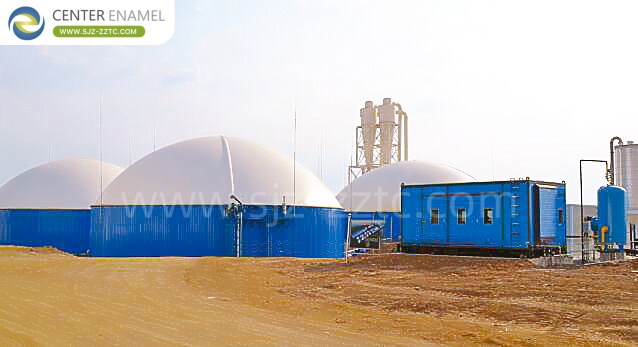
The project uses Center Enamel GFS tanks as the core anaerobic digestion facility with 5 tanks, each with effective volume of 5,400 m³, total effective volume 27,000 m³. Influent COD ≥ 60,000 mg/L, BOD ≤ 25,000 mg/L. After anaerobic digestion, effluent COD drops to below 12,000 mg/L, BOD ≤ 5,000 mg/L-overall organic removal efficiency approximately 80%. Single tank daily biogas production 4,400 m³, total project daily biogas 22,000 m³-stable biogas yield of 0.45 m³ per kg COD removed-efficient biogas energy recovery while solving palm oil processing wastewater pollution. As a trusted China slaughterhouse Wastewater Treatment Project EPC Contractor, Center Enamel applies these high-capacity principles to modern animal processing facilities worldwide.
Center Enamel Design Team
The design team includes senior engineers registered in the Hebei Provincial Science and Technology Expert Database, with design standards aligned with strict European/American high-end equipment safety standards. The team can provide complete integrated design for differentiated overseas projects in livestock biogas, POME, municipal wastewater, hazardous waste storage, seawater desalination, etc.-covering tank structure, anti-corrosion/sealing systems, biogas piping, and anaerobic process integration. Pre-design thoroughly investigates local seismic zone, wind pressure, soil bearing capacity, water quality corrosivity, and local environmental discharge standards-applying thickened panels, reinforced anchored bases, and optimized sealing/corrosion structures as needed. Complete customized equipment solutions can be tailored to customer plant area, wastewater load, treatment targets, and budget-balancing safety, economics, and local adaptation-providing compliant, stable, and highly adaptable equipment structural design support for global environmental projects.
Full-Industry-Chain Delivery Capability
Center Enamel is the only company globally integrating proprietary enamel frit R&D, self-manufactured tanks, and EPC general contracting-full-process self-control from solution design, equipment production, cross-border logistics, overseas construction, to post-construction O&M-significantly reducing client coordination and time costs. Operating as an experienced China slaughterhouse Wastewater Treatment Project EPC Contractor, the company leverages high-performance GFS tanks to deliver turnkey, long-lasting industrial engineering solutions across global markets.