
Why an EPC Contractor Chooses the USR Process for Livestock Wastewater Treatment?
Livestock manure treatment suffers from a structural contradiction: waste is generated in decentralized, fluctuating volumes, yet effective treatment demands centralized, stable infrastructure. Farmers' environmental awareness varies, illegal discharges occur, subsidies are often insufficient, and digestate utilization channels remain obstructed. Solving this requires more than equipment-it requires a delivery model that assumes responsibility for the entire system.
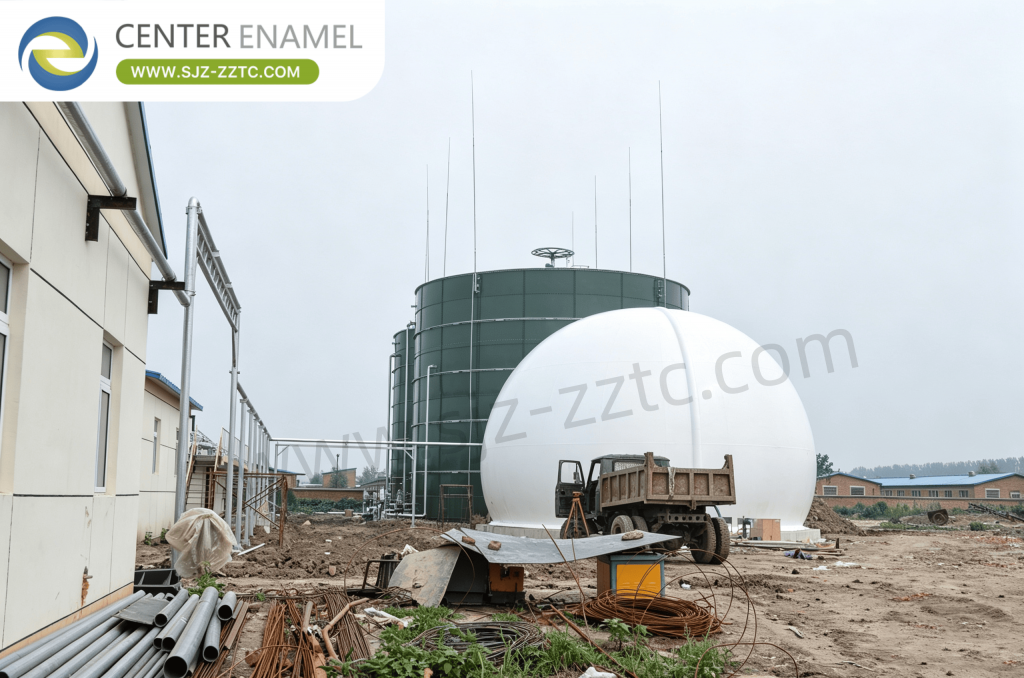
As an EPC Contractor, Center Enamel addresses this by pairing the USR Process with GFS Tanks and full-scope engineering delivery. The USR Process handles the high-solids reality of livestock wastewater without clogging; the EPC model ensures design, manufacturing, construction, and commissioning are accountable to a single party. This article examines the industry challenges, material and process advantages, environmental risk profile, R&D credentials, and installation capability behind every project we deliver.
The Structural Dilemma Facing Livestock Manure Treatment
Any effective solution must begin by acknowledging the real constraints. The core dilemma of livestock manure treatment lies in the structural contradiction of "decentralized generation vs. centralized treatment." Manure generation surges during intensification, but supporting treatment facilities lag behind. Digestate resource utilization channels are obstructed, with safety risks from heavy metal and antibiotic residues constraining farmland application. At the enforcement level, farmers' environmental awareness varies, with illegal discharges occurring frequently; at the policy level, subsidies and incentives are insufficient to effectively drive voluntary compliance. Biogas grid connection difficulties and limited digestate transport radius further compress the economic viability of resource utilization. These are not equipment problems-they are system problems, which is precisely why an EPC Contractor with integrated delivery capability is better positioned to solve them than a component supplier.
GFS Tanks Engineered for Corrosive and Variable Operating Conditions
Containment must survive conditions that destroy conventional materials. Center Enamel has independently developed over 200 specialized enamel frit formulations and supporting patents, capable of customizing anti-corrosion enamel based on customer storage media, with adaptability comprehensively superior to concrete tanks. Concrete tanks use a single material and are only suitable for neutral clean water storage. When storing corrosive materials such as livestock manure, palm oil mill effluent, chemical wastewater, food waste digestate, or high-salinity wastewater, additional anti-corrosion linings must be applied. These linings are prone to failure, preventing long-term stable operation and cannot adapt to alternating high and low concentration storage conditions.
GFS Tanks resolve this through formulation rather than added protection. They can be specifically formulated with specialized enamels resistant to strong acids, strong alkalis, high organic content, and high salinity. A single tank can switch between multiple wastewater and fermentation feedstock storage requirements. They are universally applicable across biogas anaerobic digestion, municipal wastewater, livestock farming, food processing, and industrial water treatment scenarios, eliminating the need to rebuild tanks for media changes and perfectly meeting the needs of diversified, multi-condition environmental protection projects. As an EPC Contractor, this versatility allows us to standardize on a single containment platform across an entire project portfolio while still matching each tank to its specific service conditions.
USR Process Advantages That Make It the Right Choice for Manure
Process selection determines whether a system operates reliably or fails repeatedly. The USR Process offers high solids tolerance, clog resistance, and strong adaptability, making it perfectly suited for high-suspended-solids, high-impurity, high-solids organic wastewater. Its equipment structure is extremely simple, with no precision wear parts, resulting in low capital investment, long service life, virtually no clogging failures, and extremely low subsequent maintenance costs.
The process imposes no strict requirements on sludge morphology-there is no need to cultivate mature granular sludge, as flocculent sludge can operate stably, with fast start-up and a short sludge acclimation period for rapid commissioning. Gentle hydraulic disturbance results in low sludge washout and high sludge utilization, with stable organic pollutant degradation. Operation is simple with low automation requirements and high error tolerance, making it suitable for remote sites, farms, and other settings with limited O&M capabilities-outstanding stability and practicality advantages. For an EPC Contractor working in rural agricultural settings, these characteristics directly reduce commissioning time, operator training burden, and long-term service obligations.
Environmental Toxicity Profile of Livestock Wastewater Pollutants
Understanding the pollution mechanism clarifies what treatment must achieve. Livestock wastewater pollutants carry no synthetic chemical toxicity and no hazardous substances-very low risk of acute or chronic toxicity. Pollution impacts are primarily biological and nutrient pollution. All pollutants are natural organics from livestock metabolites and feed residues, with no inhibition of microbial activity and no toxicity to soil, water, or aquatic organisms.
However, they are rich in nitrogen, phosphorus, and suspended impurities, carrying E. coli, parasite eggs, and pathogens. Direct discharge without treatment rapidly causes eutrophication, black-odor conditions, mosquito breeding, and disease transmission. Long-term discharge causes soil compaction and elevated nutrient levels in groundwater-persistent ecological pollution, but no hazardous substance accumulation or carcinogenic and mutagenic risks. This profile is favorable for biological treatment: the same characteristics that make livestock wastewater a pollution risk also make it highly amenable to anaerobic digestion and biogas recovery, provided the system is designed for high solids and variable loading.
R&D Strength and Global Certifications Behind Our EPC Delivery
Technical depth is what separates a credible EPC Contractor from an assembler. Technology R&D is Center Enamel's core competitive advantage. The company independently masters over 200 differentiated anti-corrosion enamel formulations, with full self-control over the enamel raw material chain, holding nearly 100 invention and utility patents. Products have passed NSF, WRAS, ASME, BSCI, CE, ISO9001, and other global certifications.
Certifications, Honors, and R&D Capability
| Category | Details |
| Enamel formulations | 200+ differentiated anti-corrosion formulations |
| Patents | Nearly 100 invention and utility patents |
| Product certifications | NSF, WRAS, ASME, BSCI, CE, ISO9001 |
| Enterprise honors | National High-Tech Enterprise; National Specialized and Sophisticated "Little Giant"; Hebei Manufacturing Single Champion; Provincial Smart Factory; Provincial Green Factory |
| Compliance qualifications | Complete environmental engineering and special equipment manufacturing |
| Research collaboration | Joint materials laboratories with multiple universities |
Company certifications and honors include National High-Tech Enterprise, National Specialized and Sophisticated "Little Giant," Hebei Manufacturing Single Champion, Provincial Smart Factory, and Provincial Green Factory, along with complete environmental engineering and special equipment manufacturing compliance qualifications. The company maintains long-term collaborative research with multiple universities through joint materials laboratories, continuously iterating anti-corrosion coatings and large bolted tank structural design technologies. The proprietary material technology barrier creates an irreplaceable competitive advantage, with product performance comparable to high-end imported European and American storage equipment.
Installation Teams with Global Project Experience
Execution quality ultimately determines whether a design performs in the field. The installation team has practical experience from over 10,000 GFS Tanks projects globally, strictly following standardized construction procedures-full control over project mobilization, civil coordination, tank assembly, piping, and commissioning schedules and quality.
The team is proficient in complete standardized installation processes for GFS Tanks, dual-membrane gas storage covers, USR, CSTR, and IC anaerobic reactors, and biogas desulfurization and piping systems-adaptable to large-scale farms, industrial parks, remote mountainous sites, coastal high-corrosion sites, and other complex locations-strictly implementing unified global safety construction standards. For large overseas cross-border projects, the team can be deployed as complete units for on-site construction, technical training, and local worker practical instruction-full control over construction details, air-tightness testing, and corrosion protection-ensuring timely and stable commissioning of global environmental projects through standardized delivery capability. This is what allows us to commit as an EPC Contractor to schedule and performance rather than merely supplying equipment.
FRP Roof Cover Solution for Atmospheric Storage Applications
Not every tank requires gas-tight sealing, and matching cover type to application controls cost without sacrificing function. FRP Roof is a general-purpose economical roof for atmospheric pressure storage tanks without air-tightness requirements, suitable for drinking water storage, agricultural irrigation water, firewater reserve, and general production wastewater temporary storage. It is available in two styles-flat and dome-allowing flexible selection based on tank specifications and site aesthetic requirements.
The roof is integrally molded from resin and fiberglass, lightweight, with natural water resistance and mild acid/alkali corrosion resistance. It will not rust or rot in long-term humid environments, eliminating the frequent anti-corrosion maintenance required for metal roofs. The dome style features excellent drainage performance due to its curved structure, resisting water accumulation, dust buildup, snow load, and strong winds. The flat style facilitates the installation of maintenance walkways, level gauges, and vents on top, making inspection and operation convenient. The product is fully insulated with no risk of galvanic corrosion, will not contaminate drinking water quality, and meets environmental standards for domestic water storage.
The modular design with low individual component weight allows for simple on-site hoisting and assembly, offering high construction efficiency and affordable procurement and installation costs. It is only suitable for atmospheric pressure water storage tanks without biogas collection or pressurization requirements, and is not recommended for anaerobic fermentation gas-producing conditions. It is widely used in rural agricultural water storage tanks, industrial park firewater tanks, waterworks buffer tanks, and small to medium-sized domestic wastewater temporary storage facilities-making it a cost-effective general-purpose roof choice for conventional water storage applications.
Facing decentralized manure generation and tightening discharge rules? Let Center Enamel design and build a USR Process system tailored to your farm's volume, site conditions, and biogas targets. Contact our EPC team for a feasibility review and turnkey proposal.
Frequently Asked Questions
Q: Why does an EPC Contractor prefer the USR Process for livestock wastewater?
The USR Process tolerates high suspended solids without complex separators that clog, requires no granular sludge cultivation, and operates simply at remote sites. This reduces commissioning time, maintenance burden, and long-term service risk for EPC-delivered projects.
Q: What advantage do GFS Tanks bring to livestock biogas projects?
With 200+ enamel formulations, GFS Tanks resist manure corrosion, high organics, and salinity. They handle alternating concentrations, assemble quickly for rural sites, and deliver 30+ year service life with minimal maintenance.
Q: What certifications and R&D capability back Center Enamel projects?
Center Enamel holds nearly 100 patents, 200+ enamel formulations, and certifications including NSF, WRAS, ASME, BSCI, CE, and ISO9001-with National High-Tech Enterprise and Provincial Green Factory honors supporting global tender compliance.