
Complete Biogas Solutions for New Zealand Dairy Farms: CSTR Process and GFS Tanks
New Zealand’s picturesque agricultural landscape, particularly in regions like Waikato, Canterbury, and Southland, is home to millions of dairy cattle. While this industry is the backbone of the economy, it faces a significant environmental hurdle: manure management.
With high daily volumes of dairy effluent, farmers struggle with storage, odor control, and the runoff of nutrients into local waterways. Traditional storage ponds often fail to capture methane emissions-a potent greenhouse gas-and require massive land areas for disposal. The core challenge lies in the pre-treatment stage: effectively separating sand and large solids from the slurry to prevent pipe blockages and equipment wear. Without proper homogenization, the high organic load of cow manure becomes a liability, polluting soil and water instead of powering the farm.
The Advantages of Converting Cow Manure to Biogas
Transforming waste into wealth is no longer a futuristic concept; it is the present reality of modern agriculture. Converting cattle manure into biogas offers distinct advantages beyond mere waste reduction.
Biogas capture turns an environmental liability into a renewable asset. The process significantly reduces the farm's carbon footprint by preventing methane from escaping into the atmosphere. Furthermore, the digested effluent (digestate) is a nutrient-rich, nearly odorless organic fertilizer that is superior to raw manure. It allows for precise application of nitrogen and phosphorus to crops, reducing the reliance on synthetic fertilizers and preventing the algal blooms associated with nutrient runoff. This creates a closed-loop system: the farm powers itself with renewable energy and fertilizes its pastures with the byproduct.
Center Enamel: Professional Design for Biogas Projects
Shijiazhuang Zhengzhong Technology Co., Ltd (Center Enamel) has been a global leader in the environmental engineering sector . With a massive 150,000㎡ R&D and production base and over 500 employees, Center Enamel is the largest manufacturer of Glass-Fused-to-Steel (GFS) tanks in Asia.
For New Zealand farmers, Center Enamel offers more than just hardware; they provide professional EPC (Engineering, Procurement, and Construction) services tailored to the specific needs of large-scale dairy operations. By utilizing international standards such as AWWA D103 and ISO 9001, Center Enamel ensures that their Biogas Solutions are durable, corrosion-resistant, and engineered to handle the high-solids content of cow manure in harsh environmental conditions.
Biogas Generation Principles and Pre-Treatment
The magic of biogas lies in Anaerobic Digestion (AD). Inside a sealed, oxygen-free tank, naturally occurring microorganisms break down the organic matter in cow manure through four key stages: Hydrolysis, Acidogenesis, Acetogenesis, and Methanogenesis.
However, raw manure cannot simply be pumped into a reactor. Effective pre-treatment is critical. Upon arrival, the manure passes through a screening and crushing stage to remove impurities like stones or stray bedding. Following this, a sand settling and homogenization tank balances the flow and consistency of the slurry. This initial cleaning simplifies the waste, ensuring that the subsequent biological process runs smoothly without clogging or grit buildup.
The CSTR Process: The Core Technology
At the heart of an efficient biogas plant lies the CSTR Process (Continuous Stirred-Tank Reactor). Unlike simple lagoon storage, the CSTR is an advanced anaerobic treatment technology designed for high-yield biogas production.
The CSTR reactor is equipped with a mechanical stirring device that continuously mixes the high-concentration organic waste with anaerobic microorganisms. This constant agitation ensures complete contact between bacteria and food, maximizing the degradation of organic matter. Key components include the mixer, agitator shaft, and specialized paddle designs that break surface crusts (shell breaking). By maintaining a constant temperature and continuous feeding, the CSTR significantly accelerates fermentation, producing a higher volume of biogas compared to conventional methods.
GFS Tanks + Double Membrane Roof
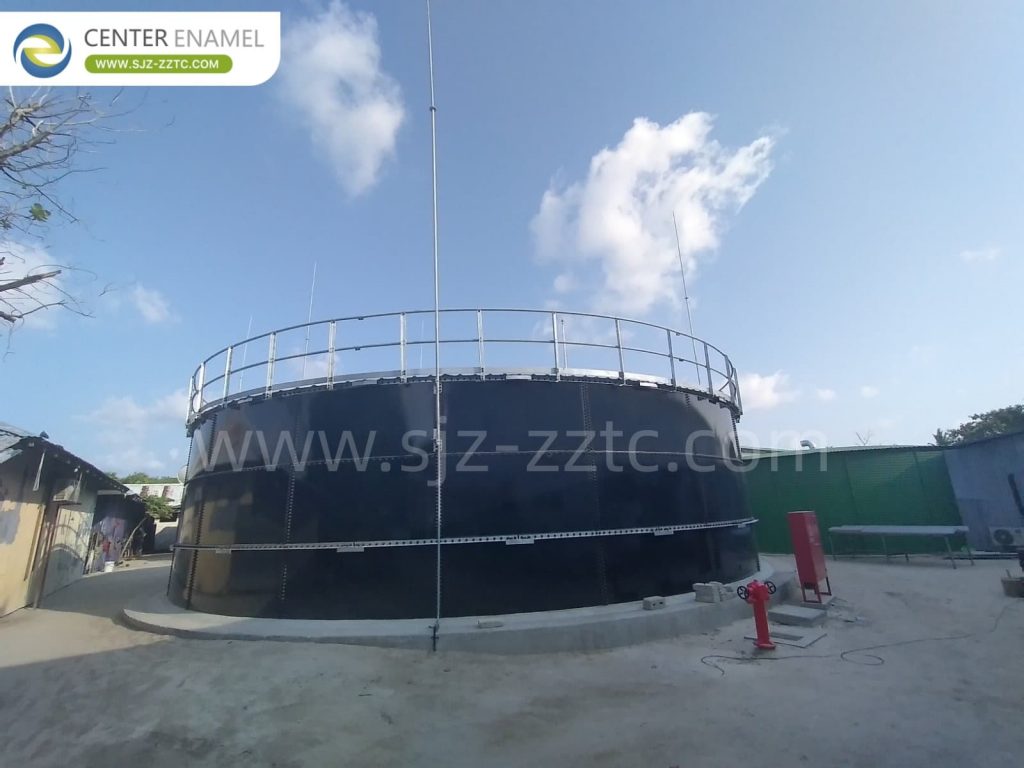
For the corrosive environment of anaerobic digestion, standard steel rusts, and concrete cracks. Center Enamel’s GFS Tanks (Glass-Fused-to-Steel) are the ultimate solution. The glass is fused to the steel at over 800°C, creating an inert, durable surface that is highly resistant to the acidic pH levels (1-14) found in cattle slurry.
When paired with a Double Membrane Roof, the system becomes a masterpiece of efficiency. While a rigid GFS roof is recommended for extremely high wind or snow loads, the Double Membrane Roof is the preferred standard solution for New Zealand conditions. Its advantages include:
Cost Optimization: Significantly lower cost than rigid steel roofs.
Space Efficiency: The integrated gas holder sits directly on top of the tank, eliminating the need for a separate ground-mounted gas holder and saving valuable farm land.
Supporting Equipment Overview
A fully functional biogas system relies on more than just the reactor. Center Enamel provides a comprehensive suite of auxiliary equipment to ensure smooth operation:
Gas Holder & Torch System: Stores the produced biogas and safely combusts excess gas during maintenance.
Dehydration and Desulfurization Tank: Raw biogas contains corrosive hydrogen sulfide (H2S) and water vapor. This equipment cleans the gas before it enters a generator.
Solid-Liquid Separator & Screw Sludge Dewatering Machine: Separates the digestate into solid and liquid fractions. The solid fraction can be used as cow bedding or sold as organic fertilizer.
Black Membrane: Often used for secondary lagoon storage or final effluent storage.
Efficient Installation and Manufacturing Capacity
Time is money for a dairy farmer. Center Enamel excels in rapid deployment. Their modular tank panels are pre-fabricated in their massive 250,000-sheet-per-year facility, ensuring consistent quality controlled by factory conditions rather than on-site variables.
The bolted design of GFS Tanks allows for installation in any weather condition-unlike concrete which requires curing time. With a team of skilled engineers and global logistics experience, Center Enamel can erect tanks on remote New Zealand farms quickly and efficiently. This modularity also allows for future expansion. If the herd grows, the biogas plant can grow with it, representing a flexible investment for the future.
Center Enamel: One-Stop EPC Solutions for NZ Farms
For New Zealand farmers looking to navigate the complexities of renewable energy, Center Enamel offers a stress-free One-Stop Solution.
As an EPC Contractor, Center Enamel takes full responsibility. They handle:
Custom Design: Engineering a system that matches your herd size and specific waste profile (CSTR vs. UASB/IC).
Equipment Supply: Providing high-quality GFS Tanks, mixers, and membrane roofs.
Construction & Commissioning: Ensuring the biology works and the gas flows.
Training: Teaching local staff how to manage the new system.
By choosing Center Enamel, a New Zealand cattle farm can modernize its waste management, achieve energy independence, and comply with strict environmental regulations-all with a single point of contact.
Turning cow manure into clean energy is the future of sustainable farming in New Zealand. By utilizing advanced Biogas Solutions like the highly efficient CSTR Process and robust GFS Tanks with a Double Membrane Roof, farmers can solve waste issues while generating profit. Center Enamel provides the durable technology and comprehensive EPC expertise required to make this a reality. It is time to stop treating manure as waste and start seeing it as the valuable resource it truly is.
Frequently Asked Questions (FAQ)
Q1: How does the CSTR process handle the high sand content in New Zealand cow manure?
A: While the CSTR is excellent for mixing, it requires efficient pre-treatment. Center Enamel’s design includes dedicated sand settling trenches and homogenization tanks before the material enters the CSTR reactor. This removes abrasive sands that could damage the agitator and pumps, protecting the glass lining of the GFS tank.
Q2: Is the Double Membrane Roof durable enough for the strong UV rays and wind in New Zealand?
A: Yes. Under normal working conditions, the double membrane roof is the preferred solution due to its cost and space savings. It is engineered with durable PVC materials designed to withstand UV exposure and wind loads typical for New Zealand. However, for sites with extreme snow loads or hurricane-level winds, Center Enamel offers a rigid GFS roof as an alternative.
Q3: What happens to the leftover liquid after the Biogas process?
A: The leftover digestate is processed through a solid-liquid separator. The liquid portion is not waste; it is a high-quality liquid fertilizer rich in nitrogen and potassium. It can be stored in a black membrane lagoon and applied to pasture via irrigation pivots, returning nutrients directly to the soil to grow more grass for the cattle.