
Complex Industrial Wastewater? Anaerobic Technologies & Proven GFS Tank Solutions to Help You Solve It
The Asia-Pacific region, particularly China, has become the world's largest industrial wastewater treatment market, with the operation and maintenance service segment's contribution continuing to rise, marking a shift from project construction to long-term operational management. The North American market focuses on upgrading existing facilities, while Europe emphasizes high-value-added resource recovery technologies.
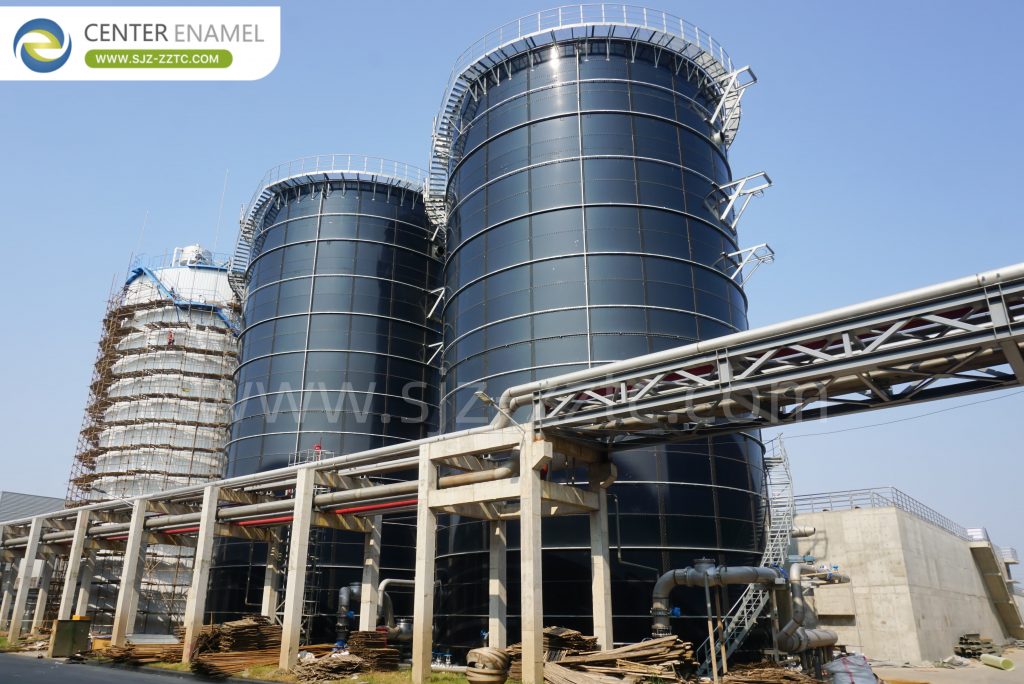
Wastewater from the new energy industry chain (lithium batteries, photovoltaics, hydrogen) has become the most notable emerging growth area due to its complex composition and high treatment difficulty, generating significant demand for customized solutions. The maturity of third-party treatment models in industrial parks continues to improve, driving consolidation in the professional operation market. The Middle East has strong demand for advanced treatment and reuse of industrial wastewater due to water scarcity; manufacturing transfer in Southeast Asia drives local industrial wastewater treatment facility construction demand.
This regional divergence shapes how Anaerobic Technologies are deployed across different markets. Whether upgrading aging infrastructure or building new capacity, selecting the right reactor and tank system is critical to any successful Industrial Wastewater Treatment Project.
GFS Tanks: Corrosion Resistance Far Superior to Traditional Concrete Tanks
Center Enamel's independently developed double-sided double-layer enameling technology is the industry's leading coating anti-corrosion technology, with corrosion resistance completely surpassing concrete tanks. Concrete tank interiors are riddled with pores, allowing wastewater and acid/alkaline media to easily penetrate and corrode the structural layer. Long-term use leads to irreversible problems such as internal wall spalling, water seepage, and rebar corrosion, which are difficult to repair and cannot be fundamentally resolved.
GFS tanks feature high-temperature enameling on both the interior and exterior surfaces of steel panels, with a dense, non-porous enamel finish that completely blocks corrosive liquids and biogas permeation. The enamel layer has extremely strong chemical stability, resisting acids, alkalis, salts, and microbial corrosion. Concrete tanks will develop extensive corrosion and leakage after 5-8 years of use, while GFS tank anti-corrosion service life can exceed 30 years, with no need for frequent internal lining repairs throughout the service life, significantly reducing long-term anti-corrosion maintenance investment and fundamentally eliminating environmental risks of medium leakage contaminating sites and groundwater. Compared to traditional concrete and FRP tanks, GFS tank coatings have no risk of peeling or blistering, and are adaptable to highly corrosive conditions such as palm oil mill effluent, livestock manure, and chemical high-salinity wastewater, with outstanding long-term comprehensive cost advantages.
Table 1: GFS Tanks vs. Traditional Concrete Tanks
| Feature | GFS Tanks | Concrete Tanks |
| Corrosion Resistance | Excellent (30+ years) | Poor (5–8 years) |
| Porosity | Non-porous enamel | Highly porous |
| Repair Needs | No lining repairs | Frequent spalling/seepage |
| Chemical Stability | Acids, alkalis, salts, microbes | Degrades over time |
| Environmental Risk | Minimal leakage risk | Groundwater contamination risk |
IC Reaction Process
Pretreated high-strength organic wastewater enters the lower main reaction zone from the bottom, mixing with recirculated sludge-water mixture and rising rapidly. Anaerobic microorganisms efficiently degrade organic matter, producing large volumes of biogas. The gas-lift action of biogas carries the mixed liquor upward to the top gas-liquid separator where biogas is collected. Degassed sludge-water mixture returns by gravity through downcomers to the reactor bottom, creating autonomous internal circulation that repeatedly enhances pollutant degradation. After multiple circulation cycles, the wastewater enters the upper polishing zone for further reaction and sludge-water separation. Remaining trace organics are fully degraded, sludge settles back to the lower reaction zone, treated effluent overflows from the top, and aged sludge is periodically discharged-fully autonomous circulation, efficient continuous operation.
Key Water Quality Characteristics of Pharmaceutical Wastewater
Complex composition, large fluctuations, high pollution load, and very poor biodegradability. COD ranges widely-fermentation type 5,000-30,000 mg/L, chemical synthesis peaking over 100,000 mg/L, with BOD/COD generally below 0.2. Water contains unreacted raw materials, drug intermediates, organic solvents, mycelium, and high concentrations of salts, with some wastewater salinity reaching tens of thousands of mg/L. Color is high, yellow-brown to dark black, with nitrogen and phosphorus pollutants severely exceeding limits, readily causing eutrophication. Water quality and quantity have no stable pattern, with alternating high/low concentration discharges-extremely high treatment difficulty.
Pakistan Food Waste + Napier Grass Biogas Demonstration Project
Center Enamel is the general contractor, with CSTR as the core anaerobic process using food waste and Napier grass as mixed fermentation feedstock. Equipped with mechanical mixing system ensuring thorough mixing of feedstock and anaerobic microorganisms-efficient organic degradation with stable daily biogas production of 100 m³. This is the local official demonstration project for validating gas production efficiency and long-term continuous operational stability. After successful pilot operation, multiple large-scale Napier grass biogas projects are planned locally to promote biomass clean energy and support regional low-carbon development.
Table 2: Pakistan Demonstration Project Performance
| Metric | Value |
| Core Process | CSTR |
| Feedstock | Food waste + Napier grass |
| Daily Biogas Production | 100 m³ |
| Mixing System | Mechanical mixing |
| Project Role | Official local demonstration |
Center Enamel's Smart Manufacturing Base Scale
Center Enamel's core intelligent manufacturing base is located in Hebei Province, China, covering a total area of over 150,000 m², with Phase I mature manufacturing facility and Phase II high-end environmental equipment industrial park-dual-base synergy ensures stable production capacity. The base includes dedicated R&D office buildings, proprietary material laboratories, and finished product testing centers, with full-process quality control systems meeting ISO, NSF, CE, and other international standards. The facility operates to green manufacturing standards, certified as a Provincial Green Factory-balancing efficient production with energy conservation and emission reduction. The company has 6 marketing service centers across China, establishing a nationwide production-sales network ensuring stable global order delivery. The base is adjacent to expressway networks and major logistics hubs, with complete container shipping capabilities-supporting simultaneous large-scale tank projects globally. The base employs over 500 staff, with multiple parallel automated production lines-facility scale and production capacity firmly placing it among the global top tier of GFS tank equipment manufacturers.
Over a Decade of Global Installation Experience
Unmatched global practical experience among domestic peers-over a decade covering multiple regions and all industry sectors. In 2009, Center Enamel completed the first overseas GFS tank installation-sending a team to Niger, Africa for drinking water storage tank installation. In 2015, it broke industry ground with China's first GFS tank export and installation to the US-passing strict US acceptance standards. All installed projects have operated stably for many years, covering livestock biogas, POME, municipal wastewater, and drinking water storage applications. Construction has covered Southeast Asia, Africa, the Americas, and other regions-accumulating specialized solutions for complex sites including mountainous terrain, coastal salt spray, tropical high temperatures, and high-standard European/American facility conditions-maturely addressing global special construction requirements.
Ready to upgrade your industrial wastewater treatment project with proven anaerobic technologies? Contact Center Enamel today for a tailored solution.
Our engineers are prepared to support your project from feasibility study to commissioning-reach out now to discuss your treatment goals.
Frequently Asked Questions
Why are anaerobic technologies ideal for industrial wastewater?
They handle high-strength organic loads, produce biogas for energy recovery, and reduce COD efficiently-even for complex, poorly biodegradable wastewater.
How long do GFS tanks last compared to concrete?
GFS tanks offer 30+ years of corrosion resistance, while concrete tanks show leakage and spalling within 5–8 years, requiring frequent repairs.
What types of industrial wastewater projects does Center Enamel handle?
We deliver EPC solutions for food waste, POME, chemical, livestock, and municipal wastewater, with 2,000+ wastewater and 1,000+ biogas projects globally.