
Complex Papermaking Wastewater Treatment with Anaerobic Technologies: Bringing Black Liquor Under Control
A paper mill rarely fails on wastewater volume. It fails on the streams inside that volume. Cooking black liquor, bleach filtrate, deinking effluent and white water behave nothing alike, yet most mills still route them toward one basin and then wonder why the aeration bill keeps climbing. Anaerobic technologies exist to break that pattern: they take the concentrated organic load out of the water before it ever reaches a blower, and turn part of it into fuel.
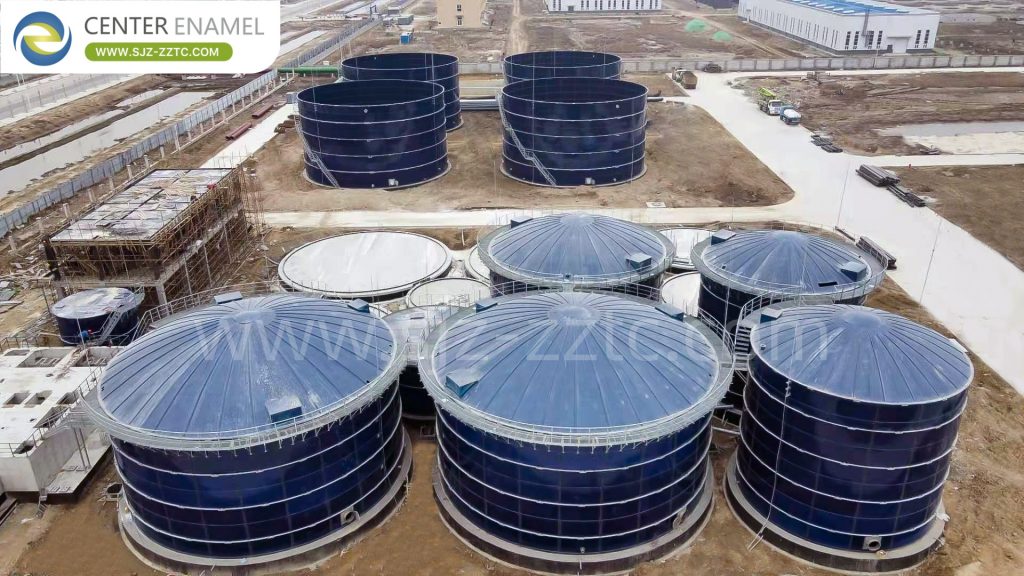
What follows looks at why the problem is genuinely hard, how anaerobic digestion solves it, and which tanks, covers and services have to hold the whole train together for twenty or thirty years.
Why Papermaking Wastewater Is the Harder Problem
Industrial wastewater is usually described by its "three highs"-high difficulty, high cost and high energy consumption-and papermaking sits at the intersection of all three. Effluent from new energy, chemical and pharmaceutical production is complex in composition and carries numerous characteristic pollutants that traditional processes struggle to remove; papermaking adds its own complication, because the load is split across several streams with completely different chemistry. Add ever-stricter discharge standards, and the pressure lands not only on treatment technology but on digitalisation and low-carbon operation-the ability to run a plant precisely enough to prove, month after month, that limits are met and energy is not wasted.
Cost sharpens the edge of the problem. Chinese suppliers hold a clear price advantage in mid-to-low-end equipment, which means price alone no longer wins a tender; process depth does.
Anaerobic Technologies: Removing the Load Before the Blowers Start
The core insight of anaerobic technologies is that organic pollution is chemical energy, and destroying it with air is the most expensive way to dispose of a resource. An IC, the Internal Circulation Anaerobic Reactor, is the third-generation high-efficiency anaerobic design built on the UASB platform: a built-in gas-lift internal circulation system recirculates the liquid inside the vessel without external return pumps, while upper and lower three-phase separators handle sludge-water separation. Biogas rising through the bed drives the circulation, which lifts upflow velocity, improves contact between sludge and wastewater, and lets the reactor carry a far higher volumetric load than a conventional basin.
Applied to papermaking wastewater, the effect is threefold. The bulk of the soluble COD is converted to biogas before aeration begins. The methane offsets purchased energy in the boiler house or dryer. And the reaction happens in a tall sealed vessel, so the footprint stays small enough to retrofit into a mill that has no spare land.
Inside the Train: Equipment That Makes Circulation Work
None of that happens without hardware that supports it, and the heart of the train is a GFS tank with a built-in gas-lift internal circulation system and upper and lower three-phase separators-the components that make autonomous circulation and sludge-water separation possible. Below the tank, a bottom precision distribution system and a pressure-regulating feed device keep the influent uniform and stable. Around it, influent lift pumps, equalisation tanks and flow meters hold feed rate under precise control; on top, high-efficiency biogas collection, desulphurisation, dehydration and storage are integrated into one unit; online monitoring tracks temperature, pH, COD and level in real time. Dedicated sludge discharge pipes at the bottom and mid-section, with recirculation control devices, complete the loop-and no external return pump is needed anywhere in it. The result is a highly integrated system with no excess external equipment, a compact structure and a high degree of automation.
Closing the Loop: White Water, Fibre and Alkali
Before anaerobic digestion even starts, the cheapest litres are the ones never discharged. White water recirculation is the core water-saving measure: paper machine white water passes through microfiltration, dissolved air flotation and disc filters, the recovered fibre goes back to repulping, and discharge volume drops by 60-80%. Screens and fine screens then recover fibrous and filler suspended solids that can be sold rather than landfilled, while coagulation, sedimentation and DAF remove the colloids and fine solids that remain.
Cooking black liquor takes a different route. It is collected separately, and alkali recovery boilers recover the alkali while burning the lignin for steam-cutting pollution at source instead of paying to treat it downstream.
A Standardized Train, Stage by Stage
Those measures combine into a standard treatment train for papermaking wastewater treatment-white water recirculation, physicochemical pretreatment, anaerobic digestion and aerobic polishing-with one governing strategy: maximise recycling to shrink the discharge volume. The table shows how each stage earns its place.
| Stage | Primary job | Key equipment and method | Effect |
| White water recirculation | Recover fibre, cut volume | Microfiltration, DAF, disc filters | 60-80% less discharge |
| Fibre and filler recovery | Turn solids into product | Screens and fine screens | Recoverable fibre and filler for sale |
| Black liquor handling | Remove load at source | Separate collection, alkali recovery boiler | Alkali recovered, lignin burned for steam |
| Physicochemical pretreatment | Remove colloids and fines | Coagulation, sedimentation, DAF | Stable feed to biology |
| Anaerobic digestion | Degrade dissolved organics | IC / UASB in GFS tanks | Biogas energy, low sludge yield |
| Aerobic treatment | Polish residual load | A/O process | COD, nitrogen and phosphorus control |
| Advanced finishing | Meet colour and permit limits | Chemical decolourisation, membrane filtration | Compliance on final discharge |
Read the table top to bottom and the logic of anaerobic technologies becomes visible: every stage in front of the reactor exists to protect it, and every stage behind it exists because the reactor has already removed the load that would otherwise cost the most to aerate.
Tanks Built for Alkali, Lignin and Sulphate
Paper chemistry is unforgiving. Black liquor is alkaline and lignin-bearing, bleach streams are oxidising, and biogas fermentation adds organic acids on the gas side-conditions that shorten the life of ordinary coated steel and crack concrete. Center Enamel's GFS tanks use proprietary double-sided, hot-rolled double-layer enamel anti-corrosion technology, resisting strong acids and alkalis, high salinity and microbial corrosion, assembled from modules on site for quick installation and long service in the most aggressive positions of a papermaking wastewater treatment plant.
Covers, Vessels and a One-Stop EPC Scope
A tank is only one part of the package, and Center Enamel builds the matrix around it. Proprietary high-strength aluminium alloy dome covers use a self-supporting structure that meets international waterproof and load-bearing standards, sealing tanks and collecting biogas. Fusion bonded epoxy tanks come off China's first intelligent standardised production line and serve drinking water, fire water and neutral media. Carbon steel tanks, stainless steel tanks, composting tanks and various non-standard pressure vessels cover the rest of the plant.
| Product line | Construction | Best suited to | Role in a paper mill |
| GFS tank | Double-sided hot-rolled double-layer enamel, bolted modules | Strong acids, alkalis, high salinity, microbial attack | Anaerobic reactor, black liquor and effluent storage |
| Fusion bonded epoxy tank | Epoxy-coated steel, intelligent standardised line | Drinking water, fire water, neutral media | Clear water, fire reserve, neutral process water |
| Aluminium dome cover | High-strength self-supporting alloy structure | Tank sealing and biogas collection | Gas-tight reactor top, odour control |
| Carbon and stainless steel tanks | Welded steel | Transfer, chemical storage, high-temperature duty | Balance-of-plant storage and dosing |
| Composting and pressure vessels | Non-standard fabrication | Sludge and biosolids handling | Digested sludge and residual streams |
Beyond hardware, the company delivers environmental EPC general contracting and anaerobic process section subcontracting as one scope, covering food waste, leachate, municipal wastewater, livestock biogas, petrochemical and metallurgical plants, and seawater desalination-with tank volume, corrosion grade and process design customised to each project rather than drawn from a catalogue.
Delivery, Service and the Paperwork Behind Every Project
Equipment travelling to a paper mill overseas has to arrive with more than a bill of lading, and a papermaking wastewater treatment project usually involves more parties than the mill expects. Regional sales centres in China and local agent networks abroad support a four-pillar service system: a 24/7 rapid response mechanism, on-site installation at home and overseas, after-sales support across the full project cycle, and long-term warranty protection. Together they cover the chain from preliminary site survey through construction management to long-term inspection and maintenance, and coordinate personnel, materials and site activity when several projects run in different regions at once-which is where multi-party coordination costs usually appear.
The front end of that service is commercial rather than technical. A multilingual marketing team-English, French, Spanish and Arabic-works across the biogas, wastewater and biomass energy markets of Southeast Asia, Africa, Europe and the Americas, reads local discharge regulations, biogas subsidy policies and carbon trading rules, and builds the site survey, solution design and return-on-investment case before a client commits. That experience also helps clients avoid the quieter risks: approval timelines, equipment import, and construction practice on the ground.
Credentials That Clear Tender Barriers
None of it matters if the paperwork does not pass. Center Enamel holds CE, NSF, WRAS, ISO9001, BSCI and ASME among its international certifications, clearing tender requirements across the EU, North America, Southeast Asia and Africa-the hard credential advantage that decides large overseas bids before technical evaluation begins.
FAQ
Which stream should feed an anaerobic reactor first?
Cooking black liquor carries the highest COD but must be diluted and equalised with washing and screening filtrate before it enters the reactor, so the sludge bed stays stable and the gas-lift circulation keeps working as designed. Feeding it unmixed risks acidification that takes weeks to recover from. Operators watch the volatile fatty acid to alkalinity ratio daily, because the reactor signals early enough when the feed is running too rich.
Does white water recirculation replace treatment?
No, it reduces the problem. Recovering fibre from white water by microfiltration, DAF and disc filters cuts discharge volume by 60-80%, but the remaining dissolved organics still need anaerobic and aerobic stages to meet a permit. Reuse is always the cheapest litre; treatment handles the rest.
Why use GFS tanks rather than concrete for these streams?
Because alkali, lignin and sulphate attack concrete and ordinary coatings, and repairs inside a live reactor are close to impossible. Double-sided double-layer enamel resists those conditions, assembles on site in bolted modules, and keeps a papermaking wastewater treatment reactor serviceable for decades rather than years-and a damaged panel can be replaced without shutting down the whole train.
Start With Your Water Analysis
Contact us today and send us your stream data-COD, pH, sulphate, flow rate and discharge permit-and our engineers will return a stage-by-stage process route with tank sizing and an indicative biogas yield. Talk to our team before you commit to a basin design, and let anaerobic technologies prove what your papermaking wastewater is actually worth.